Plant bare-root or pot-grown canes November–April, 3–4m apart — blackberries are very vigorous
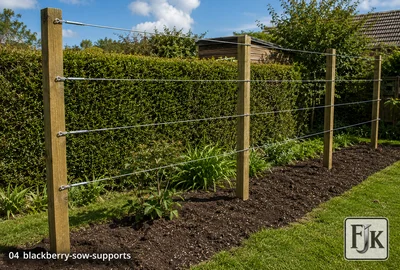
Erect a strong post-and-wire system before planting; canes need firm support all year
Thornless varieties (Loch Ness, Waldo, Chester) are far easier to manage than thorned types
Train new (green) canes along one side of the wires; keep old (fruiting, brown) canes on the other side — swap after harvest
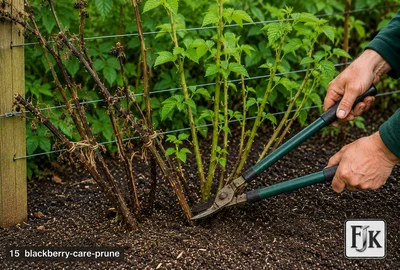
Prune immediately after fruiting: cut all canes that have fruited to the ground; tie in new canes for next year
🌱 SowPlant bare-root Nov–Mar
🌾 HarvestAug–Oct
☀ PositionSun or partial shade
📐 Spacing3–4.5m between plants
DifficultyEasy
⚡ Quick facts
Sow
Plant bare-root Nov–Mar
Plant
Nov–Mar (bare-root) · Apr–May (container)
Harvest
Aug–Oct
Position
Sun or partial shade — extremely tolerant of difficult sites
Spacing
3–4.5m (vigorous) · 1.8–2.5m (compact thornless)
Height
2–4m canes, typically trained to 1.5–1.8m
Hardiness
Fully hardy
Lifespan
20+ years
Difficulty
Easy
01 About
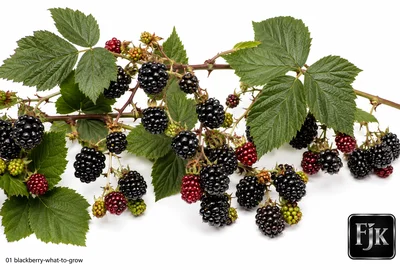
The most productive soft fruit available for the space it occupies. A single established blackberry plant produces 5–10kg of fruit per year for decades from virtually any soil, including heavy clay and deep shade that would defeat all other fruits. Modern thornless varieties have transformed blackberry growing — they are now genuinely pleasant to manage and harvest.
02 Varieties
The number of varieties shown for each crop is based on UK consumption data (2025/26) — the more popular the crop, the more variety choices we include.
Thornless
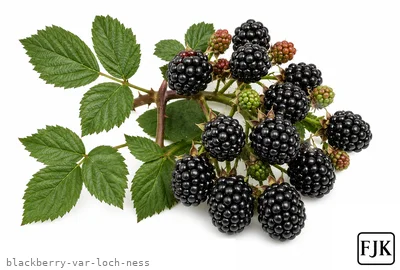
Loch Ness
Thornless
The most widely recommended thornless blackberry for UK gardens. Compact, upright habit — much less spreading than most blackberries. Very large, glossy black berries with excellent sweet flavour. Heavy, reliable crops. Ideal for smaller gardens where space is limited. AGM.
Harvest
Aug–Sep
Flavour
Rich, sweet blackberry
Fruit size
Large
Yield
Very high
Disease resistance
Very good
🏅 AGM
✓ Self-fertile
Adrienne
Thornless
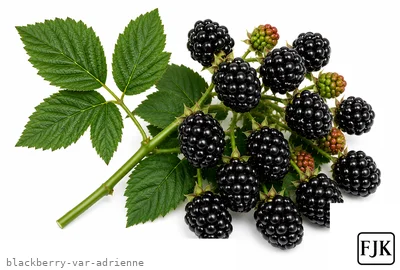
One of the earliest thornless blackberries — begins fruiting in July. Large berries with good sweet flavour. More compact than Loch Ness. An excellent choice for extending the blackberry season into late summer when other soft fruits are finishing.
Harvest
Jul–Aug
Flavour
Sweet, mild, early
Fruit size
Large
Yield
High
Disease resistance
Good
✓ Self-fertile
Waldo
Thornless
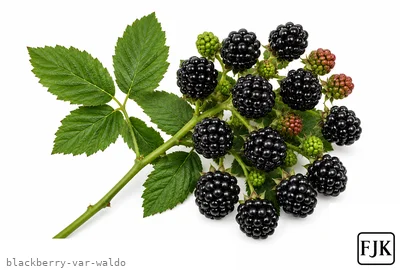
Extremely compact, semi-trailing thornless variety — ideal for smaller gardens where full-sized blackberries would be unmanageable. Very high yield for its size. Good flavour. The most compact productive thornless blackberry widely available.
Harvest
Aug–Sep
Flavour
Classic blackberry
Fruit size
Medium-large
Yield
Very high
Disease resistance
Good
✓ Self-fertile
Thorned — High Yield
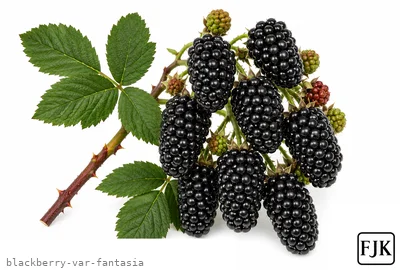
Fantasia
Thorned
The highest-yielding blackberry commercially available — produces extraordinary quantities of very large, glossy berries. Vigorous growth requires a robust support system and plenty of space. Thorned but the yield justifies the effort. Outstanding for jam, freezing, and fresh eating.
Harvest
Aug–Sep
Flavour
Rich, classic
Fruit size
Very large
Yield
Exceptional
Disease resistance
Good
✓ Self-fertile
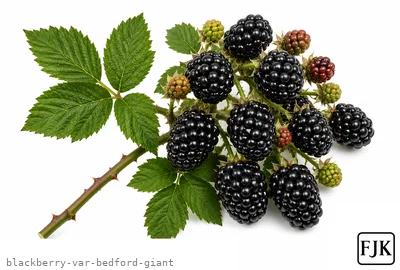
Bedford Giant
Thorned
A very early-cropping variety with very large berries beginning in July. Old variety that has remained popular for its earliness — it extends the soft fruit season from midsummer. Milder flavour than later varieties. Vigorous, thorned.
Harvest
Jul–Aug
Flavour
Mild, sweet, early
Fruit size
Very large
Yield
High
Disease resistance
Moderate
✓ Self-fertile
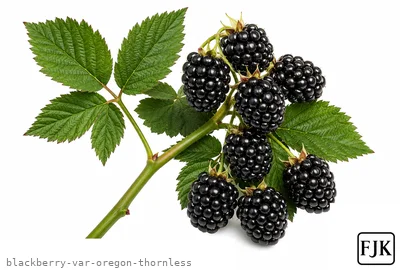
Oregon Thornless
Thornless
Late-season thornless variety with attractive ornamental foliage that colours well in autumn. Extends the blackberry season into October. Useful for decorative as well as productive use. The beautiful dissected leaves make it worth growing on a trellis or arch where the foliage is visible.
Harvest
Sep–Oct
Flavour
Sweet, mild, late
Fruit size
Medium
Yield
High
Disease resistance
Good
✓ Self-fertile
Hybrid Berries
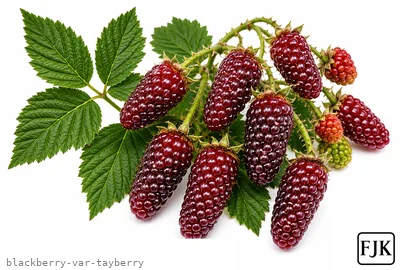
Tayberry
Hybrid (blackberry x raspberry)
A Scottish-bred hybrid between blackberry and raspberry producing very large, deep red-purple fruit with an extraordinarily rich, aromatic flavour. Outstanding for jam and eating fresh. Vigorous canes require robust support. One of the finest-flavoured hybrid berries. AGM.
Harvest
Jul–Aug
Flavour
Rich, aromatic, sweet-sharp
Fruit size
Large
Yield
High
Disease resistance
Good
🏅 AGM
✓ Self-fertile
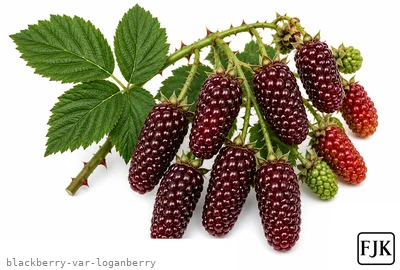
Loganberry
Hybrid (blackberry x raspberry)
An old hybrid producing large, dark red fruits with an intense, sharp, wine-like flavour that is entirely distinct from either parent. Outstanding for jam, coulis, and baking. The thorned form is very vigorous. A thornless loganberry (LY 654) is also available and recommended for garden use.
Harvest
Jul–Aug
Flavour
Sharp, wine-like, complex
Fruit size
Large
Yield
High
Disease resistance
Good
✓ Self-fertile
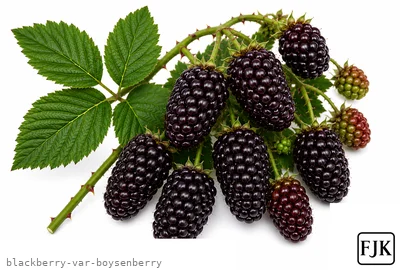
Boysenberry
Hybrid (blackberry x loganberry)
A large-fruited hybrid with very large, dark berries combining the flavours of blackberry, loganberry, and raspberry. Outstanding flavour — sweeter and less sharp than loganberry. Less vigorous than pure blackberry. Less commonly grown in the UK than in the US or Australasia but well worth seeking out.
Harvest
Aug
Flavour
Sweet, rich, complex
Fruit size
Very large
Yield
Moderate
Disease resistance
Moderate
✓ Self-fertile
03 Planting Options
🌿 Wire-trained Against a Fence or Posts
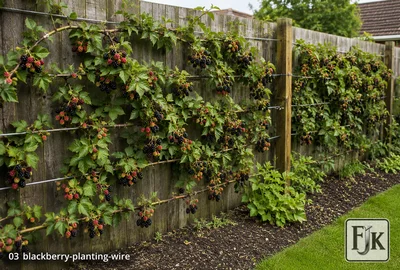
Blackberry canes become powerful and heavy once laden with fruit, so strong support installed before planting is essential — posts at no more than 2m intervals carrying horizontal wires. Plant bare-root canes with roots spread out in a wide hole and cut back hard to 25cm immediately after planting to establish strong new growth. The one-way training system is the single most effective management technique: train all new season's growth to one side of the support and the fruiting canes to the other, which keeps picking straightforward and makes pruning out spent wood simple each autumn. Check regularly for tip-layering, where cane tips root wherever they touch the ground — left unchecked this can turn one plant into a thicket within a season.
Erect strong supports before planting
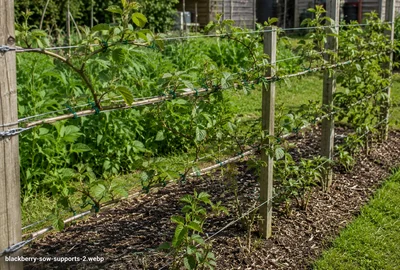
Blackberry canes are powerful and heavy when laden with fruit. Install posts at no more than 2m intervals with 3–4 horizontal wires at 60cm, 90cm, 120cm, and 150cm. Use 10–12 gauge galvanised wire strained tightly — inadequate supports collapse within a season.
Plant and cut to 25cm
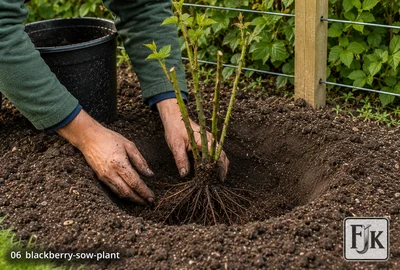
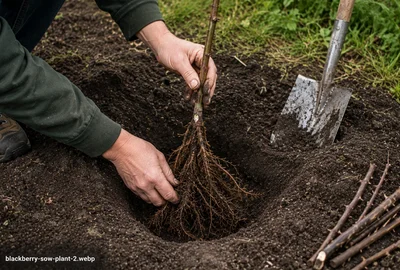
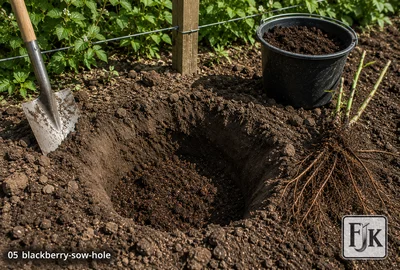
Plant bare-root canes with roots spread horizontally in a wide planting hole. Cut the cane to 25cm after planting — this promotes vigorous new cane production from the base and prevents the top from drawing moisture from roots that have not yet re-established.
Train the one-way system
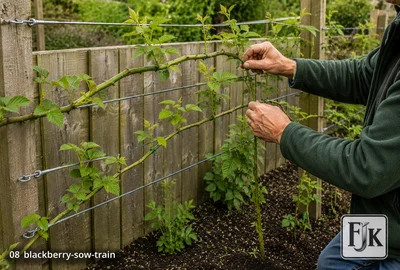
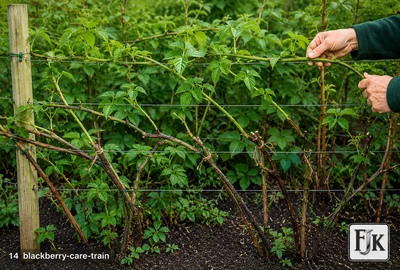
The most effective management technique for blackberries is the one-way system: train new canes to one side of the wire framework during the growing season, while the current year's fruiting canes occupy the other side. After harvest, remove all the old fruited canes and re-train the new canes into the space vacated.
Mulch generously
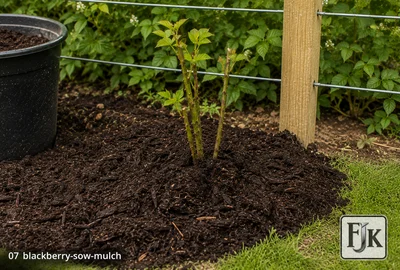
Apply a 10cm mulch of compost, woodchip, or straw along the full length of the planting. Keep clear of cane bases. Blackberries tolerate dry conditions once established but produce significantly better fruit with consistent moisture.
Contain tip-layering
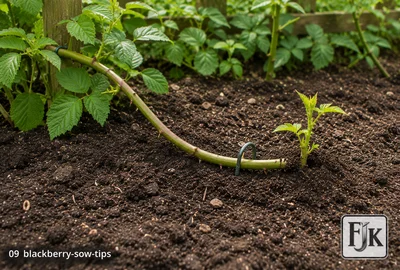
Blackberry cane tips will root where they touch the ground (tip-layering). Inspect the planting regularly and lift or pin back any tips that have contacted the soil, unless you specifically want new plants to propagate.
04 Companion Planting
✅ Grow nearby
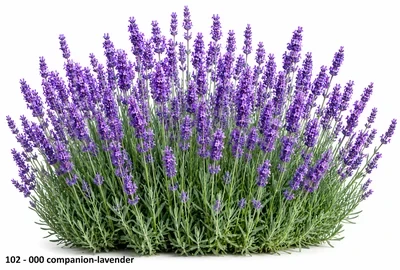
💜 Lavender
Attracts pollinators and adds a decorative, low-maintenance border nearby.
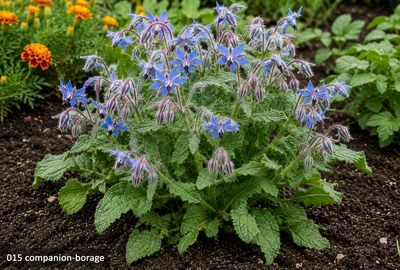
🌸 Borage
Attracts pollinators and beneficial insects, and is said to improve nearby fruit set.
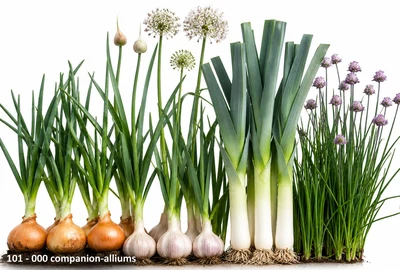
🧄 Alliums
Onion-family plants grown nearby are thought to help deter pests with their strong scent.
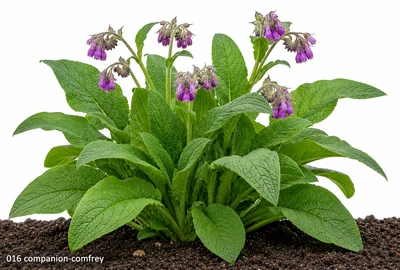
🌿 Comfrey
Deep roots mine nutrients from the subsoil; cut leaves make an excellent potassium-rich mulch.
05 Sowing — How To
Plant Nov–Mar in dormancy
Bare-root blackberry canes must be planted while dormant between November and March. They establish very reliably — blackberries are among the hardiest and most robust fruiting plants available.
Wide planting hole
Spread the roots horizontally in a wide, shallow planting hole. Firm well and water in. Cut the planted cane to 25cm immediately.
Supports must be in place
Do not plant without supports in place. Blackberry canes grow rapidly once established — a plant going into the ground in February will need to be tied to wires by June.
Regional sowing timing
Region
Sow / plant
Harvest
Notes
Scotland & Far North
Nov–Mar
Aug–Oct
Northern England
Nov–Mar
Aug–Oct
Midlands & Wales
Nov–Mar
Aug–Oct
Ireland & Isle of Man
Nov–Mar
Aug–Oct
South & SE England
Nov–Mar
Aug–Oct
South Coast & SW
Nov–Mar
Aug–Oct
06 Using a Propagator
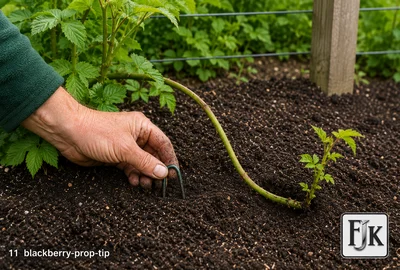
Blackberries propagate themselves naturally by tip-layering — when cane tips touch the ground, they root and produce new plants. This can be done deliberately to produce free new plants from your own stock.
Heated propagator
Not Required — No propagator needed. Blackberries propagate readily from tip layers in open ground in late summer.
Select a long new cane
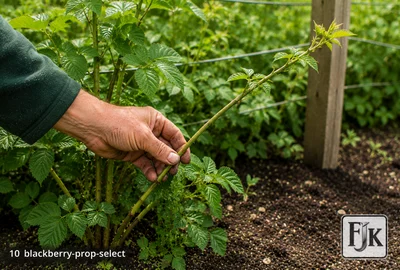
In July–August, choose a healthy, vigorous new cane that has not yet fruited. The tip must be long enough to reach the ground at a convenient propagating position.
Bury the tip
Dig a hole 15cm deep. Bend the cane tip into a U-shape and pin it into the hole with a wire staple. The growing point should face upwards. Cover with firm soil.
Sever in spring
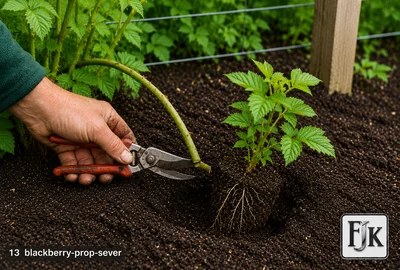
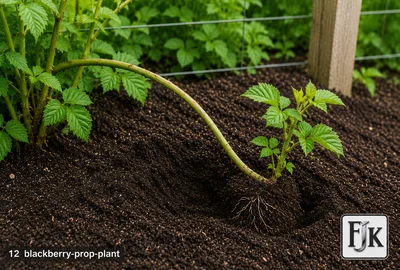
The buried tip will root and produce a new shoot through autumn and winter. In March–April, cut the cane on the parent-plant side of the new shoot. Leave for 2 further weeks, then dig up and move to the permanent position.
Plant out
Plant the new rooted plant as per a bare-root cane — wide hole, firm in, cut back to 25cm, mulch, and water. Supports must be in place before or at planting.
07 Soil Requirements
pH
5.5–7.0
Best
Loam, Sandy loam, Clay loam
Tolerates
Clay, Acid sandy
Avoid
Waterlogged, Chalky
💡 Toughest fruiting plant — tolerates almost any soil except chalk and bog.
08 Ongoing Care
🌿 The One-Way Training System
The one-way system is the clearest and most effective method for managing blackberries. During the summer, train all new canes — which will fruit next year — exclusively to one side of the wire framework (or along the top wire for a neater appearance). The current fruiting canes occupy the other side. After harvest, remove all the fruited canes entirely at the base and move the bundle of new canes into the space vacated, tying them in horizontally along the wires. This physical separation of new growth from fruiting growth makes annual pruning completely straightforward and dramatically reduces the risk of disease spreading from old to new wood.
✂️ Annual Pruning
Blackberries fruit on the previous year's canes — a cane grows in year one and fruits in year two, then dies. Annual pruning involves removing all the canes that have just fruited — cut to ground level as close to the base as possible. Do this in October or November after the last fruit is picked. The new canes that grew through the summer are retained, tied in to the wires along their length, and these will carry next year's crop. Never allow more than 6–8 canes per plant — selecting the strongest and removing the weaker ones improves fruit quality significantly.
💧 Watering & Feeding
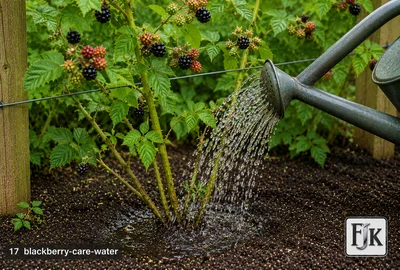
Established blackberries tolerate considerable drought but produce significantly larger, more plentiful fruit with consistent moisture through the fruiting season (August–October). Water at the base of the plant — avoid wetting the canes and foliage. Apply a balanced fertiliser in early spring and a generous mulch of compost annually. High-nitrogen feeding in summer encourages excessive cane growth at the expense of fruit — avoid it.
🍓 Harvesting
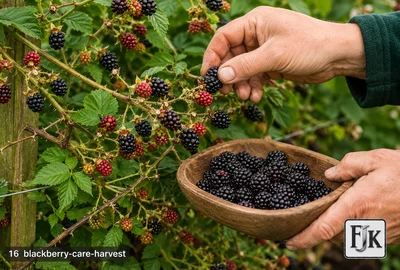
Pick blackberries when fully black, ripe, and coming away cleanly from the plug without resistance. Under-ripe berries are very sour and hard — do not pick early. Over-ripe berries fall at a touch and are soft and dull-looking. Check the planting every 2–3 days during the picking season — berries ripen over an extended period from August into October. Pick in the early morning for best flavour. In a good year, a single established plant will produce more fruit than a family can eat fresh.
09 Watch Out For
Warning
Cane spot causes purple spots on canes and should be managed by removing affected canes and improving airflow. Cane blight causes sudden wilting and darkening of canes — cut to the base and burn. Raspberry beetle attacks blackberries as well as raspberries — grubs inside fruit in August/September. Botrytis (grey mould) in wet summers — pick regularly and do not leave fruit on the plant. Tip-layering can spread the planting uncontrollably — check regularly for rooted tips.
🐛 Insects & pests
🐜 Aphids (Blackfly & Greenfly) — Curled, distorted, or stunted growing tips — aphids inject saliva that causes leaf curl to protect them
🕷 Spider Mite — Fine, silky webbing on the underside of leaves and between growing tips — the definitive identification sign
🪲 Vine Weevil — Irregular, rounded notches cut from leaf margins — the work of adult beetles feeding at night
🐌 Slugs & Snails — Silver slime trails on leaves, soil, and pots — often the first sign before damage is found
🍄 Diseases to watch
🩶 Botrytis (Grey Mould) — Botrytis cinerea (grey mould) is the most ubiquitous fungal pathogen in temperate gardens — present in virtually every garden soil and on plant debris. It becomes a disease only when conditions favour it: cool, humid, poorly ventilated environments with damaged or senescent plant tissue. In a greenhouse in autumn it can destroy an entire tomato or grape crop.
🟠 Rust — Rust diseases are caused by a large family of obligate parasitic fungi, each specific to its host or a narrow range of hosts. Leek rust (Puccinia allii) is the most common in UK vegetable gardens, producing vivid orange pustules on leek leaves in summer and autumn. While rarely fatal, severe infections significantly weaken plants and reduce yields.
Full identification and treatment advice is in the Pests and Diseases sections.
10 Storage & Preserving
🫐 Fresh
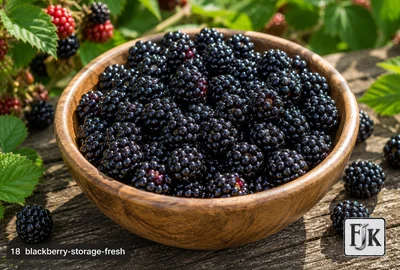
Fresh blackberries keep for 2–3 days refrigerated. Pick ripe, handle gently, do not wash until ready to eat. Homegrown blackberries picked at full ripeness bear no resemblance to commercial berries — the depth of flavour is entirely different. Eat fresh with cream, in fruit salads, or with yoghurt.
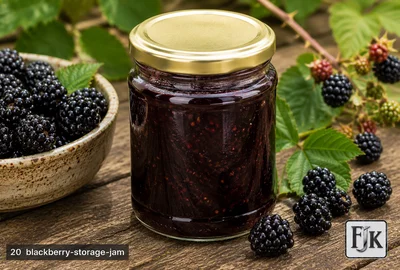
🫙 Jam & Preserves
Blackberry and apple jam is a classic British preserve, and blackberry jelly, cordial and wine are excellent uses for large gluts. The season overlaps with early apples — pair them for the best autumn preserves. Follow a tested recipe.
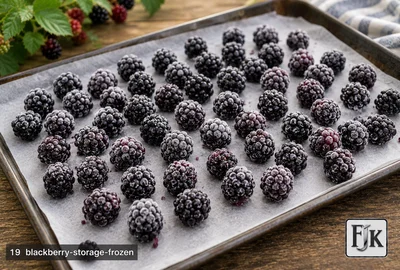
❄️ Frozen
Blackberries freeze exceptionally well. Open freeze on a tray until solid, then bag. Use within 12 months. Frozen blackberries are excellent in crumbles, pies, smoothies, and coulis. A surplus September crop frozen at peak ripeness provides outstanding fruit through winter for baking and desserts.
11 Expert Tips
💡 Choose thornless for garden use
Modern thornless varieties such as Loch Ness, Adrienne, and Waldo produce fruit that equals or exceeds thorned types in quality and yield, with the enormous practical advantage of making tying, pruning, and picking genuinely pleasant rather than a painful ordeal. There is no compelling reason to grow a thorned blackberry in a domestic garden.
💡 Exploit shade sites
Blackberries are one of very few productive fruiting plants that succeed in deep shade — including north-facing walls, under large trees, and in shaded corners that have no other use. A thornless variety trained against a north-facing fence produces a generous autumn harvest from space that would otherwise be completely unproductive.
💡 The autumn window
Blackberries fruit in August, September, and October — the least busy period in the soft fruit calendar, after strawberries, raspberries, gooseberries, and currants are finished. This temporal gap makes them more valuable than their simplicity might suggest. A garden with both summer and autumn raspberries and blackberries has continuous soft fruit from June until the first frosts.