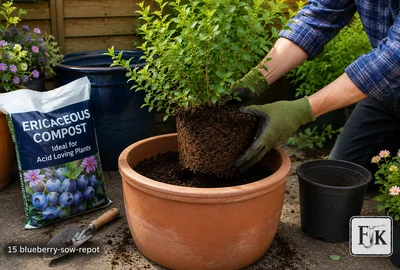
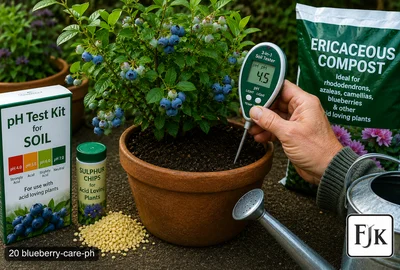
Blueberries must have acid soil — pH 4.5–5.5 is essential; grow in ericaceous compost in containers if your soil is neutral or alkaline
Plant two or more varieties for cross-pollination — even self-fertile varieties crop better with a partner
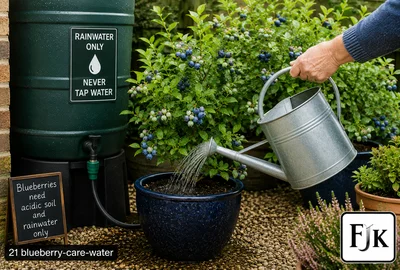
Water exclusively with rainwater — tap water raises pH and causes yellowing leaves
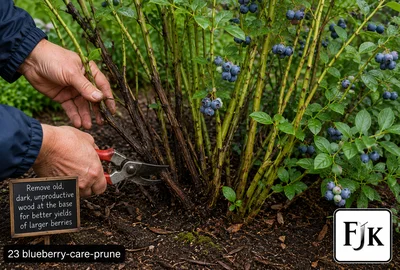
Prune in late winter: remove oldest darkest stems to the base to encourage vigorous new fruiting wood
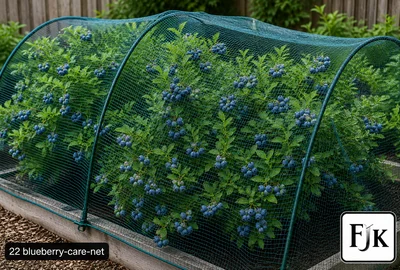
Net bushes before fruit ripens — birds will strip them completely within hours
🌱 SowPlant container-grown plants Mar–Apr or Sep–Oct
🌾 HarvestJul–Sep
☀ PositionFull sun
📐 Spacing1.5m
DifficultyModerate
⚡ Quick facts
Sow
Plant container-grown Mar–Apr or Sep–Oct
Plant
Mar–Apr or Sep–Oct (container-grown)
Harvest
Jul–Sep (early to late season varieties)
Position
Full sun — needs at least 6 hours daily
Spacing
1.5m between bushes
Height
1.2–1.8m (highbush) · 0.5–1m (half-high)
Hardiness
Fully hardy — flowers resistant to late frost
Lifespan
30–50 years
Difficulty
Moderate
01 About
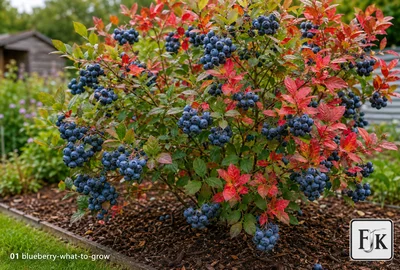
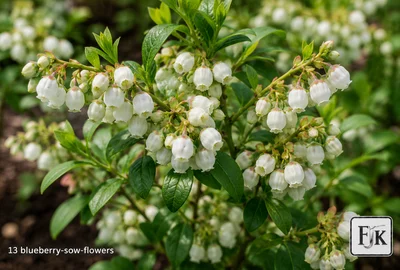
Among the most beautiful fruiting plants for the UK garden — white urn-shaped flowers in spring, clusters of blue-grey berries through July to September, and spectacular scarlet and orange autumn foliage. Blueberries have one firm requirement: acid soil with a pH of 4.5–5.5. Where garden soil is not naturally acid, grow in large containers of ericaceous compost. Within that constraint they are genuinely low-maintenance.
02 Varieties
The number of varieties shown for each crop is based on UK consumption data (2025/26) — the more popular the crop, the more variety choices we include.
Highbush — Early & Mid
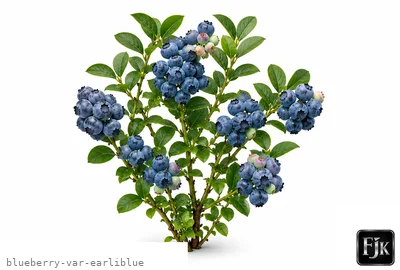
Earliblue
Highbush · Early
One of the earliest blueberries — ripening in mid-July in the south. Large berries with mild, sweet flavour. Good vigour. Valuable for extending the start of the blueberry season. Cross-pollinates well with Bluecrop and Herbert.
Harvest
Jul
Flavour
Mild, sweet, delicate
Fruit size
Large
Yield
High
Disease resistance
Good
✓ Self-fertile
🪴 Container
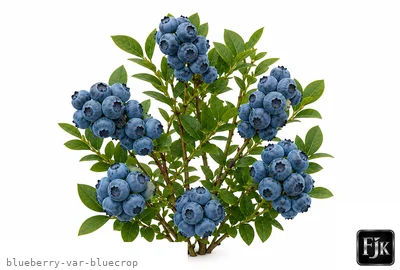
Bluecrop
Highbush · Mid
The most widely grown blueberry in the world and the benchmark for UK garden production. Very heavy, reliable crops of large, classic-flavoured berries. Excellent disease resistance. Upright, vigorous habit. The default choice for any garden.
Harvest
Jul–Aug
Flavour
Classic blueberry, slightly sharp
Fruit size
Large
Yield
Very high
Disease resistance
Excellent
✓ Self-fertile
🪴 Container
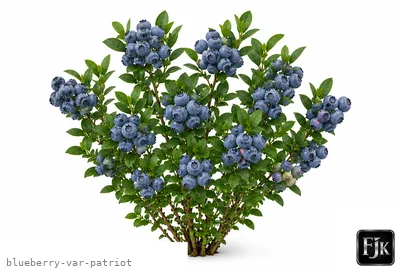
Patriot
Highbush · Mid
A compact, reliable highbush variety with very good flavour — considered superior to Bluecrop by many tasters. Good disease resistance and cold hardiness. Suitable for containers. Outstanding autumn foliage colour. A premium choice for flavour-focused growers.
Harvest
Jul–Aug
Flavour
Rich, sweet, excellent
Fruit size
Large
Yield
High
Disease resistance
Very good
✓ Self-fertile
🪴 Container
Highbush — Late Season
Chandler
Highbush · Mid–late
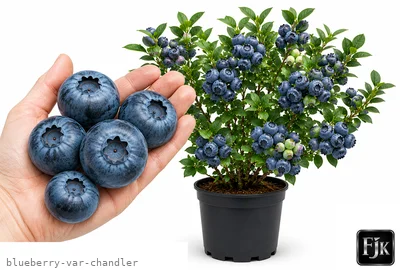
Produces the largest berries of any highbush blueberry — up to 2.5cm across — with exceptional flavour. An impressive plant for flavour quality and visual impact. Less vigorous than Bluecrop but the extraordinary berry size and quality justify the extra attention it needs.
Harvest
Aug
Flavour
Outstanding, complex, sweet
Fruit size
Very large
Yield
High
Disease resistance
Good
✓ Self-fertile
Herbert
Highbush · Mid–late
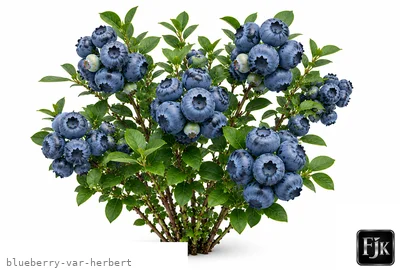
Widely considered to have the finest flavour of any highbush variety — rich, complex, aromatic berries that bear no resemblance to commercial fruit. Not the heaviest cropper but the quality is exceptional. Cross-pollinates very well with Bluecrop and Chandler.
Harvest
Aug
Flavour
Very rich, complex, aromatic
Fruit size
Large
Yield
High
Disease resistance
Good
✓ Self-fertile
Spartan
Highbush · Late
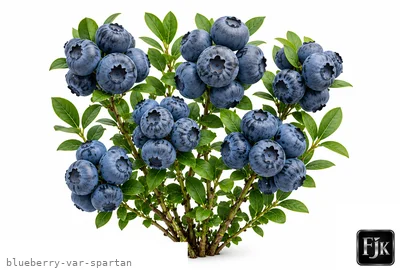
A late-season variety extending the harvest into September. Very large berries with excellent, rich flavour. Vigorous upright growth. Valuable for extending the season beyond the main July–August flush when grown alongside earlier varieties. Good autumn foliage colour.
Harvest
Aug–Sep
Flavour
Rich, sweet, excellent
Fruit size
Large
Yield
High
Disease resistance
Good
🏅 AGM
✓ Self-fertile
Half-high & Compact
Sunshine Blue
Southern highbush · Mid
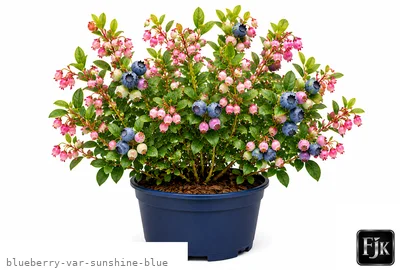
A compact half-high variety — reaching only 90cm — making it ideal for containers and small gardens. More tolerant of higher pH than most blueberries (up to pH 6.0). Semi-evergreen. Excellent choice for patio containers and for gardeners whose soil is borderline for blueberries.
Harvest
Jul–Aug
Flavour
Sweet, mild, pleasant
Fruit size
Medium
Yield
High
Disease resistance
Very good
✓ Self-fertile
🪴 Container
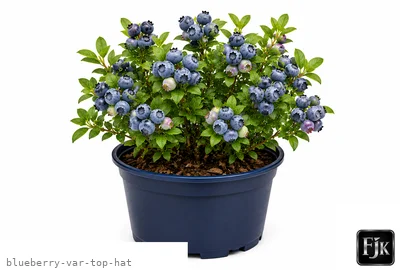
Top Hat
Half-high · Mid
A dwarf half-high variety reaching only 50–60cm. The most compact blueberry available. Ideal for patio containers and even window boxes. Good flavour and reliable yield for its size. Outstanding autumn foliage. Crosses well with Sunshine Blue.
Harvest
Jul–Aug
Flavour
Sweet, mild
Fruit size
Small-medium
Yield
Moderate
Disease resistance
Good
✓ Self-fertile
🪴 Container
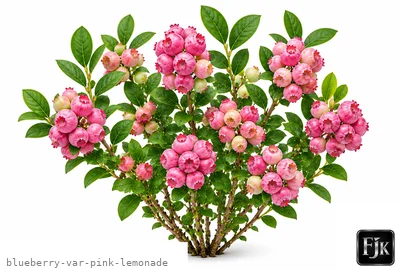
Pink Lemonade
Highbush · Late
A unique pink-fruited blueberry with an unusual lemonade-sweet flavour quite different from standard blue varieties. Striking visual appeal. Birds are sometimes confused by the colour and leave it longer before attacking. Ornamental as well as productive. A genuine curiosity.
Harvest
Aug–Sep
Flavour
Very sweet, mild, unusual
Fruit size
Medium
Yield
Moderate
Disease resistance
Good
✓ Self-fertile
🪴 Container
03 Planting Options
🌿 In Prepared Acid Soil
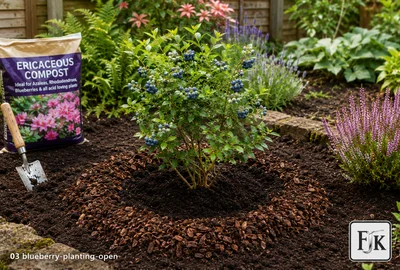
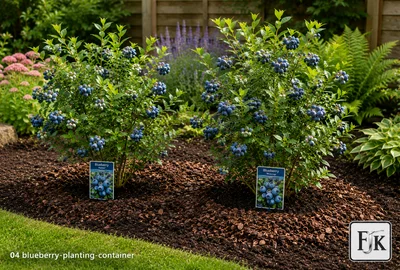
Blueberries fail outright in ordinary garden soil, so testing pH before planting is essential — anything above 5.5 will show as yellowing, chlorotic leaves within a season. Where soil tests in the right range (4.5-5.5), prepare the site generously with ericaceous compost and pine bark rather than standard compost or anything containing lime. Plant at least two varieties within 3m of each other: blueberries are technically self-fertile but crop far more heavily with cross-pollination from a second variety flowering at the same time. Plant at the same depth as in the pot — never deeper, since the root system is shallow and fibrous — then mulch with acidic pine bark or wood chip, renewed annually, to retain moisture and suppress weeds.
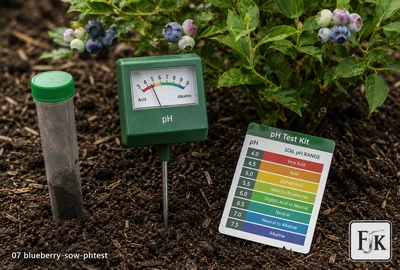
Test soil pH first
Do not plant blueberries without testing soil pH. A pH of 4.5–5.5 is essential — above 5.5 and plants will fail to thrive and show chlorosis (yellow leaves with green veins) within a season. Purchase a simple soil test kit from a garden centre. If pH is above 5.5, use containers of ericaceous compost instead.
Prepare the planting site
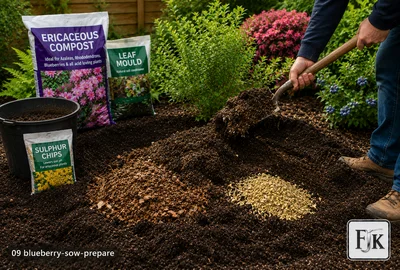
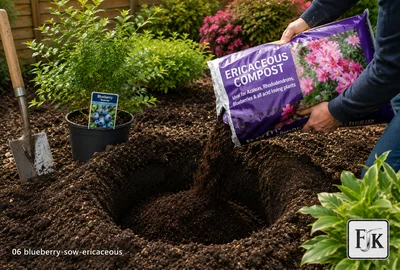
Incorporate large quantities of ericaceous compost and pine bark into the planting site. Dig out a generous planting hole (60cm wide, 45cm deep) and fill with a 50:50 mix of ericaceous compost and the excavated soil. Do not add standard garden compost or lime-containing materials.
Plant two varieties
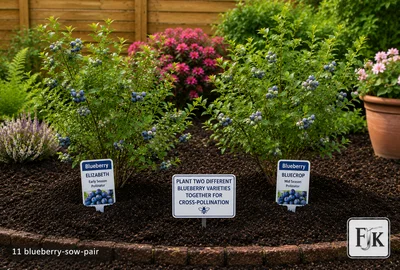
Blueberries are technically self-fertile but crop significantly more heavily when cross-pollinated by a second variety flowering at the same time. Plant at least two different varieties within 3m of each other. Choosing early and mid-season varieties extends the harvest window.
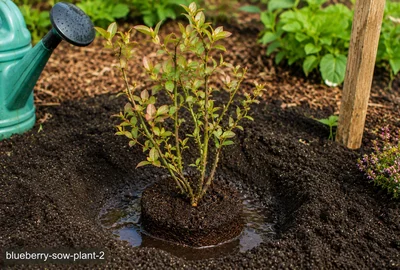
Plant at correct depth
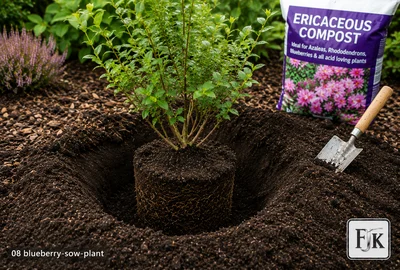
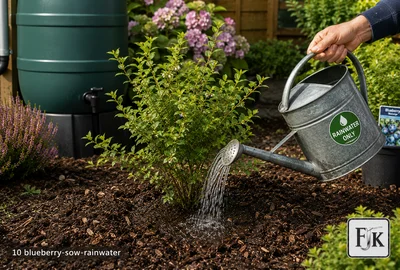
Plant at the same depth as in the container. Do not plant deep — blueberries have a shallow, fibrous root system that must not be buried. Firm gently and water in thoroughly with rainwater.
Mulch with acidic material
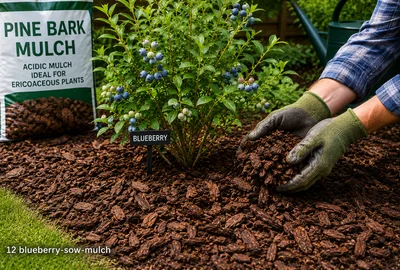
Apply a 7–10cm mulch of pine bark or wood chip around the base. This is acidic in nature, suppresses weeds, and retains moisture. Do not use garden compost (too alkaline) or farmyard manure. Renew the mulch annually.
🪴 In Containers (Recommended for Most Gardens)
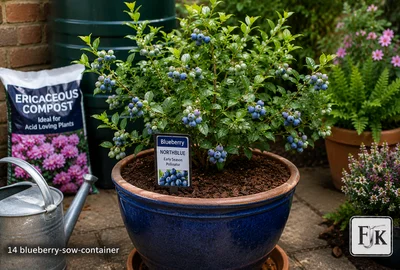
For most UK gardens, growing blueberries in containers of ericaceous compost is simpler and more reliable than trying to acidify open ground. Use a large container of at least 40-50cm diameter filled entirely with fresh ericaceous compost — even a small addition of ordinary compost will raise the pH enough to cause problems. The single most important ongoing rule is watering with rainwater rather than tap water, since most UK mains supplies are alkaline enough to gradually push compost pH out of range with regular use; a water butt is worth the investment. Repot into fresh ericaceous compost every 2-3 years in early spring, teasing out any circling roots gently as you go.
Choose a large container
Use containers of minimum 40–50cm diameter — larger is better. Blueberries grow slowly but become substantial plants over many years. Large half-barrels or similar deep containers provide enough compost volume to maintain stable pH and moisture levels.
Use ericaceous compost only
Fill entirely with ericaceous (acid) compost. Do not mix with standard compost — even a small addition of alkaline material will raise pH above the acceptable range. Use fresh ericaceous compost and replace or refresh the top layer annually.
Water with rainwater
Tap water in most of the UK is slightly alkaline and will gradually raise compost pH if used regularly. Collect rainwater in a water butt and use exclusively for container blueberries. In hard-water areas, even occasional watering with tap water can cause visible chlorosis within a season.
Repot every 2–3 years
Container blueberries need repotting into fresh ericaceous compost every 2–3 years. Repot in early spring before growth begins. Tease out circling roots gently. Do not increase pot size dramatically — a slightly restricted root run promotes better fruiting.
04 Companion Planting
✅ Grow nearby
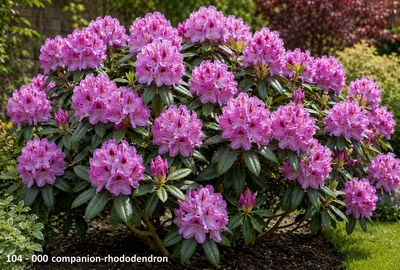
🌸 Rhododendron
Shares the same acidic, ericaceous soil requirements — a good companion in the same bed.
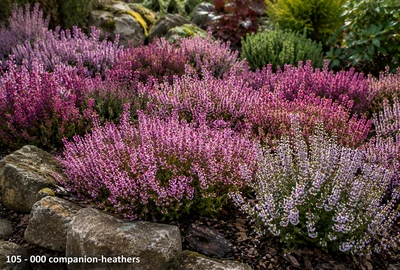
🌸 Heathers
Shares the same acidic, ericaceous soil requirements — a good companion in the same bed.
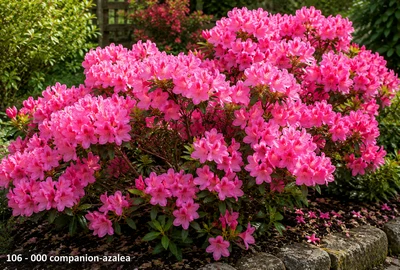
🌸 Azalea
Shares the same acidic, ericaceous soil requirements — a good companion in the same bed.
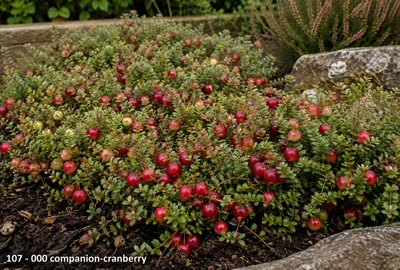
🫐 Cranberry
Another ericaceous fruit with matching acidic soil needs — grows happily in the same bed.
05 Sowing — How To
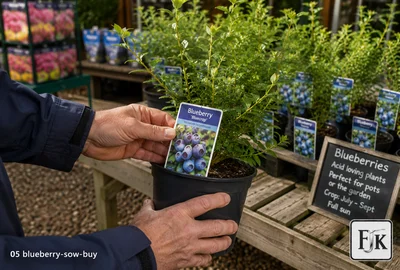
Buy established plants
Blueberries are almost always sold as container-grown plants. Buy plants that are 2–3 years old if possible — they will fruit sooner. Younger plug plants take longer to establish.
Plant spring or autumn
March–April or September–October are the best times. Avoid summer planting as the combination of heat and transplant stress in acid-hungry plants is challenging. Keep well watered after planting.
Remove flowers in year one
For the first full year after planting, remove all flowers. This redirects energy into root and framework development. A plant allowed to fruit in year one of establishment produces weak growth — the second-year yield will be significantly better as a result.
Regional sowing timing
Region
Sow / plant
Harvest
Notes
Scotland & Far North
Apr–May
Jul–Sep
Northern England
Mar–May
Jul–Sep
Midlands & Wales
Mar–May
Jul–Sep
Ireland & Isle of Man
Mar–May
Jul–Sep
South & SE England
Mar–Apr
Jul–Sep
South Coast & SW
Mar–Apr
Jul–Sep
06 Using a Propagator
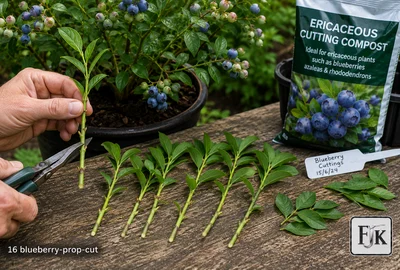
Blueberries can be propagated from softwood or semi-ripe cuttings but this is a slow process and most gardeners buy established plants. The ericaceous compost requirement applies to all propagation work.
Heated propagator
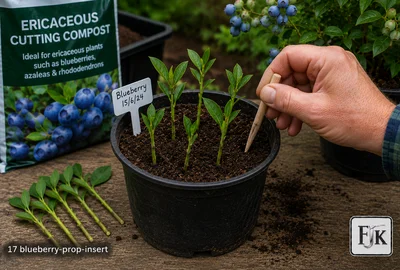
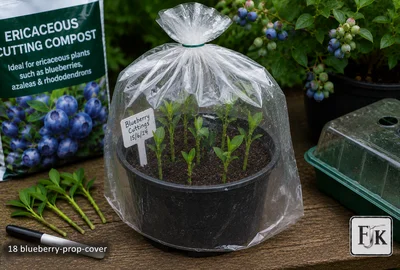
Softwood Cuttings (Optional) — In May–June, take 10cm softwood cuttings from vigorous new growth. Insert in ericaceous compost in a propagator or cover with a plastic bag to maintain humidity. Rooting takes 6–8 weeks. A heated base (20°C) improves success rates but is not essential.
Take cuttings from healthy growth
Choose vigorous, healthy shoots showing no signs of chlorosis or disease. Cuttings from strong, well-nourished plants root most reliably.
Use ericaceous compost only
Fill propagation cells or a tray with ericaceous compost. Do not use standard compost — the pH must be correct from the start. Insert cuttings to about half their length and firm gently.
Maintain humidity
Cover with a propagator lid or clear plastic bag. Keep out of direct sun. Check weekly for roots by gently tugging a cutting — resistance indicates rooting.
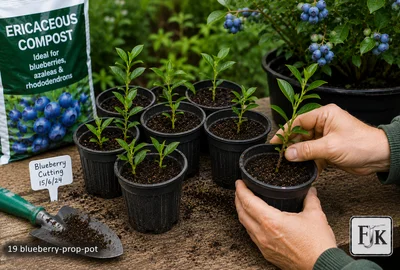
Pot on and grow for 2 years
Once rooted, pot into individual pots of ericaceous compost. Grow on for 2 years before planting in final position. Young blueberries are slow — patience produces a strong, long-lived plant.
07 Soil Requirements
pH
4.5–5.5
Best
Peat, Sandy acid soil
Tolerates
Acid sandy loam
Avoid
Chalk, Alkaline, Clay, Neutral loam
💡 MUST have acid soil — non-negotiable. Use ericaceous compost in containers.
08 Ongoing Care
🧪 pH Management
Managing soil or compost pH is the central maintenance task for blueberries. Test pH annually in spring. If pH is rising above 5.5, water with a dilute solution of sulphur-based acidifier, switch to ericaceous liquid feed, and renew the pine bark mulch. Chlorosis — yellowing between the leaf veins while the veins remain green — is the first visible sign that pH is too high. If caught early, a dose of sequestered iron (chelated iron) available in ericaceous form will restore green colour within 2–3 weeks while pH correction takes effect.
💧 Watering
Blueberries need consistent moisture through the growing season — their shallow, fibrous root system has limited capacity to access deep water. Water regularly from spring until harvest with rainwater wherever possible. Container plants may need daily checking in summer. Never allow containers to dry out completely — recovery from severe drying is slow. A water butt connected to a greenhouse, shed, or house downpipe is the ideal solution for blueberry growers.
✂️ Annual Pruning
Blueberries are lightly pruned in late winter (February–March). In the first 3 years, remove only damaged or crossing branches — allow the framework to develop fully. From year 4, begin removing some of the oldest, darkest stems (3+ years old) at the base each winter to stimulate strong new growth. New canes grow vigorously from the base and develop into the most productive wood. Remove any twiggy, unproductive branch systems. Do not hard prune — blueberries need their established framework. Annual light pruning over many years produces a continuously productive bush.
🐦 Bird Protection
Birds — particularly starlings, blackbirds, and wood pigeons — target blueberries the moment they begin to colour. Protection is essential. Drape fine-mesh netting over the entire bush from mid-July, securing at the base. A permanent fruit cage is ideal if growing multiple bushes. Without protection, the entire crop can be lost in a single day. The difficulty of protecting blueberries makes the container-grown approach particularly practical — containers can be moved under cover or into a netted structure at fruiting time.
09 Watch Out For
Warning
Chlorosis (yellowing between leaf veins) indicates pH is too high — treat with sequestered iron and lower pH. Mummified berries on the bush indicate Botrytis (grey mould) — improve airflow and pick fruit promptly. Blueberry gall midge causes leaves and shoots to deform in spring — remove affected shoots. Vine weevil grubs eat roots of container-grown plants causing sudden wilting — treat with nematodes (Steinernema kraussei) in late summer.
🐛 Insects & pests
🪲 Vine Weevil — Irregular, rounded notches cut from leaf margins — the work of adult beetles feeding at night
🐜 Aphids (Blackfly & Greenfly) — Curled, distorted, or stunted growing tips — aphids inject saliva that causes leaf curl to protect them
🟤 Scale Insect — Small brown or grey bumps on stems, branches, and the underside of leaves — the scale covers themselves
🍄 Diseases to watch
🩶 Botrytis (Grey Mould) — Botrytis cinerea (grey mould) is the most ubiquitous fungal pathogen in temperate gardens — present in virtually every garden soil and on plant debris. It becomes a disease only when conditions favour it: cool, humid, poorly ventilated environments with damaged or senescent plant tissue. In a greenhouse in autumn it can destroy an entire tomato or grape crop.
Full identification and treatment advice is in the Pests and Diseases sections.
10 Storage & Preserving
🫐 Fresh
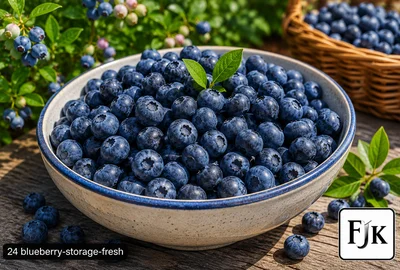
Fresh blueberries keep for 5–7 days refrigerated — the best keeping quality of any soft fruit. Do not wash until ready to eat. Eat at room temperature for best flavour — cold blueberries have significantly less aroma and taste than those allowed to warm for 30 minutes before eating. Homegrown blueberries fully ripe on the bush are a completely different product from commercial berries picked underripe for transport.
❄️ Frozen
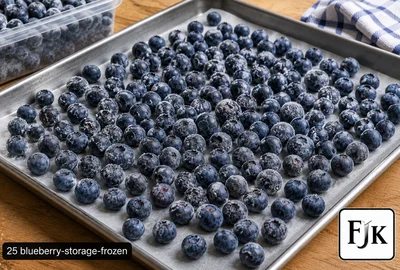
Blueberries are one of the best fruits for freezing — they retain their flavour, colour, and nutritional value exceptionally well. Open freeze on a tray until solid, then bag. Use within 18 months. They can be used directly from frozen in baking, smoothies, and pancakes. Frozen homegrown blueberries produce a far superior result in muffins and crumbles compared to commercial berries.
🫙 Jam & Preserves
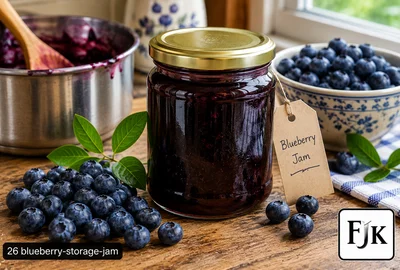
Blueberry jam has an intense, complex flavour. Blueberry compote (fruit simmered briefly with sugar and lemon juice) is simpler than jam and excellent over ice cream, yoghurt, and pancakes. Follow a tested recipe.
11 Expert Tips
💡 Start with two mid-season varieties
For most gardeners, two mid-season highbush blueberries — Bluecrop and Herbert, or Bluecrop and Chandler — provide reliable cross-pollination, a generous combined yield, and a picking window across July and August. Add an early variety (Earliblue) or late variety (Spartan) in subsequent years to extend the season.
💡 The container advantage
Container-grown blueberries on a south-facing patio have significant advantages over open-ground planting: pH is controllable, rainwater use is easy to enforce, netting and protection is straightforward, and containers can be moved inside a greenhouse or polytunnel in February to force an early crop. The limitation is watering demand in summer.
💡 The autumn display
Highbush blueberry foliage turns brilliant scarlet, orange, and crimson in October — among the finest autumn colour of any garden shrub. Even in years when the fruit crop disappoints, the ornamental value in autumn makes them worth growing. Position where the autumn display can be seen from the house.