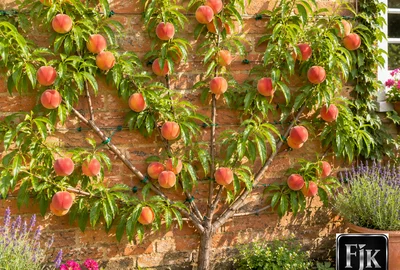
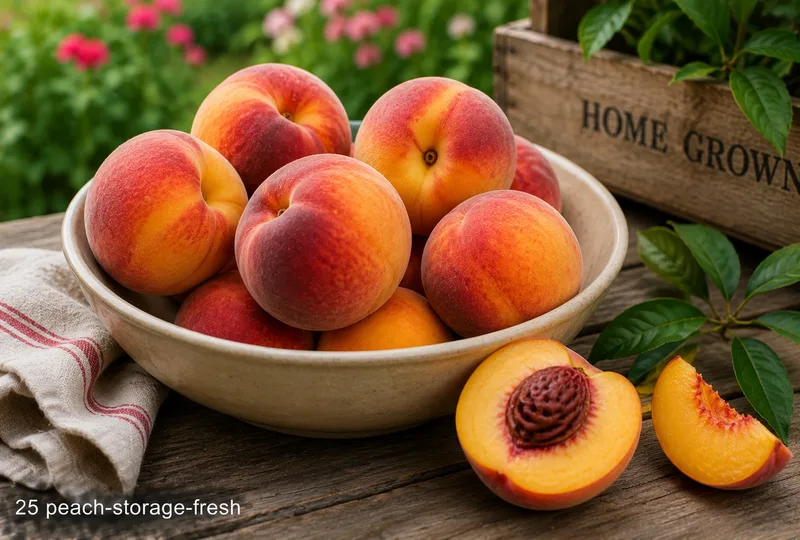
A sun-warm peach picked straight from a south-facing wall in August is one of the great experiences of the British kitchen garden. Peaches thrive as fan-trained specimens against a sheltered south wall throughout England and Wales, and in containers that can be brought under cover for winter. Two management disciplines are essential: rain exclusion to prevent leaf curl, and hand pollination in February when no bees are flying.
02 Rootstock Guide
The rootstock controls the ultimate size of the tree. Choose it first — before the variety. All sizes below are approximate and depend on soil and management.
Peaches rootstocks
Rootstock
Size
Height
Spacing
Suitable for
Support & notes
St Julien A
Semi-vigorous
3–4m
4–5m
Fan · Bush (mild areas only)
Stake for 5 years — The standard peach rootstock. Good vigour for fan training.
Pixy
Dwarfing
2–3m
3m
Container · Small fan
Permanent stake — For containers and compact fans. More intensive management needed.
Bonanza/genetic dwarfs
Dwarf
1.0–1.5m
Container
Large containers · Patio
Container support — Genetic dwarf peaches bred specifically for container production. No special rootstock.
Pollination groups
Group SF — Self-fertile — all UK peach varieties are self-fertile. However, as flowers open in February and March before pollinating insects are active, hand pollination is strongly recommended to ensure a good fruit set.
Training forms
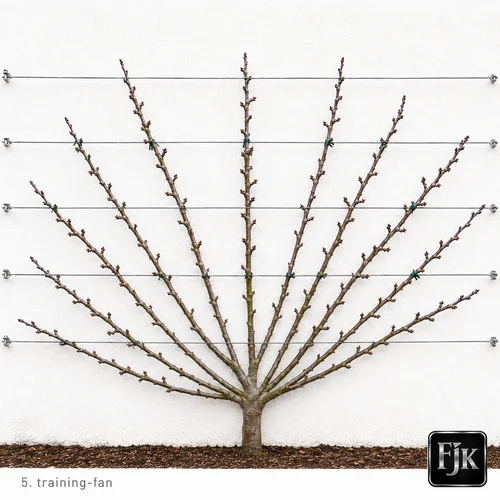
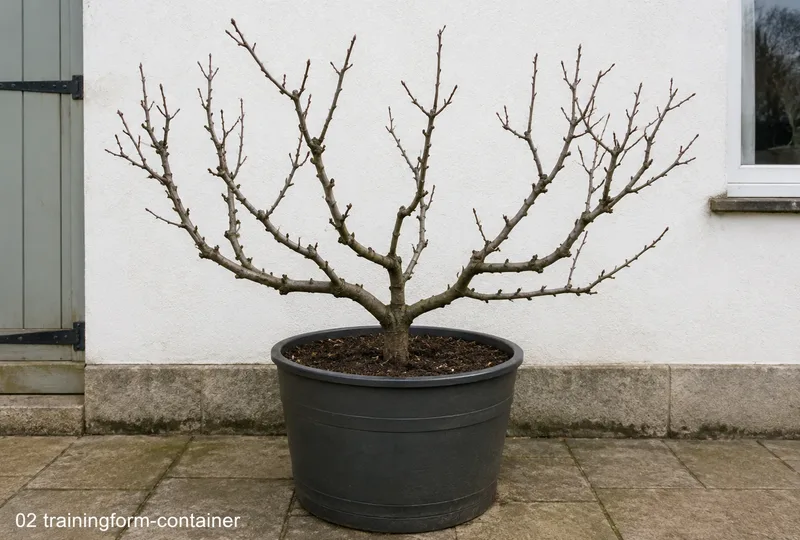
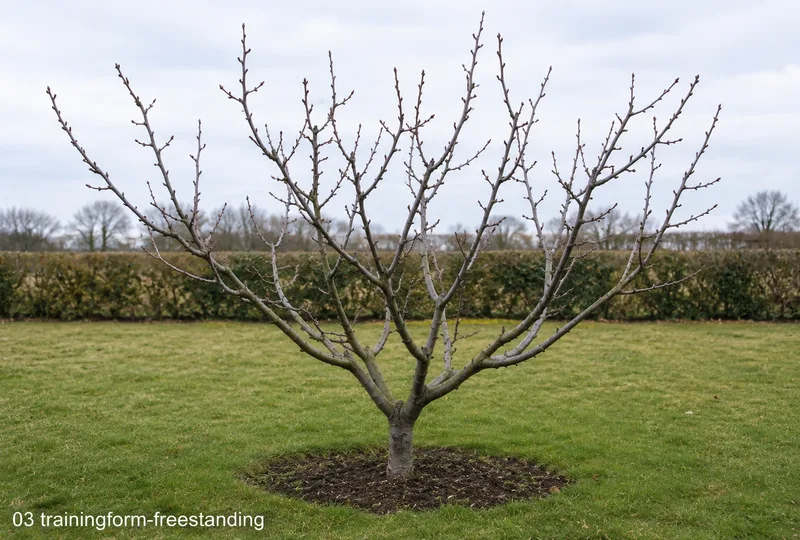
fancontainerfree-standing
03 Varieties
The number of varieties shown for each crop is based on UK consumption data (2025/26) — the more popular the crop, the more variety choices we include.
White-fleshed Varieties
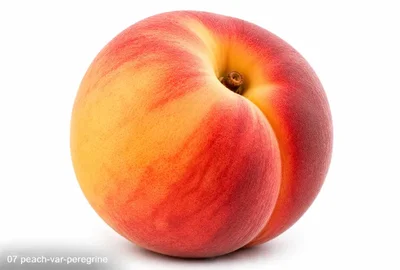
Peregrine
White-fleshed · Early
The benchmark wall-trained peach for UK gardens. White flesh with exceptional flavour — rich, fragrant, and complex. Heavy, reliable crops on a south wall. Ripens in late July and August. The first choice for anyone starting with wall peaches.
Harvest
Jul–Aug
Flavour
Outstanding — rich, wine-like, fragrant, complex
Fruit size
Large
Yield
Very high
Disease resistance
Good
✓ Self-fertile
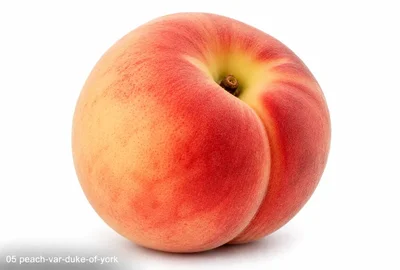
Duke of York
White-fleshed · Very early
One of the earliest peaches — ripening in early July on a warm south wall. White flesh with very good flavour. Valuable for extending the peach season into the first weeks of July. A companion to Peregrine for an extended harvest.
Harvest
Jul
Flavour
Sweet, rich, outstanding early
Fruit size
Large
Yield
High
Disease resistance
Good
✓ Self-fertile
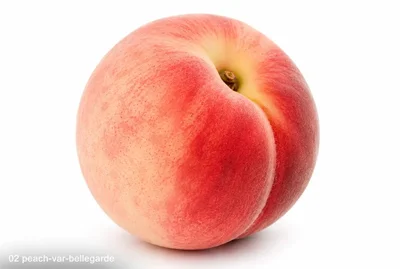
Bellegarde
White-fleshed · Late
A late-ripening white peach extending the harvest into September. Rich, sweet flavour. Deep red-flushed skin. A heritage variety with excellent quality in warm years. Best in the south where September warmth can reliably develop the fruit.
Harvest
Sep
Flavour
Rich, sweet, complex, late season
Fruit size
Large
Yield
High
Disease resistance
Good
✓ Self-fertile
Yellow-fleshed Varieties
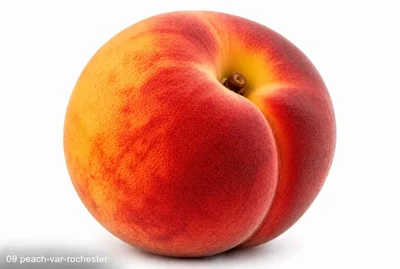
Rochester
Yellow-fleshed · Mid
The most widely grown peach in the UK. Yellow flesh with juicy, sweet, classic peach flavour. Very heavy, reliable crops. Good disease resistance. Crops slightly later than Peregrine. The robust, productive choice for those prioritising yield and reliability.
Harvest
Aug
Flavour
Juicy, sweet, classic peach
Fruit size
Large
Yield
Very high
Disease resistance
Very good
✓ Self-fertile
🪴 Container
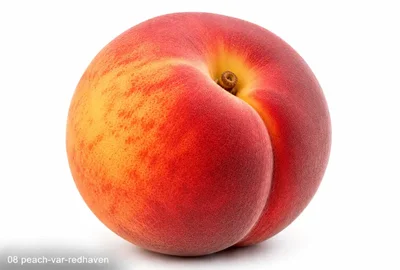
Redhaven
Yellow-fleshed · Early-mid
An American variety with excellent disease resistance and good flavour. Attractive red-flushed yellow fruit. Crops in late July and early August. Good for containers. Particularly valued for its disease resistance compared to older varieties.
Harvest
Jul–Aug
Flavour
Juicy, sweet, excellent
Fruit size
Large
Yield
High
Disease resistance
Very good
✓ Self-fertile
🪴 Container
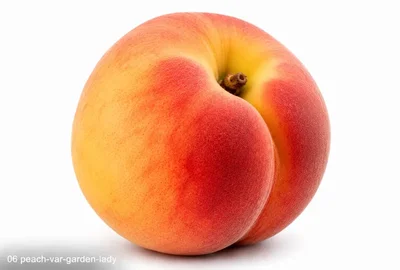
Garden Lady
Genetic dwarf · Yellow
A genetic dwarf peach bred specifically for container growing. Reaches only 1.2–1.5m. Very reliable in containers on a sunny patio. Good sweet flavour. Ideal for those without wall space or who want to grow a peach in a pot.
Harvest
Aug
Flavour
Sweet, pleasant, good for a dwarf
Fruit size
Medium-large
Yield
High
Disease resistance
Good
✓ Self-fertile
🪴 Container
Patio & Hardy Varieties
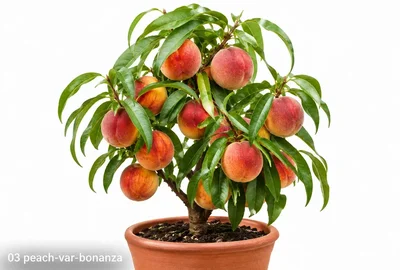
Bonanza
Genetic dwarf · Yellow
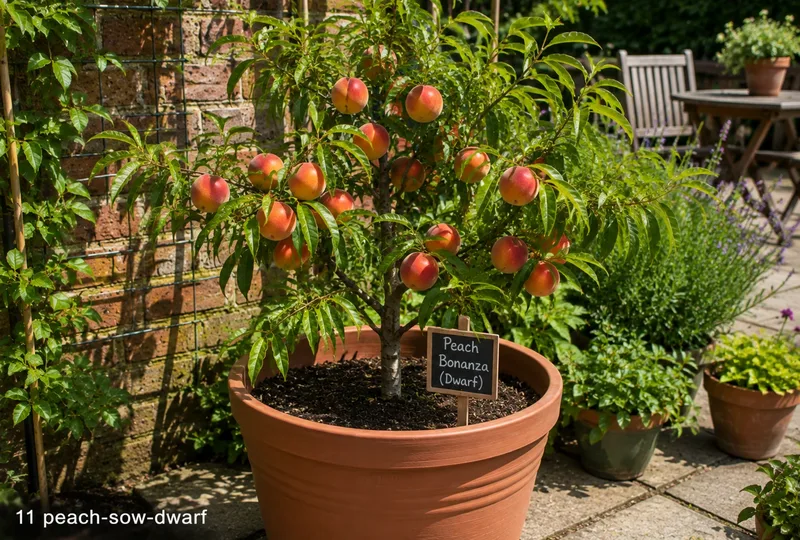
A compact genetic dwarf peach reaching only 90–120cm — the most compact peach available. Profuse pink flowers in spring. Regular crops of medium, sweet peaches. Ideal for patio containers and balconies. An ornamental as well as productive plant.
Harvest
Aug
Flavour
Sweet, mild, pleasant
Fruit size
Medium
Yield
High
Disease resistance
Good
✓ Self-fertile
🪴 Container
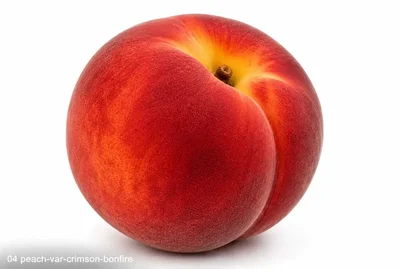
Crimson Bonfire
Genetic dwarf · Deep red
A newer ornamental-fruiting genetic dwarf peach with deep red-purple foliage providing outstanding ornamental impact from spring through autumn. Good quality fruit. Bred for patio container use. One of the most attractive fruiting plants available.
Harvest
Aug
Flavour
Sweet, good quality
Fruit size
Medium
Yield
High
Disease resistance
Good
✓ Self-fertile
🪴 Container
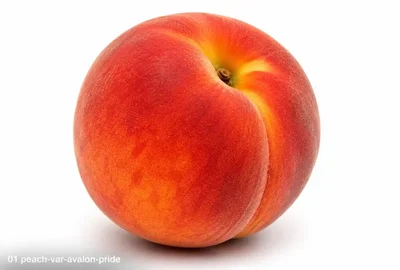
Avalon Pride
Standard · Disease resistant
The only variety with genuine genetic resistance to peach leaf curl — making it possible to grow outdoors without a rain shelter. Outstanding for UK gardens where construction of a shelter is not practical. Large, red-flushed fruit with excellent flavour. A significant advance for UK peach growing.
Harvest
Aug
Flavour
Rich, sweet, excellent
Fruit size
Large
Yield
High
Disease resistance
Exceptional (leaf curl resistant)
✓ Self-fertile
🪴 Container
04 Where to Source
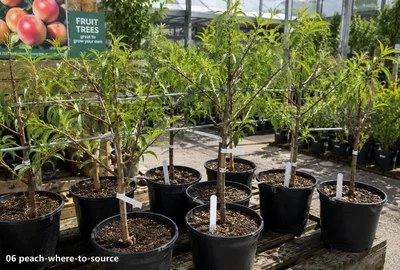
Peaches are sold as bare-root trees in winter or container-grown for planting almost year-round. Specialist fruit nurseries offer pre-trained fans ready to tie in against a wall, which saves several years of formative training compared to starting from a young whip.
🌳 Specialist Fruit Nurseries
A pre-trained fan costs more than an untrained tree but is well worth it for peaches — correct early framework training matters enormously for a wall-trained fruit tree, and mistakes are hard to undo years later.
Timing tip: Order seeds in January and February. Popular varieties sell out quickly. Garden centres and markets are a reliable backup from April onwards.
05 Planting Options
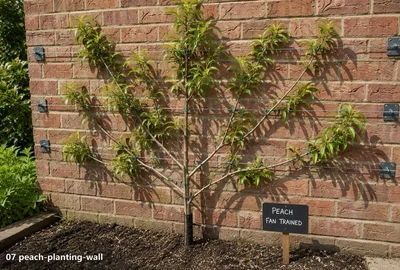
🌿 Fan-trained Against a South Wall (Best Method)
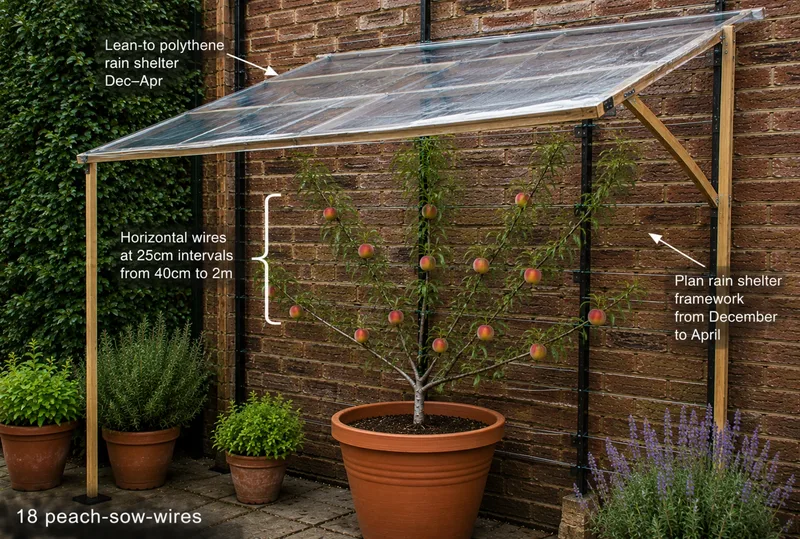
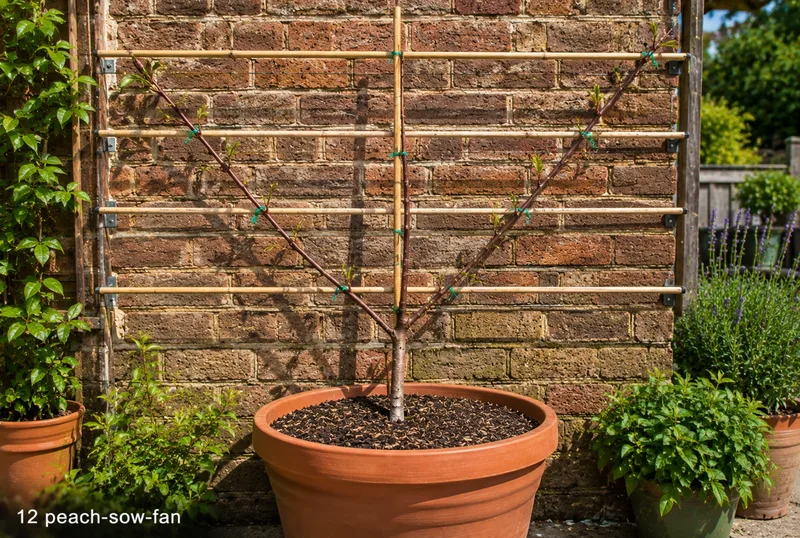
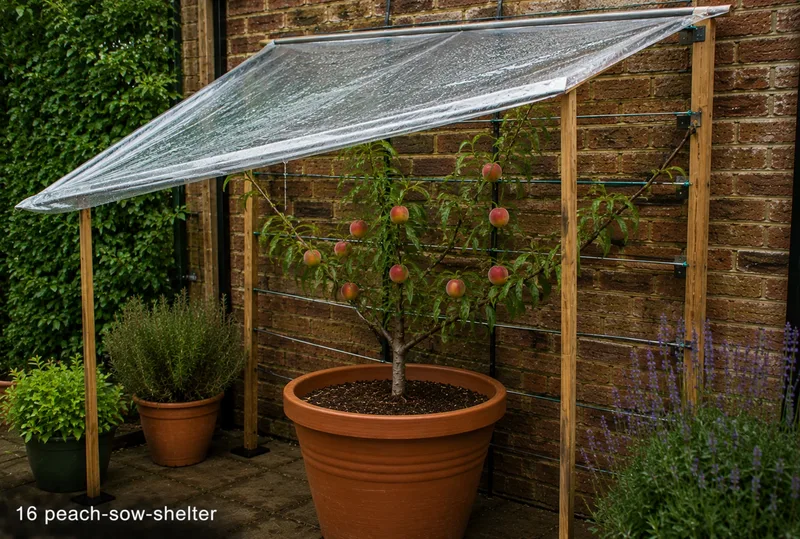
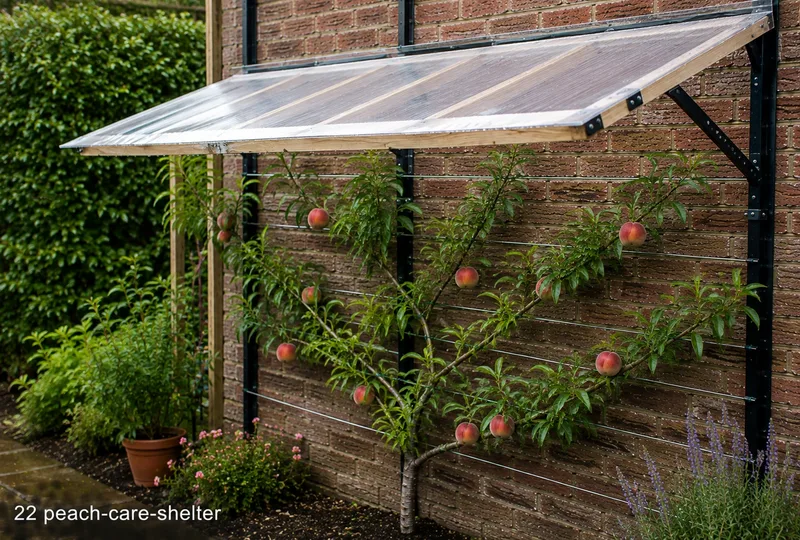
A south-facing wall is the best position for peaches in the UK — the reflected heat and shelter it provides make ripening reliable in most summers, and the flat, trained form makes rain exclusion and hand pollination straightforward. Install horizontal wires at 25cm intervals from 40cm to 2m above the ground, and plan a removable rain shelter (a simple lean-to polythene roof works well) to keep the developing fan dry from December to April — this single measure is the most effective defence against peach leaf curl. Because peaches flower in February before most pollinating insects are active, hand pollinating with a soft brush at midday on dry, still days makes a substantial difference to the eventual crop.
Fix wires and install rain shelter framework
Install horizontal wires at 25cm intervals from 40cm to 2m. Additionally, plan a rain shelter — a lean-to polythene roof over the fan from December to April. This rain exclusion is the primary defence against peach leaf curl.
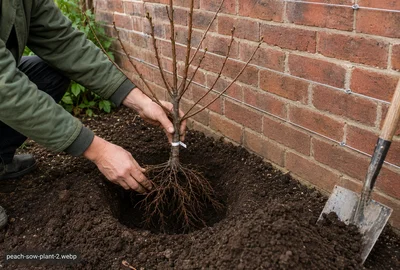
Plant bare-root in winter
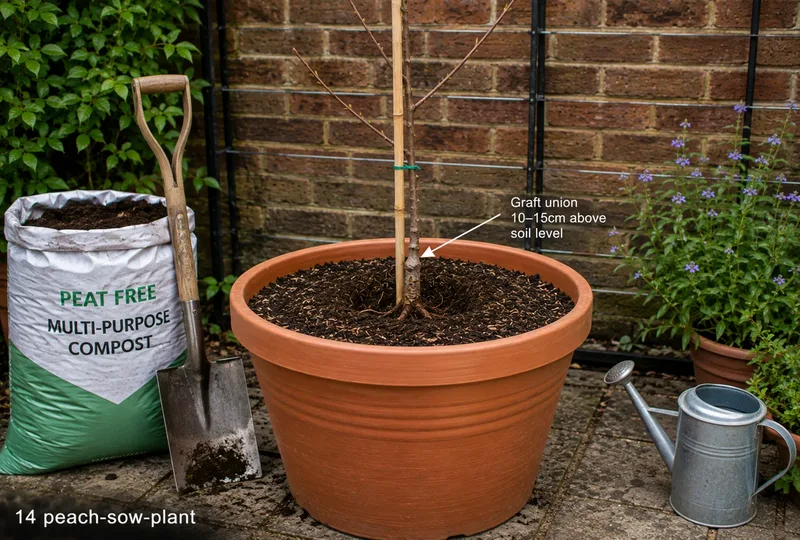
Plant Nov–March with the graft union 10–15cm above soil. The tree will establish through winter and begin growth in spring. Stake and mulch in a wide circle.
Form the fan framework in year one
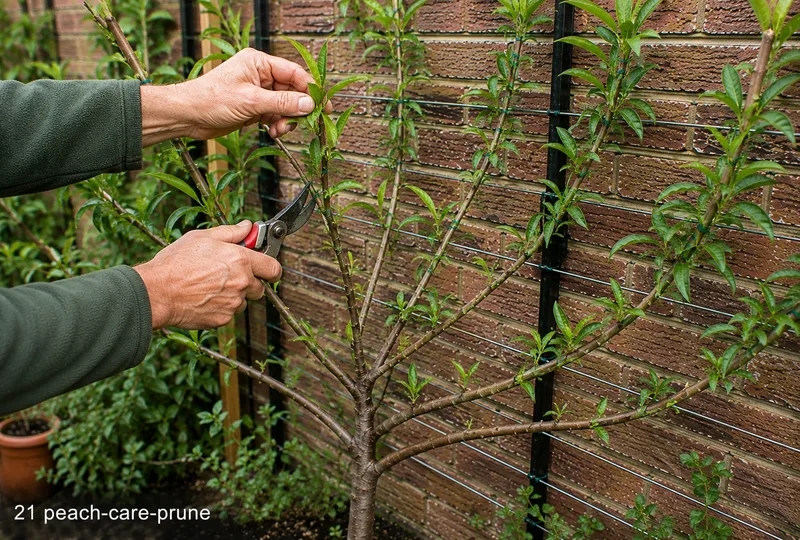
Select two main lateral branches at approximately 45 degrees either side of the main stem. Tie to canes on the wires. Remove all other branches. The fan will develop from these two arms over the next 3–4 years.
Hand pollinate in February–March
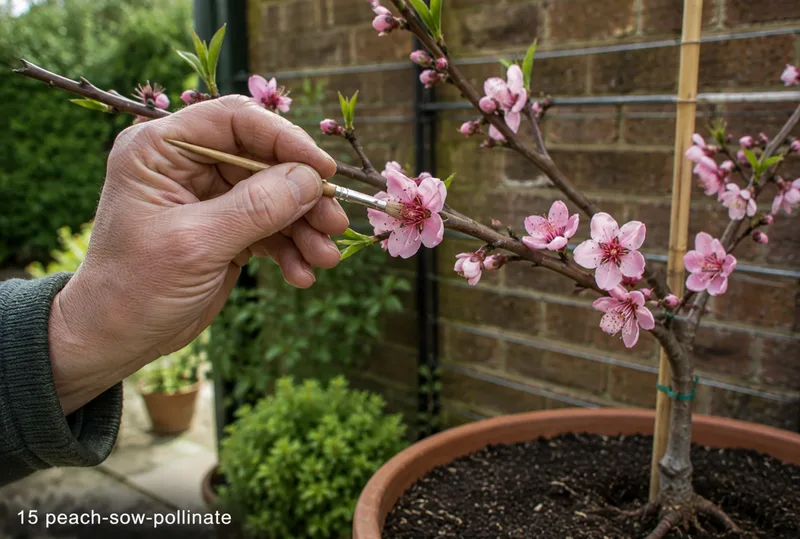
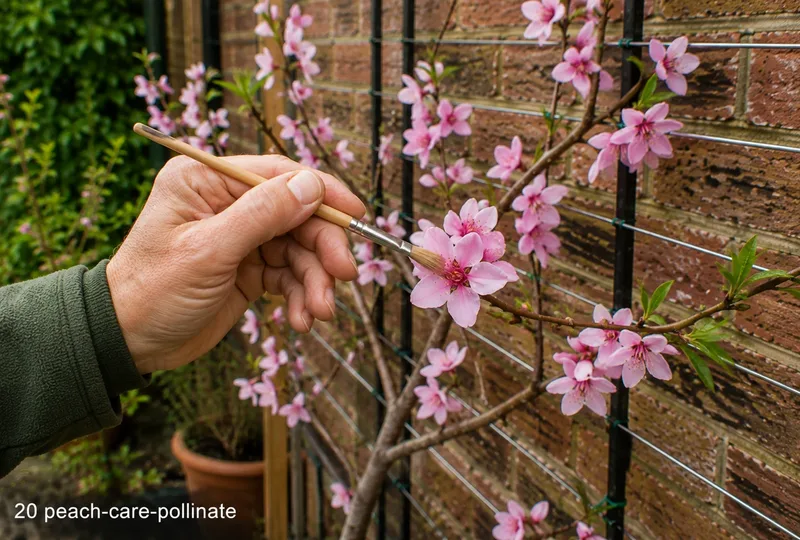
Use a soft paintbrush or cotton bud to transfer pollen between open flowers at midday on dry, still days. Work systematically across all open flowers. Repeat daily while flowers are open. This simple 5-minute task dramatically improves fruit set.
Thin fruits in May–June
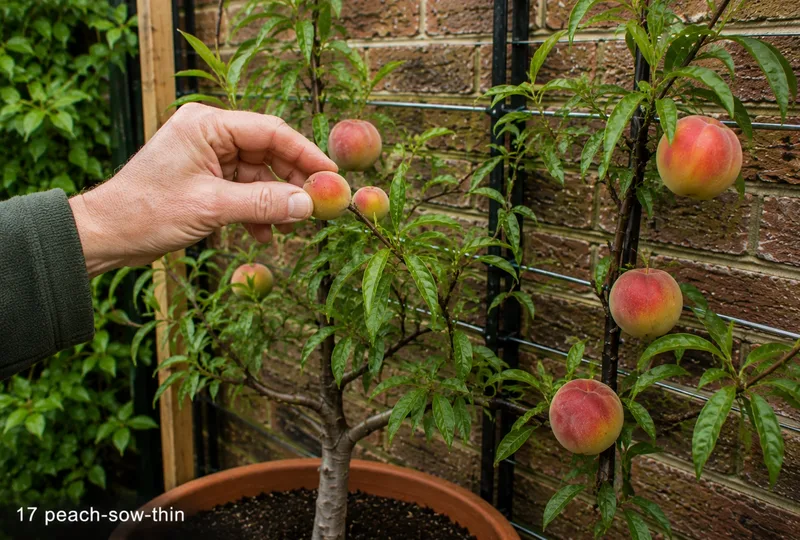
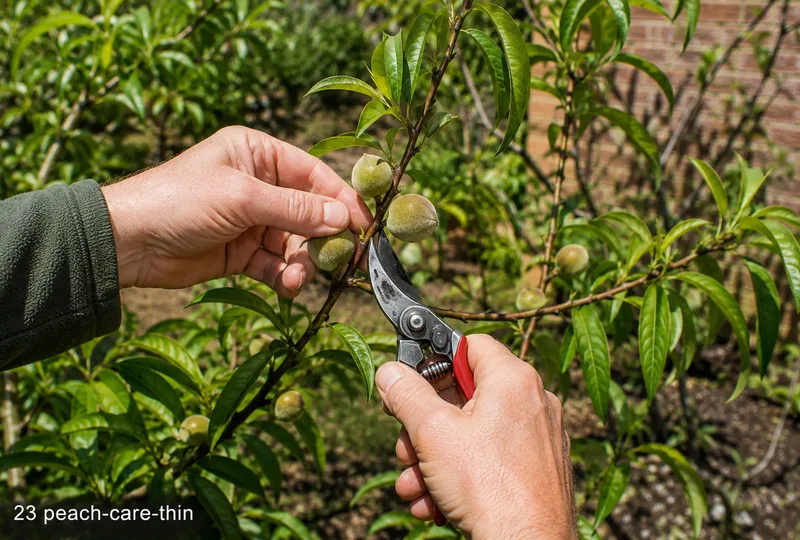
Thin to 15–20cm between fruits when they reach marble size. This seems brutal but is essential — it produces large, well-flavoured fruit and prevents branch breakage under excessive weight.
🪴 In a Large Container
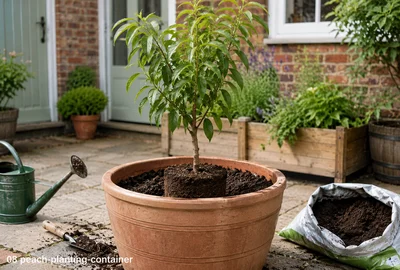
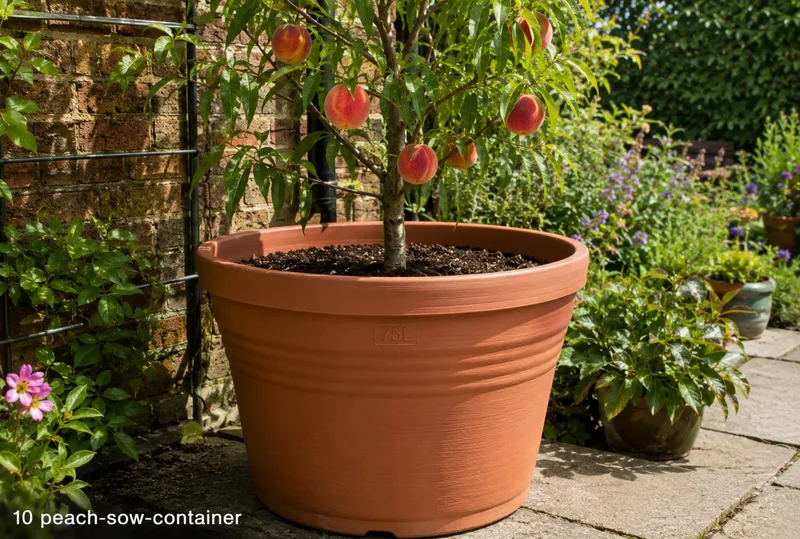
Growing in a large container is a practical alternative to a wall for gardeners without a suitable south-facing spot, and it gives the option of moving the tree under cover to protect the earliest blossom. Use a minimum 50-litre container of free-draining compost — 75–100 litres is better still — positioned in the sunniest, most sheltered patio spot available. Genetic dwarf varieties such as Garden Lady and Bonanza are bred specifically for pot culture, reaching only 1.2–1.5m while fruiting prolifically. Bringing the container into an unheated greenhouse or cool conservatory over winter both protects the flowers from frost and rain and removes the need for a separate rain shelter against leaf curl.
Use a 50L+ container
A minimum 50-litre container is needed. Larger is better — 75–100 litres gives much better results. Use a free-draining compost. Position in the sunniest, most sheltered patio spot available.
Choose a genetic dwarf variety
Garden Lady, Bonanza, and similar genetic dwarfs are bred for container production. They reach only 1.2–1.5m and fruit prolifically in pots. Standard varieties in containers require more management.
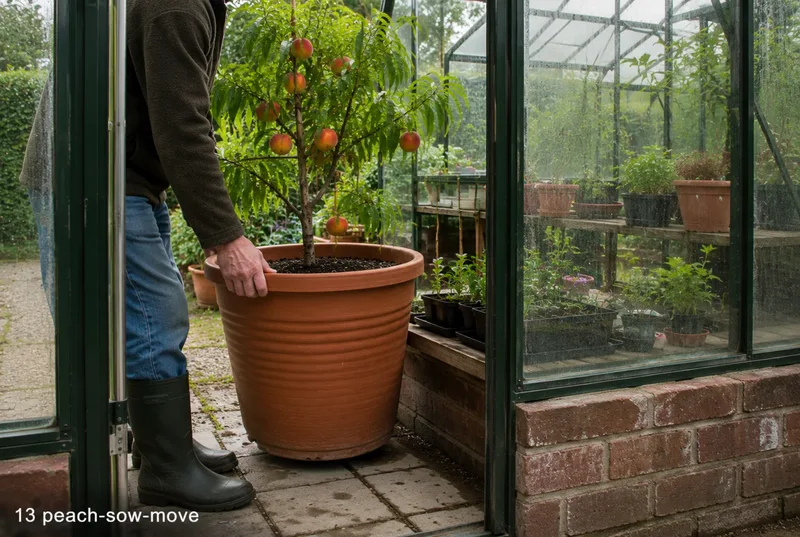
Move under cover for winter
Bringing a container peach into an unheated greenhouse or cool conservatory for winter protects the flowers from frost and rain. This also eliminates the need for a rain shelter against leaf curl. Move out when frost risk has passed in April.
06 Companion Planting
✅ Grow nearby
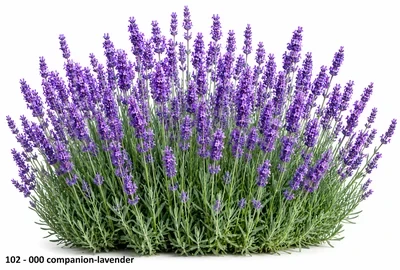
💜 Lavender
Attracts pollinators and adds a decorative, low-maintenance border nearby.
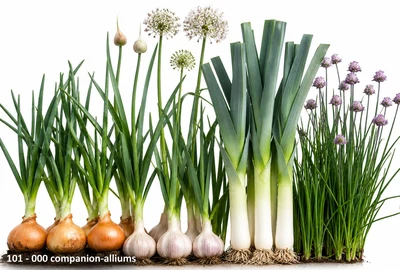
🧄 Alliums
Onion-family plants grown nearby are thought to help deter pests with their strong scent.
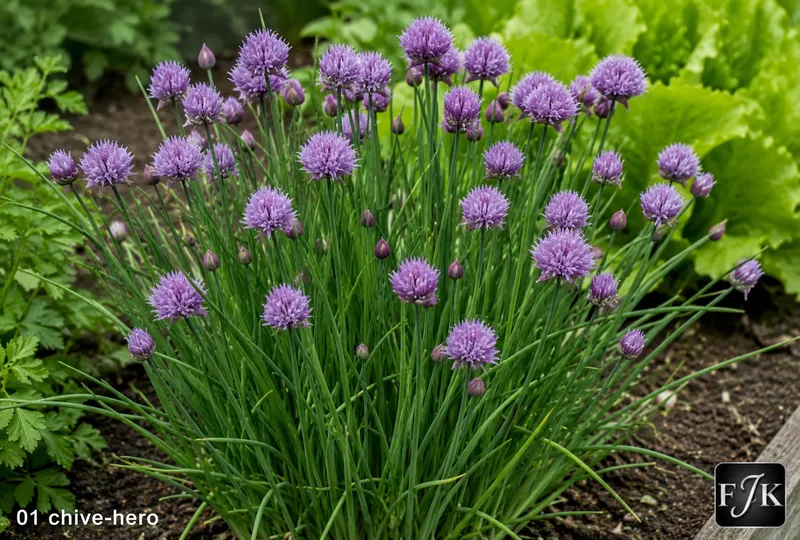
A mild allium companion said to help deter aphids and other pests with its strong scent.
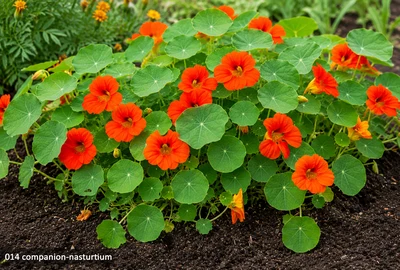
🌸 Nasturtium
Acts as a trap crop for aphids, drawing pests away from the main plant.
07 Sowing — How To
Plant Nov–Mar against prepared wall
Wire framework and rain shelter framework must be in place before planting. Plant at the same depth as the nursery mark with the graft union above soil.
Install rain shelter from December
The polythene rain shelter over the fan must be in place by December of the first winter. Leaf curl spores overwinter and are spread by rain splash onto the swelling buds in late winter.
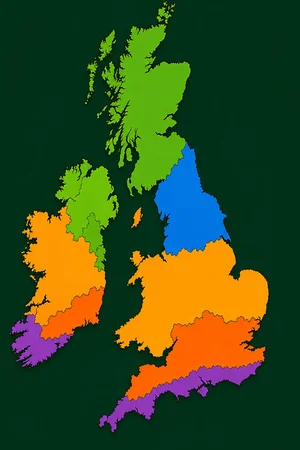
Regional sowing timing
Region
Sow / plant
Harvest
Notes
Scotland & Far North
Nov–Mar
Jul–Aug
Northern England
Nov–Mar
Jul–Aug
Midlands & Wales
Nov–Mar
Jul–Aug
Ireland & Isle of Man
Nov–Mar
Jul–Aug
South & SE England
Nov–Mar
Jul–Aug
South Coast & SW
Nov–Mar
Jul–Aug
08 Using a Propagator
Peaches are grafted by specialist nurseries. Home propagation is not practical for wall-trained specimens. Container-grown trees are the most common and reliable way to buy a peach — plantable at any time of year — though bare-root trees are also sold in winter by specialist fruit nurseries.
Heated propagator
Not Applicable — Purchase from specialist fruit nurseries.
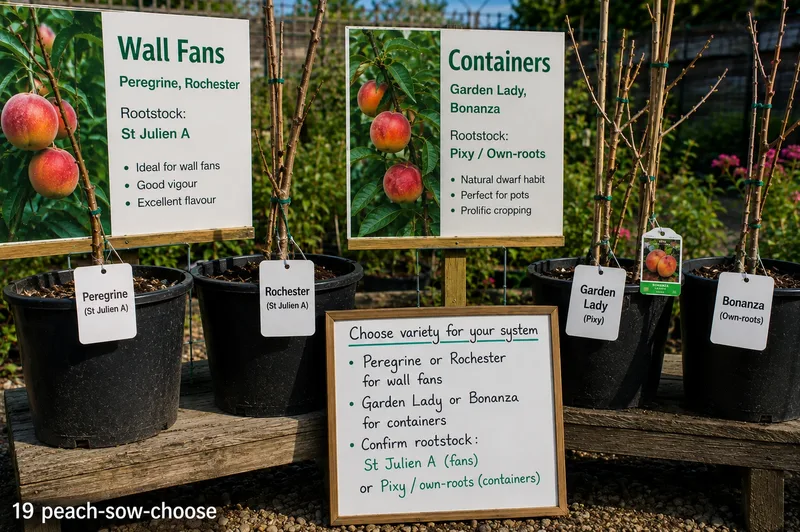
Choose variety for your system
Peregrine or Rochester for wall fans. Garden Lady or Bonanza for containers. Confirm rootstock is St Julien A (fans) or Pixy/own-roots (containers).
09 Soil Requirements
pH
6.0–7.0
Best
Sandy loam, Loam
Tolerates
Clay loam
Avoid
Waterlogged, Very heavy clay, Chalky
💡 Well-drained, fertile soil. Avoid chalky soils where possible.
10 Ongoing Care
🌧️ Rain Exclusion Against Leaf Curl
Peach leaf curl (Taphrina deformans) is the primary disease challenge for UK growers. It causes leaves to blister, redden, and fall prematurely, severely weakening the tree. The fungal spores spread exclusively via rain splash onto the swelling buds in late winter and early spring. The only reliable organic prevention is to exclude rain from the tree between December and April by installing a lean-to polythene shelter over the fan. This single intervention eliminates the disease almost completely. Remove the shelter in May when the risk has passed and pollinating insects need access. Trees in containers moved under cover in winter are automatically protected.
🌸 Hand Pollination
Peach and nectarine flowers open in February and March — weeks before bees become active in the UK. Without hand pollination, very few flowers are fertilised and fruit set is poor. Each day while flowers are open, use a soft paintbrush (a 1-inch watercolour brush is ideal) to transfer pollen between open flowers. Work at midday on dry, still days when pollen is most freely released. A daily 5-minute session during the flowering period — typically 2–3 weeks — significantly improves the number of fruits that develop.
✂️ Summer Fan Pruning
Peaches and nectarines fruit on the previous year's wood — a shoot that grew this summer will carry fruit next summer. Fan management involves: selecting young green shoots produced this year to be tied in as next year's fruiting wood; removing shoots facing directly into or away from the wall; and cutting out the old wood that has already fruited (which will not fruit again). Do this in stages through summer — pinching out to 2 leaves any shoots not needed for fruiting in June, then removing fruited wood after harvest and tying in the replacement shoots.
🍑 Fruit Thinning
When fruitlets reach marble size (about 2cm), thin to one per spur cluster. When they reach golf-ball size, thin again to 15–20cm between remaining fruits. Thinning is particularly important for peaches — the fruits are large and heavy, and branch breakage from an unthinned crop is a serious risk. Thinned fruits produce better flavour, better size, and a tree that is not exhausted for the following year. It is the most frequently skipped step and the one that most improves crop quality.
11 Watch Out For
Warning
Peach leaf curl is the most serious disease — prevent with rain exclusion Dec–Apr; if seen, remove all affected leaves immediately. Aphids colonise young shoots in spring — treat with soap spray. Peach scale insects can build up on the bark — scrub off with a soft brush in winter. Birds peck ripening fruit — net or place paper bags over developing fruits in July. Silver leaf can enter pruning wounds — prune in summer only.
🐛 Insects & pests
🟤 Scale Insect — Small brown or grey bumps on stems, branches, and the underside of leaves — the scale covers themselves
🐜 Aphids (Blackfly & Greenfly) — Curled, distorted, or stunted growing tips — aphids inject saliva that causes leaf curl to protect them
🍄 Diseases to watch
🍑 Peach Leaf Curl — Peach leaf curl (Taphrina deformans) is the most damaging disease of peaches and nectarines in the UK. It infects the developing leaves in spring, causing them to blister, redden, and fall prematurely. Repeated defoliation over several years progressively weakens and eventually kills the tree. Rain exclusion is the only reliable prevention.
🌿 Bacterial Canker — Bacterial canker (Pseudomonas syringae pv. morsprunorum) is the most serious disease of stone fruit trees in the UK. It kills whole branches and can destroy a young tree in 2–3 years if unchecked. The bacteria enter through winter pruning wounds, leaf scars, and bud scale scars — which is why pruning stone fruit in winter is so dangerous.
Full identification and treatment advice is in the Pests and Diseases sections.
12 Storage & Preserving
🍑 Fresh (Eat Immediately)
Home-grown peaches must be eaten within 1–3 days of picking — they are not a keeping fruit. Eat at room temperature for maximum flavour. The experience of eating a peach still warm from the wall in August — juice running, skin yielding, flavour incomparably better than any shop peach — is the reason to grow them. Pick when the flesh around the stalk gives slightly to gentle pressure and the fruit pulls away cleanly from the spur.
❄️ Frozen & Preserved
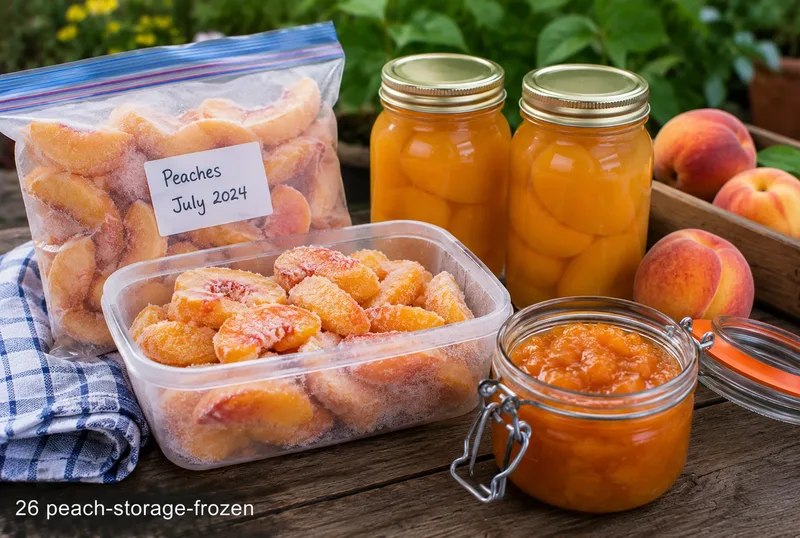
Peel, stone, and slice surplus peaches. Toss in lemon juice to prevent browning. Open freeze on a tray then bag. Use within 12 months. Peaches lose some of their texture but retain excellent flavour from frozen. Peach jam, peach chutney with ginger, and peaches in brandy all make outstanding preserves. Follow a tested recipe.
13 Expert Tips
💡 The lean-to shelter transforms results
A simple lean-to polythene shelter over a wall-trained peach — a timber frame attached to the wall, covered with 150 micron polythene, installed in December and removed in May — transforms the reliability of UK peach growing. It eliminates leaf curl, protects early flowers from frost, and is a one-off construction that lasts many years. This single addition is the difference between a struggling tree and a productive one.
💡 Peregrine for white flesh, Rochester for yellow
The flavour difference between white-fleshed (Peregrine, Duke of York) and yellow-fleshed (Rochester, Garden Lady) peaches is real and significant. White-fleshed peaches have a softer, more fragrant, wine-like flavour. Yellow-fleshed varieties are juicier and more robust. Grow both for a contrast — Peregrine ripens in late July, Rochester in mid-August.
💡 Container peaches in the greenhouse
A genetic dwarf peach variety (Garden Lady, Bonanza) in a 75-litre container in an unheated greenhouse produces a reliable, heavy crop with none of the complication of rain shelters or hand pollination — the greenhouse environment protects naturally and early warmth advances the flowering season when bees may still be present from autumn. A winter greenhouse peach on the patio is one of the most rewarding container fruit growing options.