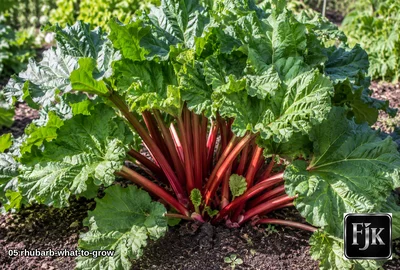
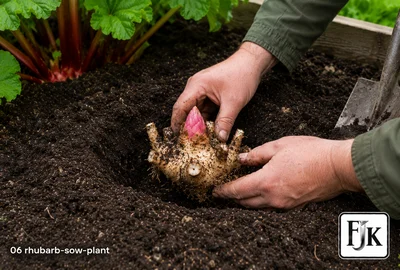
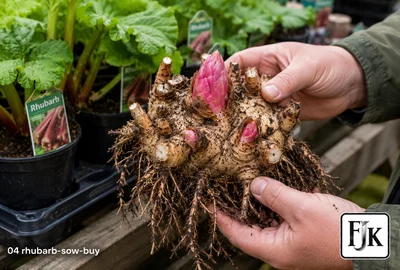
Plant divisions (crowns) October–March in a permanent, sunny spot with rich, deeply dug soil
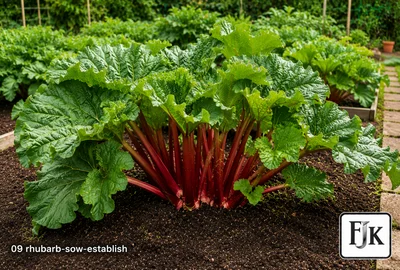
Do not harvest in the first year — let the plant establish fully; light harvest only in year two
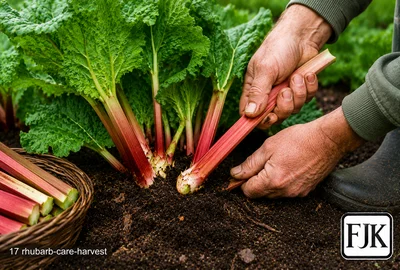
Pull stalks with a twisting motion rather than cutting — pulling is cleaner and reduces disease entry
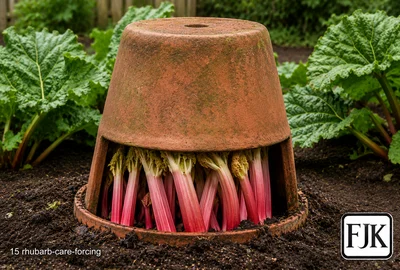
Force early stems by covering the crown with a bucket or forcing pot in January for tender, sweet pale stalks 4–6 weeks earlier
Stop harvesting by mid-June to allow the plant to rebuild energy for next year
🌱 SowPlant crowns Oct–Nov or Mar–Apr
🌾 HarvestMar–Jun
☀ PositionFull sun or light shade
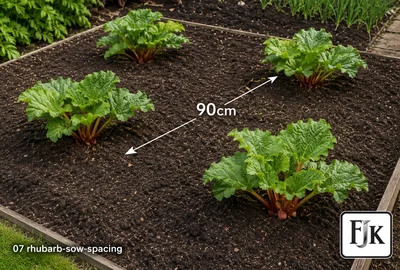
📐 Spacing90cm
DifficultyEasy
⚡ Quick facts
Sow
Plant crowns Oct–Nov or Mar–Apr
Plant
Oct–Nov (best) · Mar–Apr (also good)
Harvest
Feb–Mar (forced) · Apr–Jun (natural)
Position
Full sun or light shade
Spacing
90cm between crowns
Height
60–100cm (stalks) · 1.2–1.5m (leaves)
Hardiness
Fully hardy — crowns survive severe frost
Lifespan
20+ years
Difficulty
Easy
01 About
Botanically a vegetable but used entirely as a fruit, rhubarb is the first harvest of the year and one of the most welcome. In a garden with a forcing pot and a good variety, stalks can be pulled as early as February — months before any other fresh fruit is available. Plant once and harvest for 20 years with almost no effort beyond division every 5–6 years.
02 Varieties
The number of varieties shown for each crop is based on UK consumption data (2025/26) — the more popular the crop, the more variety choices we include.
Early Season
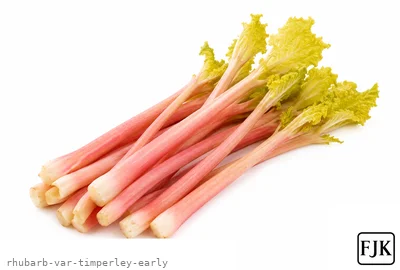
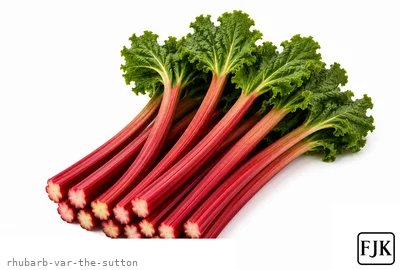
Timperley Early
Early · Excellent for forcing
The earliest and most commonly grown forcing rhubarb. The benchmark variety for anyone who wants to force rhubarb. Responds extremely well to forcing and can produce stalks as early as February under a forcer. Lighter pink colour than later varieties. AGM.
Harvest
Feb–May
Flavour
Mild, sweet when forced · Sharper unforced
Fruit size
Medium · Slender
Yield
High
Disease resistance
Good
🏅 AGM
✓ Self-fertile
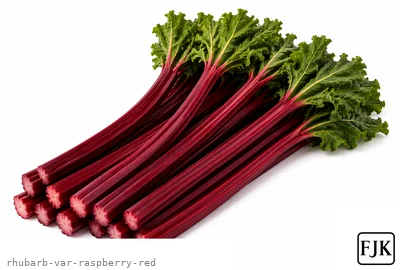
Raspberry Red
Early–mid
Produces very bright red stalks with good colour throughout their length — many varieties are only red on the outside. Mild, pleasant flavour. Early to mid-season. Good for forcing. A popular choice for those who want consistently red-coloured stalks for visual appeal in puddings and preserves.
Harvest
Mar–Jun
Flavour
Sweet, mild, pleasant
Fruit size
Medium · Very red
Yield
High
Disease resistance
Good
🏅 AGM
✓ Self-fertile
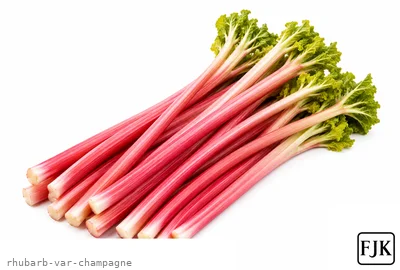
Champagne
Early
Produces slender, bright red stalks with a noticeably sweeter, more delicate flavour than most varieties. Early season. Less vigorous than Victoria or Stockbridge Arrow but the superior flavour makes it a favourite for eating fresh and for cordial making.
Harvest
Mar–Jun
Flavour
Sweet, mild, delicate
Fruit size
Slender · Elegant
Yield
Moderate
Disease resistance
Good
✓ Self-fertile
Maincrop
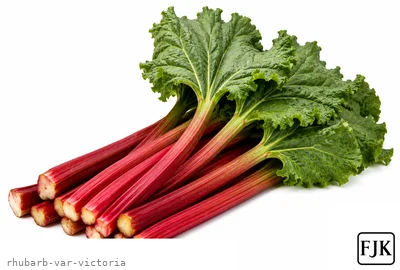
Victoria
Mid-season · Classic
The classic, most widely grown rhubarb variety in the UK — reliable, vigorous, very heavy cropping, and well-suited to all regions. Thick, substantial stalks with good flavour. The benchmark variety for productivity. The default choice for any garden.
Harvest
Apr–Jun
Flavour
Classic sharp-sweet rhubarb
Fruit size
Large · Thick
Yield
Very high
Disease resistance
Excellent
✓ Self-fertile
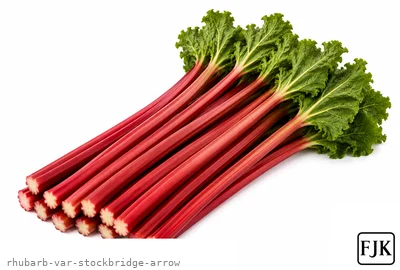
Stockbridge Arrow
Mid-season
Thick, deeply coloured stems with excellent flavour and very heavy yields. One of the best all-round maincrop varieties for the domestic garden. Good disease resistance and vigour. The deep red colour is retained in cooking, making it particularly attractive for jams and desserts.
Harvest
Apr–Jun
Flavour
Rich, classic, good depth
Fruit size
Large · Thick · Deep red
Yield
Very high
Disease resistance
Very good
✓ Self-fertile
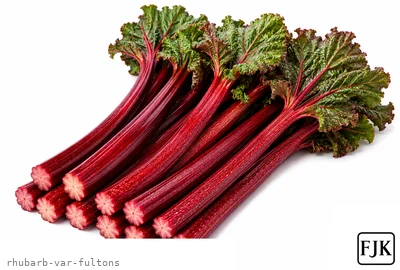
Fulton's Strawberry Surprise
Mid-season
An unusual variety with distinctly sweet, mild flavour with strawberry undertones — quite different from the sharp character of most rhubarb. Very popular where a sweeter, less acidic rhubarb is preferred. Good vigour. The name is entirely accurate — the flavour is genuinely reminiscent of strawberry.
Harvest
Apr–Jun
Flavour
Unusually sweet, strawberry-like
Fruit size
Medium-large
Yield
High
Disease resistance
Good
🏅 AGM
✓ Self-fertile
Late & Perpetual
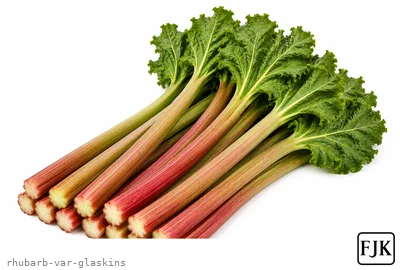
Glaskin's Perpetual
Long season · Late
One of the only rhubarb varieties that can be harvested through July and into August — significantly extending the season beyond the usual June cutoff. Milder flavour than most varieties. Can be raised from seed (unusual for rhubarb). The extended season is the primary virtue.
Harvest
Apr–Aug
Flavour
Mild, less acidic
Fruit size
Medium
Yield
High
Disease resistance
Good
✓ Self-fertile
Poulton's Pride
Long season · Early to late
A long-season variety that produces sweet, red-flushed stalks from early spring and, with light picking, keeps cropping well into late summer — one of the longest-cropping rhubarbs available. Vigorous and reliable once established. A good choice if you want rhubarb little and often over many months rather than one big spring flush. Do not pull any stalks in the first year after planting.
Harvest
Mar–Sep
Flavour
Sweet, mild
Fruit size
Medium
Yield
High
Disease resistance
Good
✓ Self-fertile
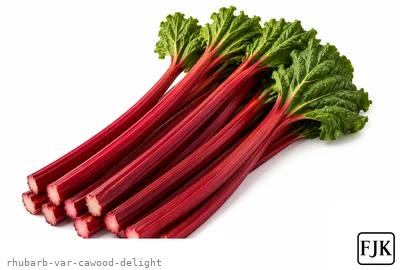
Cawood Delight
Mid-season
A newer variety with very deep red colouration throughout the stalk and excellent rich flavour. Developed in Yorkshire. Vigorous and productive. The outstanding colour — deeper red than most varieties — makes it particularly attractive for preserves and desserts where visual impact matters.
Harvest
Apr–Jun
Flavour
Rich, sweet, excellent
Fruit size
Large · Deep red
Yield
High
Disease resistance
Good
✓ Self-fertile
03 Planting Options
🌿 In Open Ground
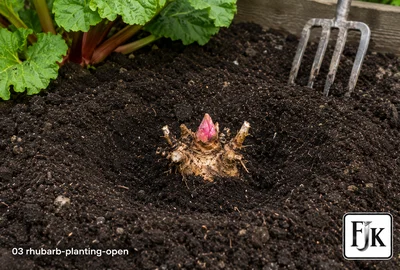
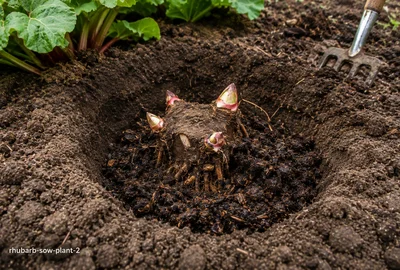
Rhubarb is a long-term, hungry perennial that will occupy the same ground for 20 years or more, so the planting hole deserves real investment: dig at least 60cm wide and 45cm deep and fill generously with well-rotted compost or manure — this preparation only happens once. Position the crown so the topmost pink growing bud sits just at or just below the soil surface, then leave it completely alone in its first full growing season; pulling stalks too early weakens the crown for years afterwards. Remove any flower stems the moment they appear, and mulch generously with compost or manure each spring to keep the crown vigorous for decades of harvests.
Prepare a generous planting hole
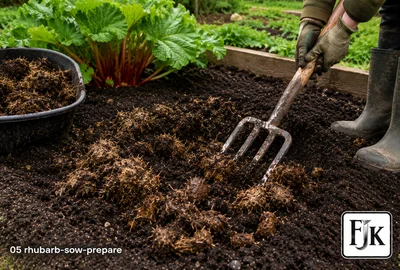
Rhubarb is a long-term, hungry perennial. Dig a hole at least 60cm wide and 45cm deep. Fill with a generous quantity of well-rotted compost or manure — the richer the planting, the better the long-term yield. This preparation only happens once in 20 years, so do it thoroughly.
Plant crowns at the correct depth
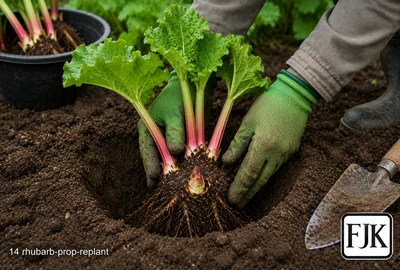
Position the crown so that the topmost pink growing bud is just visible at or just below the soil surface — no more than 2–3cm deep. Too deep and the bud rots; too shallow and the crown dries out. Firm gently around the roots and water in well.
Leave completely alone in year one
Do not pull a single stalk in the first full growing season after planting. This year of establishment allows the root system to develop to a size that will support decades of productive harvesting. Pulling stalks in year one significantly shortens the productive life of the plant.
Remove flower stems immediately
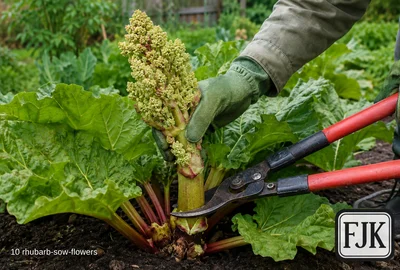
Any flower stems that emerge — tall, branching structures quite different from the leaf stalks — must be cut out at the base immediately they appear. Allowing a plant to flower and set seed exhausts the crown and dramatically reduces next year's yield. Do this every year for the life of the plant.
Mulch generously in spring
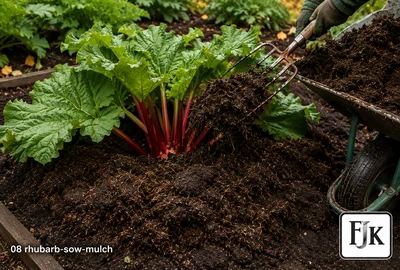
Apply a thick mulch of well-rotted compost or manure around the crown each spring, keeping it clear of the growing buds. This feeds the plant, retains moisture, and suppresses weeds for the full growing season.
04 Companion Planting
✅ Grow nearby
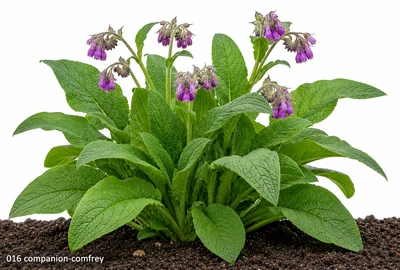
🌿 Comfrey
Deep roots mine nutrients from the subsoil; cut leaves make an excellent potassium-rich mulch.
Most vegetables grow well in proximity, benefiting from the general growing conditions.
05 Sowing — How To
Buy named variety crowns
Always buy named variety crowns rather than unnamed plants. Named varieties have predictable stalk colour, flavour, and season length. Avoid raising rhubarb from seed — seed-raised plants are variable and many produce inferior green stalks.
Plant Oct–Nov for best results
Autumn is the best planting time — crowns establish through winter and are ready to grow strongly the following spring. March–April planting also works but produces a slightly less vigorous first growing season.
One crown is usually enough
A single well-grown rhubarb crown produces a huge quantity of stalks. Two or three crowns provide enough for jam, crumbles, and freezing for a household. Space crowns 90cm apart in all directions.
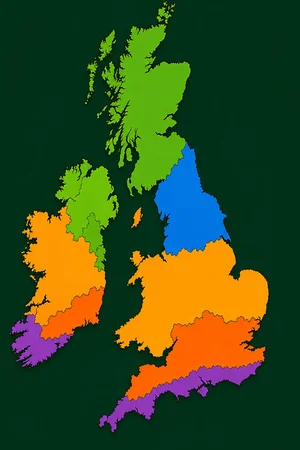
Regional sowing timing
Region
Sow / plant
Harvest
Notes
Scotland & Far North
Mar–Apr
Apr–Jun
Northern England
Mar–Apr
Apr–Jun
Midlands & Wales
Mar–Apr
Apr–Jun
Ireland & Isle of Man
Mar–Apr
Apr–Jun
South & SE England
Mar–Apr
Mar–Jun
South Coast & SW
Mar–Apr
Mar–Jun
06 Using a Propagator
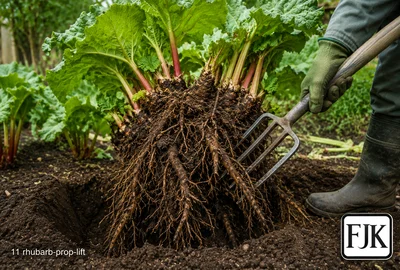
Rhubarb is propagated by dividing established crowns — a straightforward task done every 5–6 years. No propagator is needed. Division simultaneously renews the plant (which becomes less productive as it ages) and produces multiple new plants for free.
Heated propagator
Not Required — Rhubarb divides easily from established crowns without any heat or specialist equipment.
Lift the crown in autumn
In October–November, use a fork to lift the entire crown out of the ground. A well-established crown will be surprisingly large and heavy — lever carefully from multiple angles to avoid breaking roots unnecessarily.
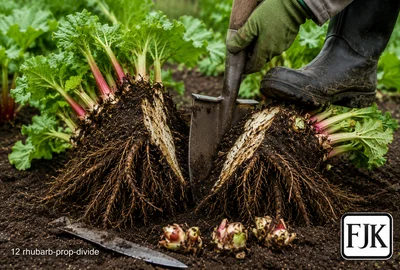
Divide with a sharp spade
Place the crown on firm ground and cut through it with a sharp spade. Each division needs at least one visible pink bud (growing point) and a generous portion of root. Divisions with 2–3 buds establish fastest.
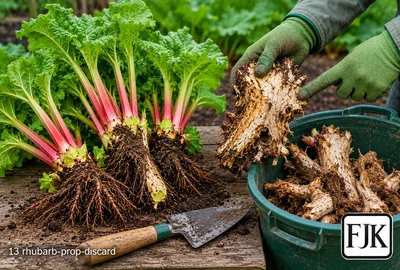
Discard the old centre
The central portion of an old crown is often exhausted and less productive. Replant only the vigorous outer sections. Compost the unproductive centre.
Replant immediately
Replant divisions in prepared ground at the correct depth (buds just at or just below soil surface) without delay. Water in and mulch. New plants will establish through winter and produce their first light harvest the following spring.
07 Soil Requirements
pH
5.5–6.8
Best
Loam, Clay loam
Tolerates
Sandy loam, Clay
Avoid
Waterlogged, Very poor
💡 Deep, rich soil preferred. Tolerates heavier soils if not waterlogged.
08 Ongoing Care
🫙 Forcing for Early Stalks
Forcing rhubarb is one of the most rewarding techniques in the kitchen garden. In late January or early February, place a large terracotta forcer, upturned dustbin, or thick black polythene dome over the crown to exclude all light. Forced stalks emerge pale pink to almost white, slender, very tender, and significantly sweeter than unforced stalks — the absence of light means the plant cannot produce the chlorophyll or oxalic acid that gives unforced rhubarb its sharp flavour. Stalks are ready to pull in 4–6 weeks, typically giving a harvest in February or March. Only force the same crown every other year — forcing exhausts the plant and alternate-year forcing allows full recovery.
🌹 Harvesting Correctly
Always harvest rhubarb by grasping the stalk firmly at the base and pulling with a gentle twisting motion — never cut. Cutting leaves a stub that rots and can introduce disease into the crown. Pull individual stalks selectively, always leaving at least 4–5 large healthy leaves on the plant at all times to maintain photosynthesis. In the natural season (April–June), harvest freely. Stop all harvesting completely in late June to allow the plant to build energy reserves through the remainder of summer for the following year's growth.
🌱 Annual Mulching & Feeding
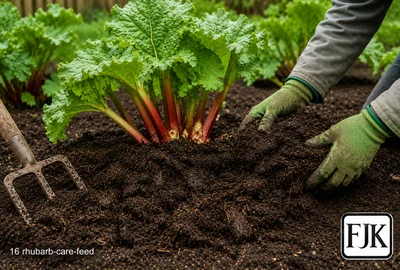
Each spring, as the first buds begin to swell, apply a generous mulch of well-rotted compost or manure around the crown in a wide circle. Keep the mulch clear of the growing buds themselves. This single annual treatment provides the nutrients, moisture retention, and weed suppression needed for a full season of productive growth. Rhubarb responds very well to generous organic feeding — the difference between a well-mulched and an unmulched crown in stalk production by midsummer is dramatic.
✂️ Flower Stem Removal
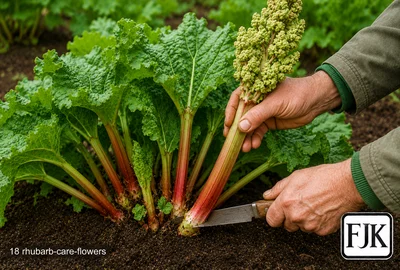
Rhubarb flower stems — tall, thick, branching structures topped with small cream-coloured flowers — must be removed the moment they appear, every year, without exception. A flowering rhubarb puts enormous energy into seed production that is irreplaceable as a resource for the following year's crown development. Cut the flower stem to the base using a sharp knife. Multiple flower stems may appear through the season — remove each one as it develops. If the urge to let one flower for ornamental reasons is strong, compromise by removing it before seed is set.
09 Watch Out For
Warning
Crown rot causes the crown to become soft and discoloured — remove and burn affected crowns, do not replant in the same site for at least 3 years. Honey fungus (Armillaria) attacks the crown and roots — look for black bootlace-like mycelium beneath the soil surface and white mycelium under the bark at the base. Remove and burn affected crowns. Slugs can damage emerging stalks in spring — use copper tape rings or nematode treatments around the crown base.
🐛 Insects & pests
🐌 Slugs & Snails — Silver slime trails on leaves, soil, and pots — often the first sign before damage is found
🐜 Aphids (Blackfly & Greenfly) — Curled, distorted, or stunted growing tips — aphids inject saliva that causes leaf curl to protect them
🪲 Vine Weevil — Irregular, rounded notches cut from leaf margins — the work of adult beetles feeding at night
🍄 Diseases to watch
🩶 Botrytis (Grey Mould) — Botrytis cinerea (grey mould) is the most ubiquitous fungal pathogen in temperate gardens — present in virtually every garden soil and on plant debris. It becomes a disease only when conditions favour it: cool, humid, poorly ventilated environments with damaged or senescent plant tissue. In a greenhouse in autumn it can destroy an entire tomato or grape crop.
⬜ Sclerotinia (White Mould) — Sclerotinia sclerotiorum causes a sudden, dramatic collapse of apparently healthy plants. It produces dense white cotton-wool-like mycelium and large black resting bodies (sclerotia) that persist in soil for up to 10 years. A single severely affected bed can remain a reservoir for re-infection for a decade.
Full identification and treatment advice is in the Pests and Diseases sections.
10 Storage & Preserving
🌹 Short-term Fresh
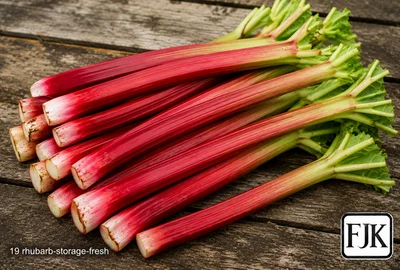
Freshly pulled rhubarb stalks keep for up to a week wrapped in damp newspaper in the refrigerator. Stalks deteriorate rapidly at room temperature and should be processed or refrigerated within hours of pulling. Forced rhubarb in particular should be used quickly — its delicate flavour diminishes rapidly after harvest.
❄️ Frozen
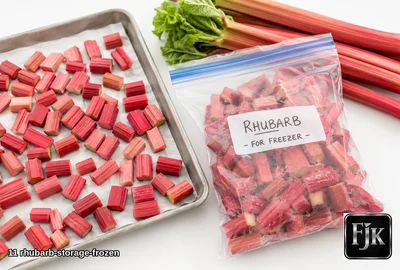
Rhubarb freezes exceptionally well and retains all its cooking quality from frozen. Wash, trim, and cut into 2–3cm pieces. Open freeze on a tray until solid, then bag. Alternatively, freeze as a purée (cooked with sugar) ready to use directly. Use within 18 months. Frozen rhubarb is ideal for crumbles, pies, compotes, and jam through winter and spring.
🫙 Jam, Chutney & Cordial
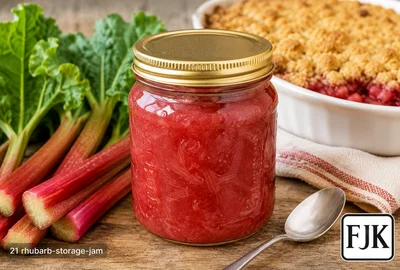
Rhubarb and ginger jam is a classic combination. Rhubarb chutney pairs extremely well with cheese and cold meats, and rhubarb cordial is a beautiful pink drink diluted with sparkling water. Follow a tested recipe.
11 Expert Tips
💡 The alternate-year forcing technique
Force one crown in year one, leave it unforced in year two while forcing a second crown, then return to the first in year three. This rotation allows each crown to fully recover between forcing years, maintaining productivity for decades. Never force the same crown two years in succession.
💡 Yorkshire forcing rhubarb
The Yorkshire Triangle (Rothwell, Morley, and Wakefield) is famous for its forced rhubarb, grown in complete darkness in heated sheds producing bright pink, extraordinarily sweet stalks in the depths of winter. The same principle applies in the garden — complete darkness is the key to the palest, sweetest, most tender forced stalks.
💡 Rhubarb as ground cover
The vast leaves of established rhubarb plants make them excellent ground cover for suppressing weeds in areas between other fruit crops. The ornamental value of the large architectural leaves and vibrant red stalks in spring is considerable — rhubarb earns its place in a well-designed kitchen garden on aesthetic grounds alone.