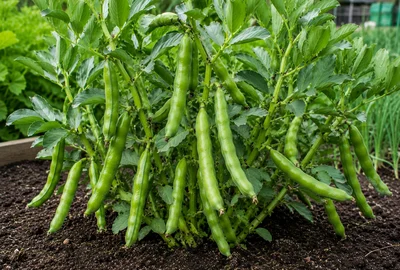
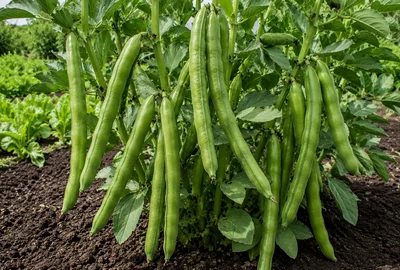
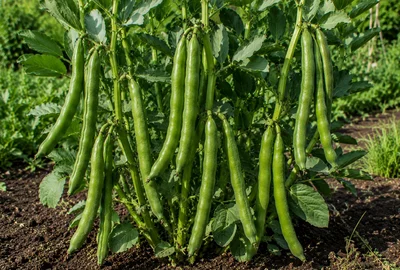
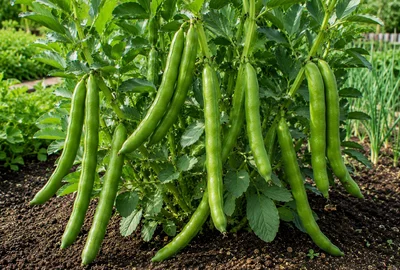
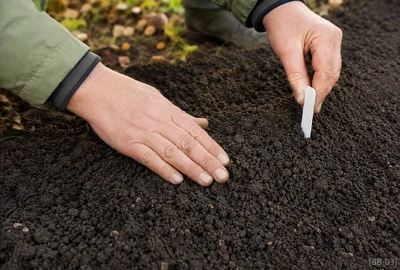
Sow direct outdoors Oct–Nov (autumn) or Feb–Apr (spring) at 5cm depth
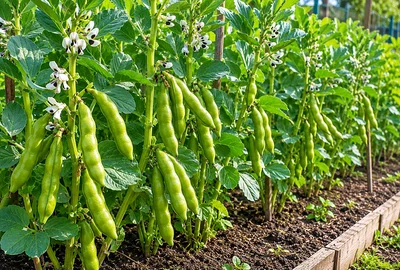
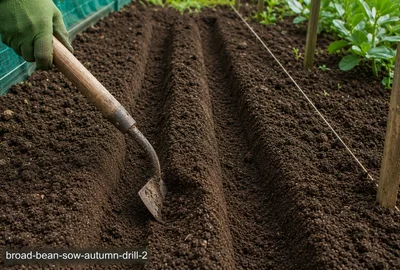
Sow in double rows 20cm apart — staggered seeds for best use of space
No indoor heat needed — broad beans are fully hardy and prefer cool conditions
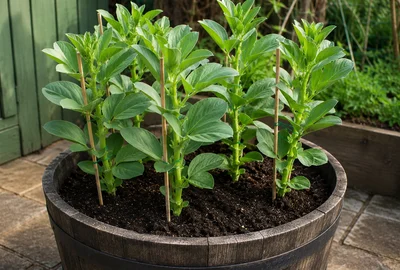
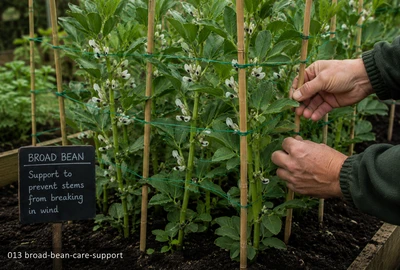
Support with canes and string at 30cm and 60cm height as plants grow
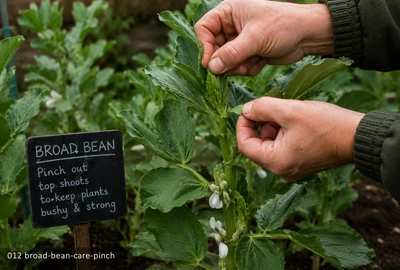
Pinch out growing tips when first pods set — removes blackfly and boosts yield
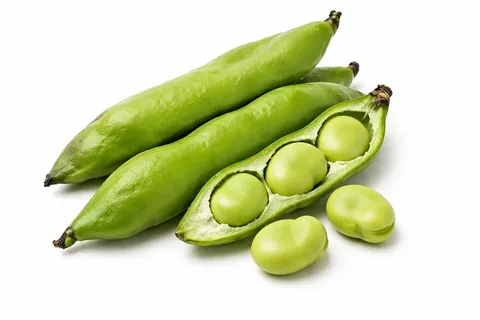
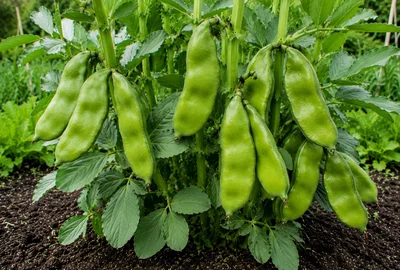
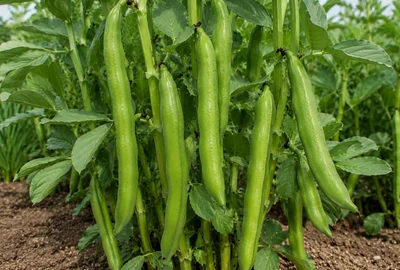
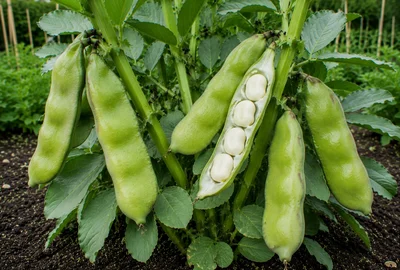
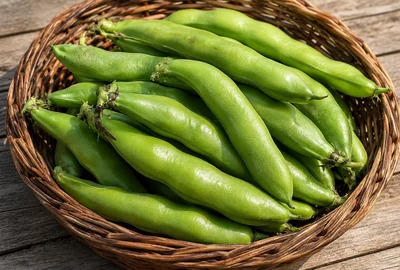
Pick pods when well-filled but before the scar on each bean turns dark
Leave roots in the ground after harvest — they fix nitrogen for the next crop
🌱 SowOct–Nov (autumn) or Feb–Apr (spring indoors)
🌾 HarvestMay–Jul (autumn) / Jun–Aug (spring)
☀ PositionFull sun or light shade
📐 Spacing20–25cm
DifficultyEasy
⚡ Quick facts
Difficulty
Easy
Crop type
Hardy Annual
Position
Full Sun or Light Shade
Soil
Deep, Fertile, Well-Drained
Container friendly
Dwarf varieties in large deep containers
Greenhouse recommended
No — cold hardy outdoors
Outdoor suitable
Yes — all UK regions
Frost hardy
Yes — very hardy (autumn sowings to -10°C)
01 About
Broad beans are the first real harvest of the kitchen garden year — a promise that the season has truly arrived. Autumn-sown plants overwinter as sturdy, frost-hardened seedlings and crop four to six weeks earlier than spring sowings, with heavier yields and better drought resistance. Spring sowings under cover extend the choice of varieties and allow a second flush of pods into August. The flavour of freshly picked broad beans — especially young ones eaten pod-and-all when tiny — is in a completely different class from anything bought in a shop. Double-podded and eaten straight from the garden, they are one of the great pleasures of growing your own.
02 What to Grow
Broad beans fall into four distinct groups. Dwarf varieties reach only 30–45cm — ideal for exposed plots and containers, requiring no staking. Longpod varieties are the workhorses: long pods with 8–10 beans each, heavy yields, and the best autumn hardiness — Aquadulce Claudia is the classic. Windsor varieties are shorter and stockier with fewer, larger beans per pod — richer flavour but less frost hardy, best sown in spring. Coloured and heritage varieties include the crimson-flowered Crimson Flowered (one of the most ornamental vegetables you can grow), the red-seeded Red Epicure, and the pink-seeded Karmazyn — all with outstanding individual character.
03 Varieties
The number of varieties shown for each crop is based on UK consumption data (2025/26) — the more popular the crop, the more variety choices we include.
🌱 Dwarf
Compact plants 30–45cm tall. No staking required. Ideal for containers, exposed plots, and windy sites.
Bonny Lad
Dwarf · Short Pod
A compact, bushy dwarf broad bean reaching about 40–45cm. Branches freely and carries plenty of short pods, each holding 4–5 beans. No staking needed. Sow Feb–Apr, or Oct–Nov under cover; ideal for containers and exposed gardens.
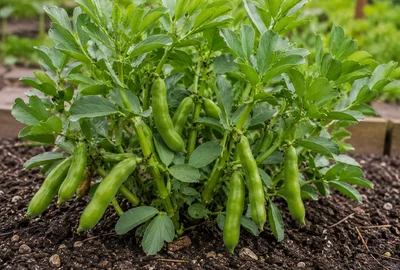
Dwarf
No Stake
Container
Compact
Robin Hood
Dwarf · Short Pod
Very similar to Bonny Lad but slightly more compact. Reliable and uniform. Excellent for raised beds and containers where height is a concern. Good yield for its size.
AGM
Dwarf
No Stake
Container
Compact
Masterpiece Green Longpod
Dwarf · Long Pod
Unusually long pods for a dwarf variety — up to 30cm. Plants reach 45cm. Good yield of well-filled pods with 7–8 beans each. AGM holder. Best of both worlds.
AGM
Dwarf
Long Pod
High Yield
📏 Longpod
The classic tall broad bean. Long pods with 8–10 beans. Best autumn hardiness. Heavy yields. The backbone of the kitchen garden.
Aquadulce Claudia
Longpod · Autumn Hardy
The definitive autumn-sowing broad bean. Exceptional frost hardiness, long pods with up to 9 beans each, and outstanding reliability. The first choice for October sowing across all UK regions. AGM holder.
AGM
Autumn Sow
Frost Hardy
Classic
Imperial Green Longpod
Longpod · Spring/Autumn
Tall, vigorous plants producing very long pods — up to 38cm — with 8–9 large, bright green beans. Heavy cropper. Suitable for both autumn and spring sowing. AGM holder. Excellent for freezing.
AGM
Long Pod
High Yield
Freezing
Express
Longpod · Early Spring
One of the earliest-maturing broad beans — ready 12–14 weeks from spring sowing. Long, well-filled pods. Good for impatient gardeners who want the earliest possible spring harvest from an indoor sowing.
AGM
Early
Spring Sow
Fast Maturing
🏆 Windsor
Shorter, stockier plants. Fewer but larger beans per pod. Richer, sweeter flavour. Best for eating fresh rather than freezing.
Bunyard's Exhibition
Windsor · Heritage
One of the finest heritage broad beans. Stocky plants with short, fat pods containing 4–5 very large beans. Rich, deep flavour — considered by many to be the best-tasting broad bean available. Spring sow only.
Heritage
Windsor
Flavour
Green Windsor
Windsor · Classic
The standard Windsor type. Short pods, 4–5 large beans per pod. Compact plants reaching 60–75cm. Excellent fresh flavour. Best eaten young before the skins toughen. Spring sow only.
Windsor
Classic
Fresh Eating
White Windsor
Windsor · Heritage
Heritage Windsor with distinctive cream-white seeds rather than the typical green. Mild, sweet flavour. Compact plants. Slightly less common than Green Windsor but worth growing for its appearance and taste.
Heritage
Windsor
White Seed
Mild
🎨 Coloured & Heritage
Ornamental varieties with vivid flowers or coloured seeds. Outstanding individual character.
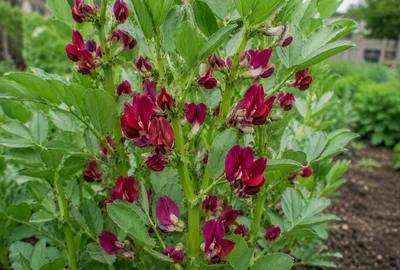
Crimson Flowered
Heritage · Ornamental
The most ornamental broad bean — vivid crimson flowers instead of the usual black-and-white. An 18th-century heritage variety rescued from near extinction. Shorter pods with 3–5 beans. Grows to 90cm. Flowers are edible.
Heritage
Crimson Flower
Ornamental
Red Epicure
Heritage · Red Seed
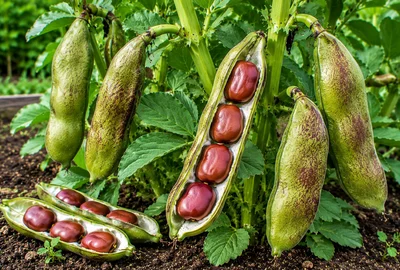
Striking deep red seeds that turn brown on cooking. Sweet, rich flavour — one of the best-tasting broad beans. Plants grow to 90cm with standard longpod-style pods. The red colour fades with blanching but remains in raw preparations.
Heritage
Red Seed
Flavour
Unusual
Karmazyn
Heritage · Pink Seed
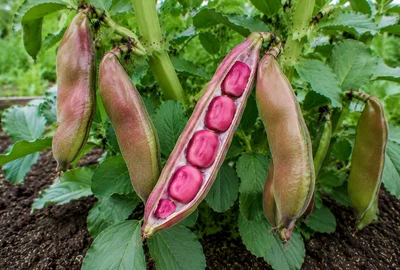
Polish heritage variety with distinctive pink-red seeds. Rich, earthy flavour. Vigorous plants reaching 120cm. Pods similar to longpod type. Rare and worth seeking out — a genuinely different broad bean with outstanding character.
Heritage
Polish
Pink Seed
Rare
04 Where to Source
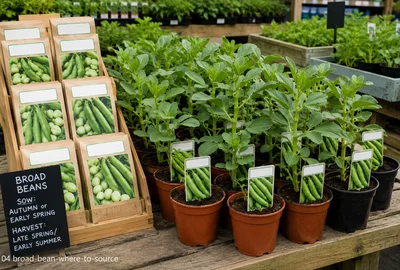
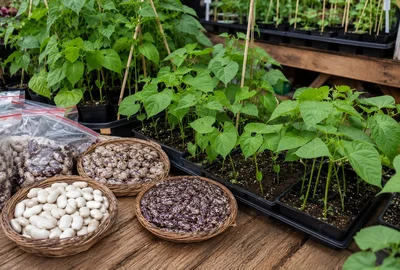
Broad bean seeds are widely available from all major UK seed suppliers from late summer onwards — look for Aquadulce Claudia as the autumn sowing standard. For coloured and heritage varieties, specialist seed suppliers and heritage seed libraries are the best sources for Crimson Flowered, Karmazyn, and Red Epicure. Most garden centres stock a limited range of plug plants in spring for those who miss the sowing window.
📬 Seeds by Post
Online specialist seed companies offer the widest variety selection including coloured-seed heritage varieties, dwarf types, and autumn-hardy longpods unavailable in garden centres. Order from August for autumn sowing.
🏪 Garden Centres
Convenient for standard varieties such as Aquadulce Claudia and Bonny Lad. Stocks from September for autumn sowing, and from February for spring.
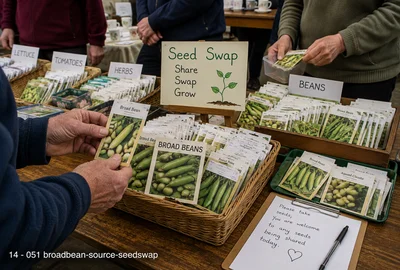
🌱 Seed Swaps
Broad bean seeds stay viable for 3–4 years. Local seed swaps and heritage seed libraries are excellent sources for Crimson Flowered, Karmazyn, and other rare varieties.
Timing tip: Order seeds in January and February. Popular varieties sell out quickly. Garden centres and markets are a reliable backup from April onwards.
05 Planting Options
🌱 Open Ground
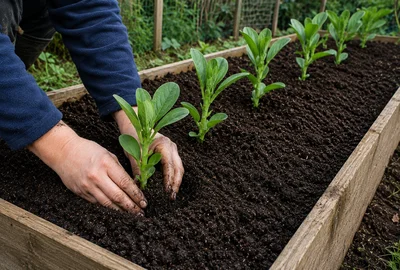
The standard method for both autumn and spring sowings. Prepare a deep, fertile bed. Sow seeds 5cm deep, 20–25cm apart in double rows 20cm apart, with 45cm between double rows. Autumn sowings (October to November) produce the earliest crop — plants overwinter and crop from May. Spring direct sowings (March to April) crop from late June. Support tall varieties with canes and string when plants reach 30cm.
Suitable varieties: All varieties. Longpod varieties particularly suited to autumn direct sowing. Dwarf varieties need no support.
🪵 Raised Bed
Raised beds with deep, well-drained compost-rich soil are excellent for broad beans — the improved drainage prevents waterlogging in wet winters, which is the main cause of autumn sowing failure. Sow at the same spacing as open ground. The warmer, friable soil in raised beds also speeds spring germination. Tall varieties still need support — push canes in at each corner and run string around the row at 30cm and 60cm.
Suitable varieties: All varieties. Raised beds particularly benefit autumn sowings by improving winter drainage.
🪣 Container / Large Pot
Dwarf varieties grow well in large deep containers — a minimum depth of 30cm. Use a rich, free-draining compost. Plant 3–4 seeds per large pot or 1 per 15cm container at 5cm depth. Water regularly as containers dry out faster. Dwarf varieties (Bonny Lad, Robin Hood) are self-supporting and ideal for exposed balconies and patios.
Suitable varieties: Dwarf varieties only — Bonny Lad, Robin Hood, Masterpiece Green Longpod. Avoid tall longpod varieties in small containers.
06 Companion Planting
✅ Grow nearby
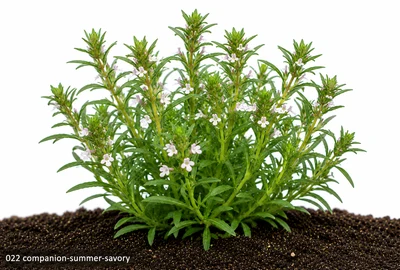
🌿 Summer Savory
Traditionally grown alongside all beans — said to improve flavour and deter blackfly. A reliable companion in the kitchen garden.
Broad beans follow brassicas well in the rotation. The nitrogen left by the bean roots benefits the following brassica crop the next year.
❌ Keep apart
🧅 Onions — Alliums inhibit the growth of all legumes including broad beans. Maintain strict rotation and keep alliums and legumes in separate beds.
🧄 Garlic — Garlic root secretions stunt legume growth. Never follow broad beans with garlic in the same bed without rotating.
🌿 Fennel — Fennel is allelopathic and inhibits the development of most vegetables including broad beans. Grow fennel in an isolated bed.
07 Sowing — How To
🍂 Autumn Direct Sow — Outdoors
Prepare the drill
Use a draw hoe or trowel to create a flat-bottomed drill 5cm deep and about 8cm wide. A double-row drill works well — make two parallel drills 20cm apart. Broad beans like firm, fertile soil. Avoid freshly manured ground which promotes leafy growth at the expense of pods.
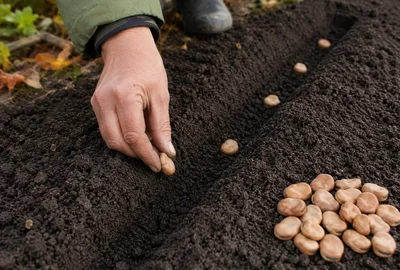
Place seeds
Space seeds 20–25cm apart in the drill, in a staggered double row. Each seed should sit flat. Handle seeds carefully — the white scar (hilum) can be damaged by rough treatment. Push each seed down firmly so it contacts the base of the drill.
Cover and firm
Rake soil back over the seeds and firm with the back of the rake or your foot. The drill should be filled level with the surface. Water in well. Label clearly with variety and date. Mice can be a problem — a layer of fine mesh over the row for the first few weeks helps.
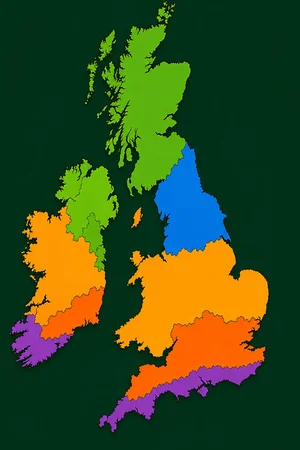
Autumn Direct Sow — Outdoors — regional timing
Region
Sow / plant
Harvest
Notes
Scotland & Far North
—
Jul–Aug
Not recommended
Northern England
Oct–Nov
Jun–Aug
Oct–Nov
Midlands & Wales
Oct–Nov
May–Aug
Oct–Nov
Ireland & Isle of Man
Oct–Nov
Jun–Aug
Oct–Nov
South & SE England
Oct–Nov
May–Jul
Oct–Nov
South Coast & SW
Oct–Nov
May–Jul
Oct–Nov
🌡️ Spring Indoor Sow — Pots
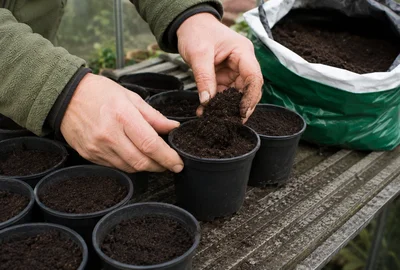
Fill pots with compost
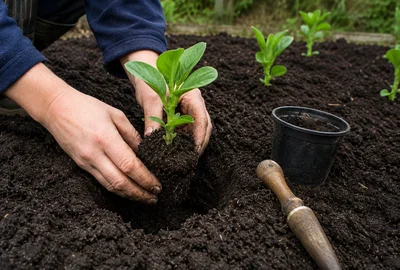
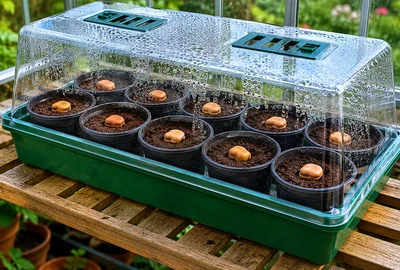
Use 7–9cm pots filled with general-purpose or seed compost. One seed per pot. Broad beans have large seeds and develop a strong tap root — deep pots are better than modules. Fill to within 2cm of the rim and firm lightly.
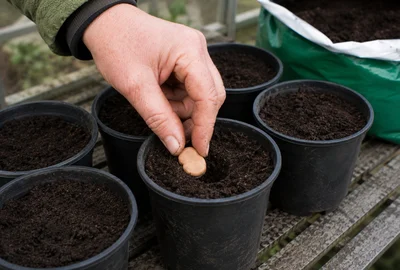
Press seed into compost
Push one seed 5cm deep into the centre of each pot. The white hilum scar can face any direction. Firm the compost back around the seed. Label each pot with variety name and date — different varieties look identical as seedlings.
Into propagator
Place pots in a cool, bright spot at 10–15°C — a cool windowsill, unheated porch, or cold greenhouse is ideal. Broad beans do not need high heat and will germinate at lower temperatures than most vegetables. Germination takes 7–14 days.
Grow on seedlings
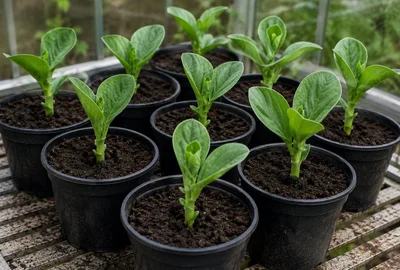
Once shoots appear, move to a bright, cool position. Broad beans grow better in cool, bright conditions than on a warm windowsill. Grow on until 8–10cm tall, then harden off for 7–10 days before transplanting outside.
Spring Indoor Sow — Pots — regional timing
Region
Sow / plant
Harvest
Notes
Scotland & Far North
Mar–Apr
Jul–Aug
Mar–Apr
Northern England
Feb–Mar
Jun–Aug
Feb–Mar
Midlands & Wales
Feb–Mar
Jun–Jul
Feb–Mar
Ireland & Isle of Man
Feb–Mar
Jun–Jul
Feb–Mar
South & SE England
Feb–Mar
May–Jul
Feb–Mar
South Coast & SW
Feb–Mar
May–Jul
Feb–Mar
08 Using a Propagator
Broad beans do not need high heat to germinate — they are cool-season hardy crops that prefer cool, moist conditions. Spring sowings can be started in individual pots indoors from February.
Heated propagator
A heated propagator is not needed and is counterproductive — broad beans prefer 10–15°C, not the 20°C+ of a heated unit. A cool windowsill, unheated porch, or cold greenhouse is ideal. If you don't have any of these, a bright spot on an ordinary windowsill away from radiators works perfectly well.
Unheated propagator
An unheated propagator on a cool, bright windowsill is ideal for February and March indoor sowings — without one, individual 9cm pots on any bright windowsill give exactly the same result. Broad beans germinate in 7–14 days at cool temperatures without any additional warmth.
09 Soil Requirements
pH
6.0–7.5
Best
Loam, Clay loam, Clay
Tolerates
Sandy loam
Avoid
Waterlogged, Acid
💡 Tolerates heavier soils better than most crops. Fix nitrogen into soil.
10 Ongoing Care
🎋 Supporting
Tall longpod and Windsor varieties reach 90–120cm and will collapse in wind without support. Push canes in at each corner of the row and run string around the outside at 30cm and 60cm height. Do this when plants are 20–25cm tall before they begin to topple. Dwarf varieties (Bonny Lad, Robin Hood) are self-supporting and need no canes.
✂️ Pinching Out
When the first pods begin to set, pinch out the top 8–10cm of each plant. This removes the soft growing tip where blackfly colonies congregate most heavily and diverts the plant's energy into pod development. Pinched-out tips can be eaten — they have a mild beany flavour and are excellent wilted in butter.
💧 Watering
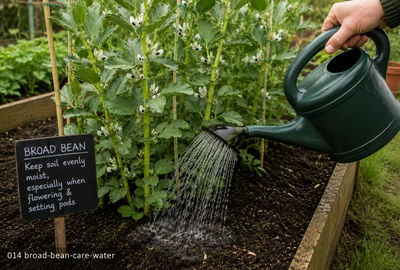
Broad beans need consistent moisture when pods are swelling. Water deeply once a week in dry weather. Autumn-sown plants rarely need watering until spring. Spring sowings in containers need more attention — check daily in warm weather and never let the compost dry out completely while pods are forming.
🐞 Blackfly
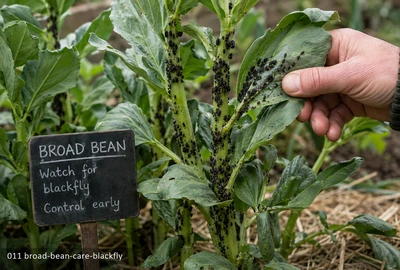
Blackfly (black bean aphid) colonies appear on growing tips and the undersides of leaves from May onwards. Pinching out tips removes the main infestation point. For established colonies, a strong jet of water removes most aphids. Encourage natural predators — ladybirds, lacewings, and hoverflies all feed on blackfly.
11 Watch Out For
Warning
Blackfly colonies congregate on growing tips from May onwards. Pinch out the top 8–10cm of each plant when the first pods set — this removes the main colonies instantly and diverts energy into pod development. Chocolate spot (brown blotches on leaves and stems) is a fungal disease encouraged by overcrowding and wet conditions — space plants adequately and improve air circulation.
🐛 Insects & pests
🐜 Aphids (Blackfly & Greenfly) — Curled, distorted, or stunted growing tips — aphids inject saliva that causes leaf curl to protect them
🐌 Slugs & Snails — Silver slime trails on leaves, soil, and pots — often the first sign before damage is found
🍄 Diseases to watch
🟠 Rust — Rust diseases are caused by a large family of obligate parasitic fungi, each specific to its host or a narrow range of hosts. Leek rust (Puccinia allii) is the most common in UK vegetable gardens, producing vivid orange pustules on leek leaves in summer and autumn. While rarely fatal, severe infections significantly weaken plants and reduce yields.
🩶 Botrytis (Grey Mould) — Botrytis cinerea (grey mould) is the most ubiquitous fungal pathogen in temperate gardens — present in virtually every garden soil and on plant debris. It becomes a disease only when conditions favour it: cool, humid, poorly ventilated environments with damaged or senescent plant tissue. In a greenhouse in autumn it can destroy an entire tomato or grape crop.
🌿 Fusarium Wilt — Fusarium wilt (Fusarium oxysporum) is a soil-borne vascular disease that invades root systems and blocks the water-conducting tissue of the plant. Infected plants die of internal drought even with adequate soil moisture. Different formae speciales (strains) target specific host plants — asparagus fusarium is different to tomato fusarium.
🌿 Mosaic Virus (TMV / CMV) — Tobacco mosaic virus (TMV) and Cucumber mosaic virus (CMV) are among the most widespread plant viruses affecting vegetable crops worldwide. TMV is extraordinarily stable — it can remain viable on contaminated hands and tools for years, and even survives in processed tobacco. There is no cure; infected plants must be destroyed.
Full identification and treatment advice is in the Pests and Diseases sections.
12 Storage & Preserving
🫛 Store in Pod (Short Term)
Freshly harvested broad beans keep best left in their pods. Store unwashed in the fridge for up to 5 days. The pods protect the beans and slow moisture loss. Shell only when ready to cook — shelled beans deteriorate faster.
🥣 Shelled — Refrigerator
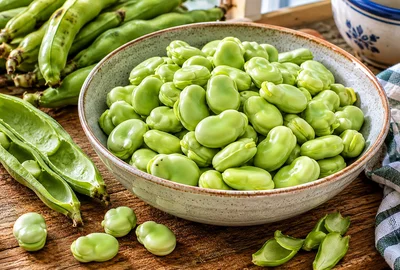
Shelled beans keep for 2–3 days in the fridge in a covered bowl or bag. For the very best flavour, double-pod them — slip the grey outer skin off each bean to reveal the vivid green interior. Double-podded beans are far sweeter and more tender, and worth the extra few minutes.
🧊 Freeze (Long Term)
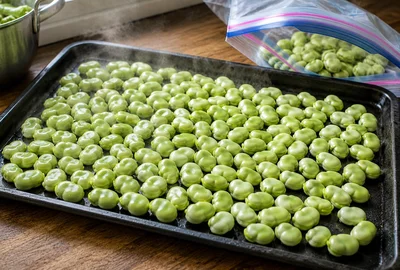
Broad beans freeze exceptionally well. Shell, blanch in boiling water for 2 minutes, drain, cool immediately in cold water, then open-freeze on a tray before bagging. Frozen broad beans retain excellent flavour and texture for up to 12 months. Double-pod after defrosting for the best result.
13 Expert Tips
💡 Pinching Out Tips
Pinch out the growing tips when the first pods begin to set — this removes the soft tip where blackfly colonies congregate and diverts energy into pod development. The pinched tips are edible and delicious wilted in butter.
💡 Autumn Sowing
Autumn-sown broad beans are significantly more productive than spring sowings — if your soil drains well, always sow in October or November. The overwintered plants develop a deeper root system and crop 4–6 weeks earlier with heavier yields.
💡 Harvest Young
Harvest pods young — when the beans inside are visible as bumps but before the scar on each bean turns dark. Young beans are sweeter and more tender than mature ones. Once the scar blackens, the bean becomes floury and loses its fresh flavour.
💡 Double Podding
Double-podding — slipping the grey outer skin off each shelled bean — transforms the flavour and texture. Ten minutes of work that makes a very significant difference to the eating quality, revealing the vivid green interior.
💡 Nitrogen Nodules
Leave the roots in the ground after harvest. The nitrogen-fixing root nodules break down slowly and release nitrogen that benefits the following brassica crop in the rotation.
14 Common Mistakes
⚠ Sowing & Timing
Sowing too late in autumn — October to early November is the window. Late November sowings in cold, wet soil often rot before germinating.
Not supporting tall varieties — longpod varieties reach 90–120cm and will collapse in wind without canes and string at 30cm and 60cm.
Sowing in waterlogged soil — autumn sowings in poorly drained ground rot over winter before they can establish.
⚠ Harvesting & Pest Control
Harvesting too late — pods left to mature fully become tough and floury. Pick when pods feel well-filled but beans are still vivid green inside.
Ignoring blackfly — colonies on growing tips multiply rapidly. Pinch out tips early and check undersides of leaves weekly from May.
Overwatering in pots — broad beans prefer cool, moist conditions but not waterlogged compost. Let pots dry slightly between waterings.