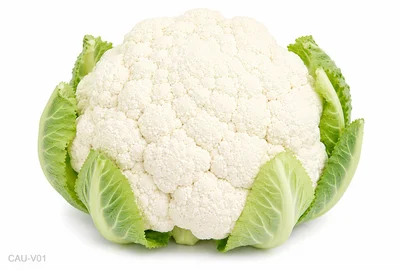
All Year Round
White
Most reliable all-purpose white cauliflower for UK conditions. Medium-sized firm curds from summer through to autumn. Compact enough for smaller plots.
- Reliable
- Beginners
Brassica oleracea (Botrytis)
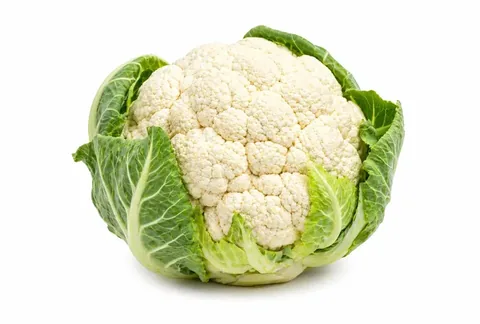
The most demanding of the brassicas, but a perfect white curd cut fresh from the garden is one of the great vegetable triumphs. Cauliflower demands consistency — steady moisture, firm soil, and no growth checks — but rewards that attention with a spectacular harvest. Modern varieties extend the season from June through to November, and coloured types including orange Cheddar, purple Graffiti, and lime-green Romanesco have transformed this classic vegetable into one of the most striking crops on the plot.
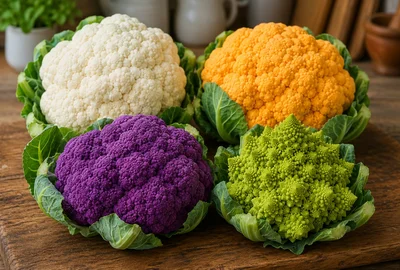
Standard white cauliflowers are the classic choice — summer types like Snowball mature in 12–16 weeks, autumn types like All Year Round give larger heads from August to November. Coloured varieties are increasingly popular: Cheddar produces vivid orange curds rich in beta-carotene; Graffiti and Violetta are striking purple; Romanesco produces extraordinary lime-green fractal spirals with a nutty flavour unlike any other brassica. All benefit from the same careful growing method — it is the attention to detail that differs, not the technique.
The number of varieties shown for each crop is based on UK consumption data (2025/26) — the more popular the crop, the more variety choices we include.
The classic choice. Summer and autumn types give a long harvest season from June to November.
Most reliable all-purpose white cauliflower for UK conditions. Medium-sized firm curds from summer through to autumn. Compact enough for smaller plots.
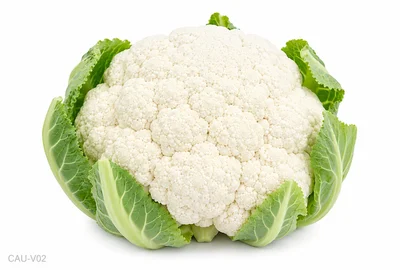
Classic compact summer type ready in 12–14 weeks from transplanting. Small, tight, pure white curds. One of the best for smaller gardens.
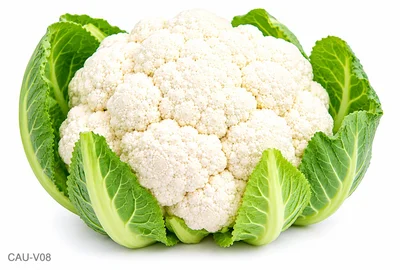
Reliable autumn cauliflower producing large, firm, very white heads from August to October. Strong outer leaves protect the curd from weather.
Orange, purple, and green varieties with striking appearance and distinctive flavour. Grown exactly like white types.
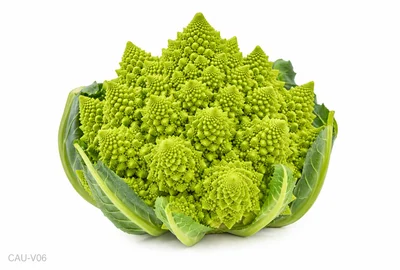
Extraordinary lime-green spiral fractal heads. Nutty, sweet flavour unlike any other brassica. Slightly more demanding — needs a long warm season. Worth every effort.
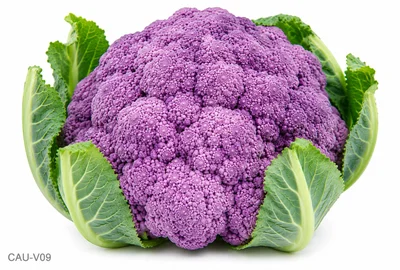
Vivid purple heads that retain colour when lightly cooked. Milder and sweeter than white types. Very reliable — one of the easiest coloured cauliflowers to grow well.
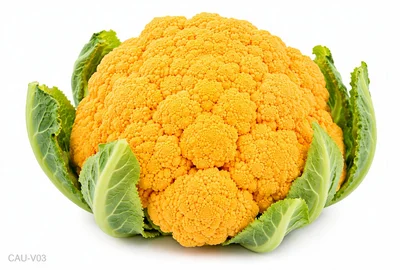
Bright orange curds rich in beta-carotene. Mild, slightly sweet flavour. Colour deepens on cooking. One of the most visually striking vegetables in the kitchen garden.
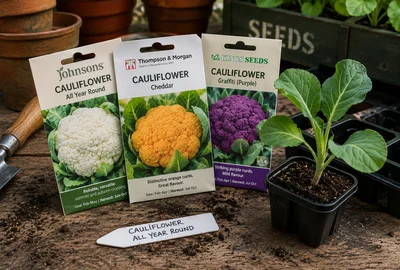
Cauliflower seed is available from all main online seed companies. The widest range of coloured varieties is found online — garden centres typically stock white types only. Plug plants appear in garden centres from March and market stalls from April. Buying plugs saves the most difficult early stage and is a very good option for a first attempt at this crop.
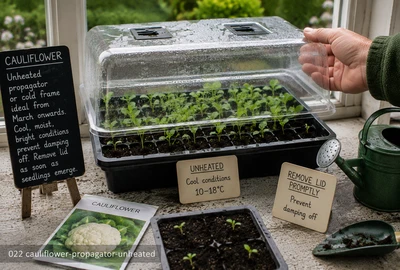
Always sow cauliflower in individual modules — root disturbance at transplanting causes an immediate growth check that can ruin curd quality. Sow one seed per module at 1cm depth. Germinate at 10–18°C in a cold frame or on a cool windowsill. Transplant carefully when plants have 4–5 true leaves. Firm in very well and water immediately.
Suitable varieties: All varieties.
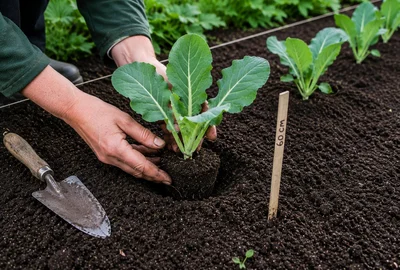
Garden centres sell cauliflower plug plants from March. Buying plugs bypasses the most difficult early stage and is an excellent option for a first attempt. Choose compact, sturdy plugs — not tall and drawn. Plant out immediately, firm in very well, and water thoroughly. Plugs establish quickly if planted carefully.
Suitable varieties: All varieties. Particularly recommended for beginners.
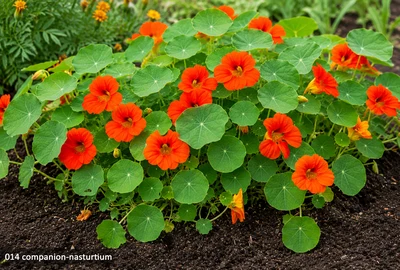
Nasturtiums attract aphids away from brassicas, acting as a sacrificial trap crop. Plant at the bed edges and they draw blackfly away from cauliflower.
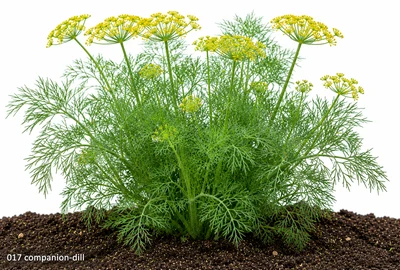
Dill attracts beneficial predatory insects that prey on caterpillars and aphids — two of the main cauliflower pests. Plant at the margins of the brassica bed.
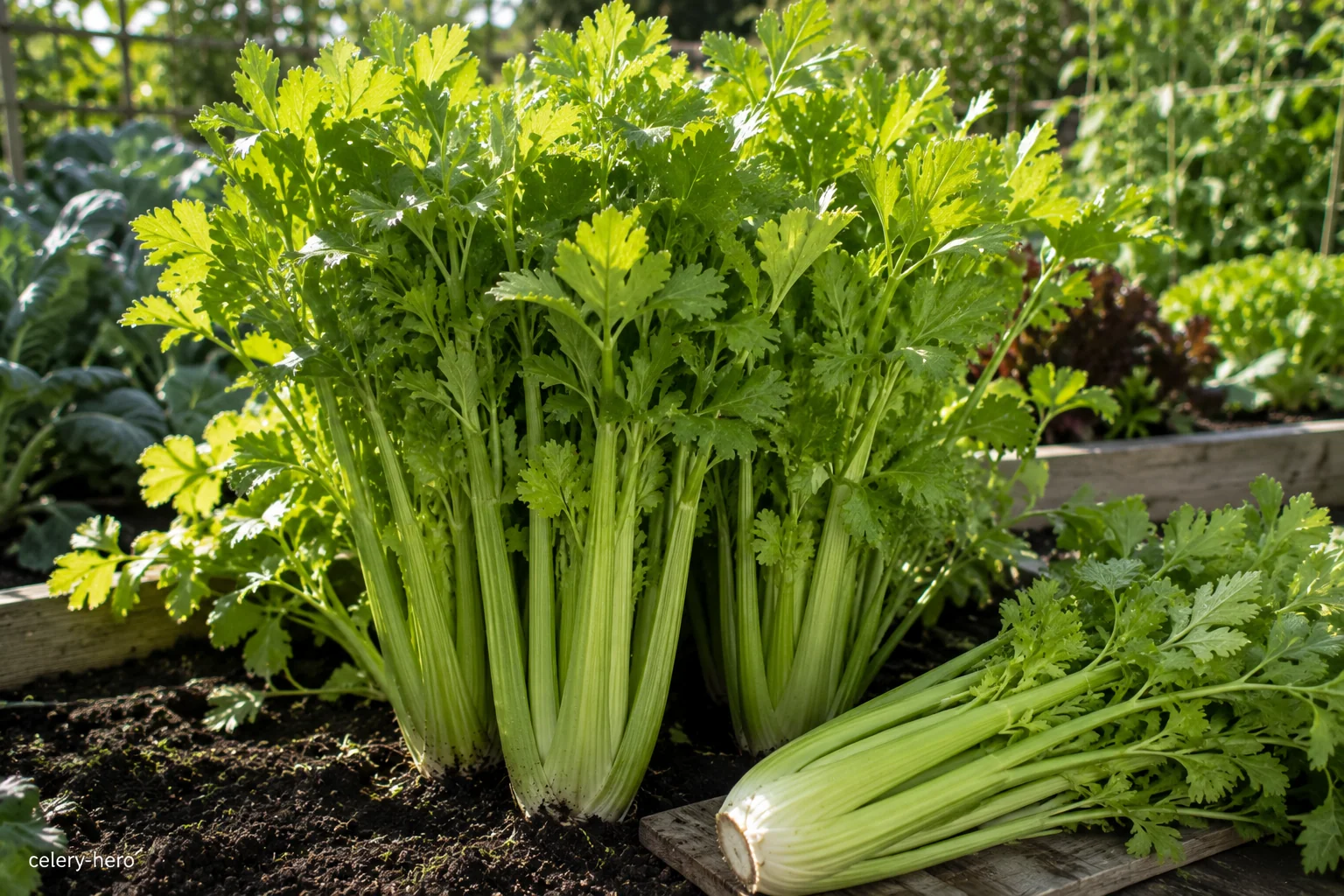
Celery is said to repel the white cabbage butterfly. Interplanting celery around brassicas is a traditional kitchen garden pest-deterrent combination.
Cauliflower is sensitive to root disturbance — always sow in modules rather than a seedbed, and transplant carefully before plants become pot-bound. Cool germination conditions produce the sturdiest transplants.
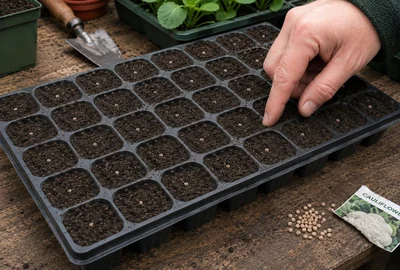
Fill modules with fresh seed compost. Sow one seed per cell at 1cm depth. Place in a cold frame or on a cool, bright windowsill at 10–18°C. No artificial heat needed — cauliflower prefers cool germination.
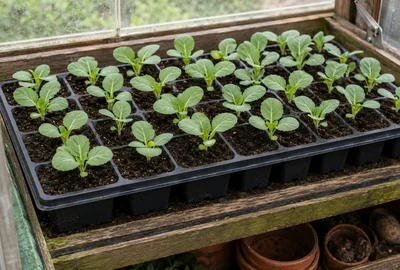
Keep compost evenly moist. Germination takes 7–12 days. Grow on at 10–15°C until plants have 4–5 true leaves. Do not allow to become pot-bound — pot-bound plants suffer an immediate growth check.
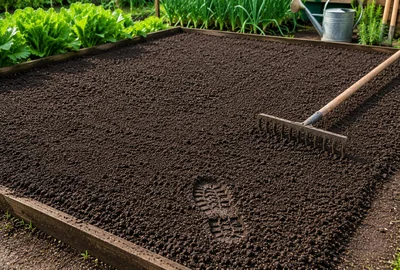
Tread the bed several times to firm it thoroughly. Add a general brassica fertiliser if the soil is light. Lime if pH is below 6.5. Cauliflower needs the firmest, most fertile soil of all brassicas.
Plant at 60cm spacing. Firm each plant in very well — press the soil down hard around the roots. Water in thoroughly. Disturb the roots as little as possible during planting — any damage causes a growth check.
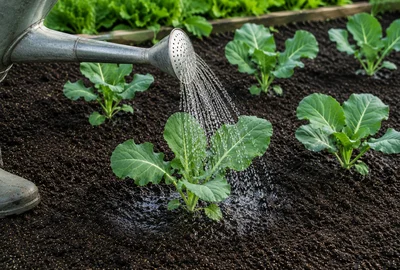
Cauliflower cannot tolerate any check in growth. Water deeply and regularly throughout the season. In dry spells, water every 2–3 days. Mulch around plants immediately after planting to retain moisture.
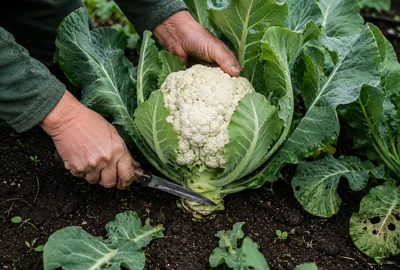
When the curd begins to form, snap or tie inner leaves over it to protect from sunlight and frost. Harvest when the curd is firm, white, and still tight — do not delay as quality deteriorates quickly.

| Region | Sow / plant | Harvest | Notes |
|---|---|---|---|
| Scotland & Far North | Apr–May | Jul–Sep | Sow under cover in April. Summer cauliflower only — autumn types may not mature before hard frosts. · Apr–May |
| Northern England | Mar–May | Jul–Oct | Sow under cover from March for summer crops. Autumn varieties suit this region well. · Mar–May |
| Midlands & Wales | Feb–May | Jun–Oct | February start under cover for early summer harvest. Autumn varieties reliable. · Feb–May |
| Ireland & Isle of Man | Feb–May | Jun–Oct | February start under cover for early summer harvest. Autumn varieties reliable. · Feb–May |
| South & SE England | Feb–May | Jun–Nov | Widest window. Successional sowings give harvests from June through to November. · Feb–May |
| South Coast & SW | Jan–May | May–Nov | January start under glass possible. Overwintering varieties suit milder SW winters. · Jan–May |
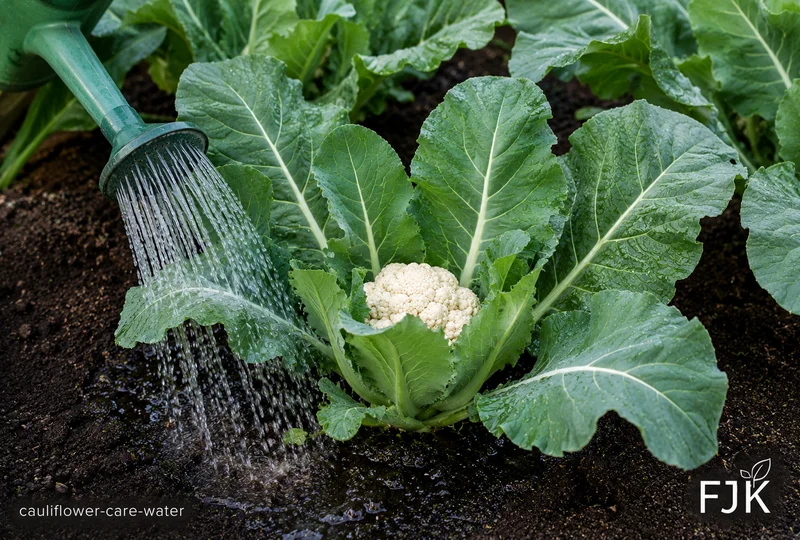
Water deeply and consistently — every 10 days in dry weather as a minimum, more frequently in summer. A single dry week can trigger irreversible bolting or curd failure. Apply a mulch of compost around plants immediately after planting to hold moisture and even out extremes. In a dry summer, cauliflower will need more attention than almost any other crop on the plot.
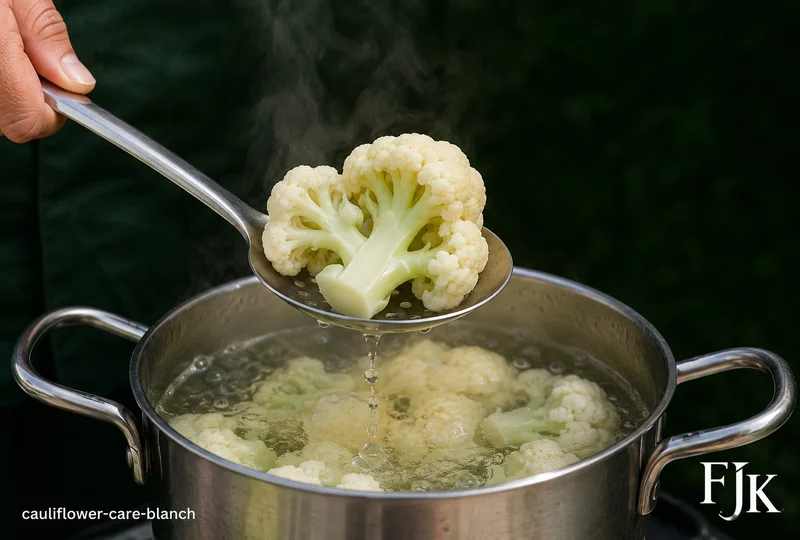
As soon as the curd reaches the size of a golf ball, bend the inner leaves over it and secure with a soft tie, rubber band, or clothes peg. This protects the developing curd from sunlight — which causes yellowing — and from frost damage in autumn. Check every few days and retie as the curd grows. Blanching is not optional for quality white curds.
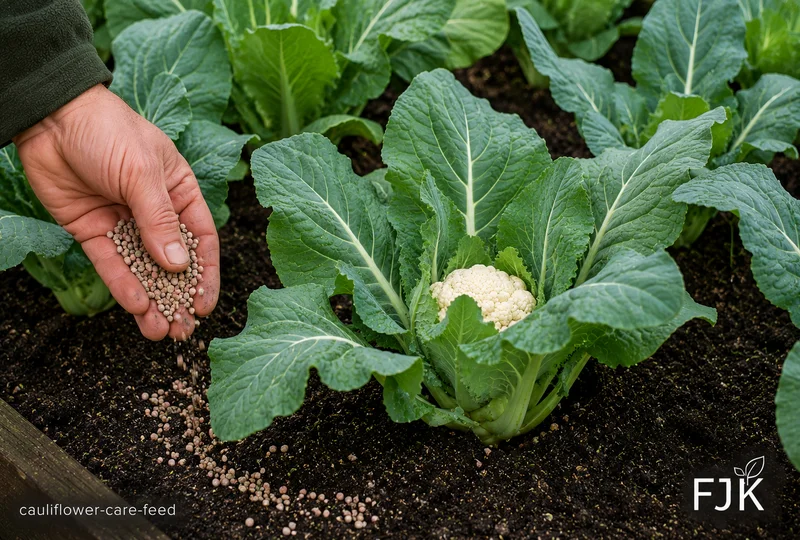
Apply a balanced granular fertiliser at planting time. A liquid feed every 2–3 weeks through summer supports steady, consistent growth. Avoid excessive nitrogen in the final 4 weeks before harvest — it encourages leafy, loose-structured curds rather than firm, tight ones. Brassica-specific feeds with added trace elements give the best results.
Any stress — drought, heat, cold, transplant shock, or root damage — triggers bolting or the production of tiny, buttoned, or discoloured curds. Cauliflower demands more consistent care than any other common vegetable. Plan your watering schedule before you plant, firm the soil before transplanting, and blanch the curd as soon as it forms.
Full identification and treatment advice is in the Pests and Diseases sections.
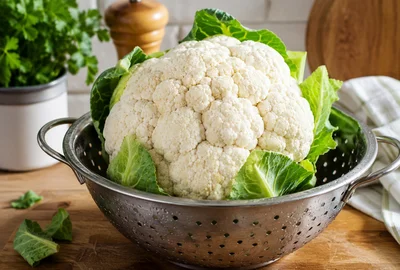
Store whole heads stem-up in the fridge for up to 7 days, loosely wrapped in a damp cloth. The leaves protect the curd — do not remove them until just before use. Cut florets keep for 2–3 days in a sealed bag. Home-grown cauliflower deteriorates faster than shop-bought — eat within a week of harvest for best flavour.
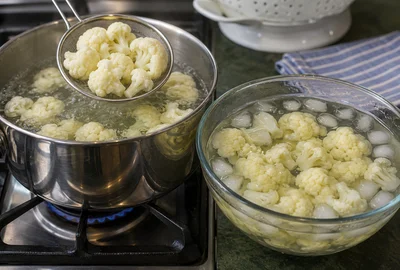
Break into florets, blanch in boiling water for 3 minutes, plunge into ice water, drain, and freeze flat on a tray before bagging. Keeps for up to 12 months. Texture softens but flavour remains very good. Frozen cauliflower is excellent in soups, gratins, curries, and cauliflower cheese.

Cauliflower cheese is the classic glut solution — one large head feeds a family. Also outstanding roasted whole at 200°C with olive oil and spices. Cauliflower soup blends beautifully. Pickled cauliflower florets are excellent with cheese and cold meats.
Cauliflower germinates and grows best at 10–18°C. A cold frame, unheated greenhouse, or cool windowsill produces sturdy, compact transplants that establish far better than those raised in warmth. Drawn, leggy seedlings caused by too much heat rarely recover fully.
Cauliflower needs firmer planting than any other vegetable. After preparation, tread the bed, rake it, tread again, and rake again. When planting, firm each transplant in harder than you think necessary — use your boot heel if the soil is soft. Loose soil causes stress and almost always produces poor, buttoned curds.
A good cauliflower curd at its peak is firm, tight, and white. Harvest in the morning when it is at its coolest and most compact. A yellowing curd is still edible but quality drops rapidly. Once you see the surface beginning to separate or discolour, cut immediately — do not wait.