Plant bare-root bushes November–March, 1.2–1.5m apart; red and white currants tolerate part shade better than most fruits
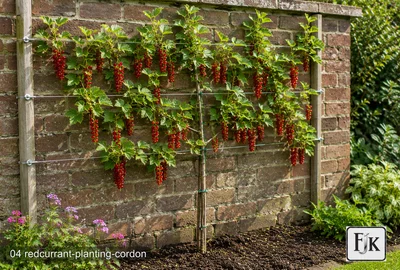
Train as an open-centred bush or a single-stemmed cordon against a fence for space efficiency
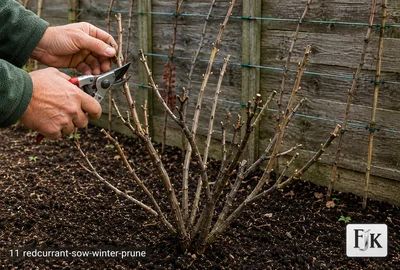
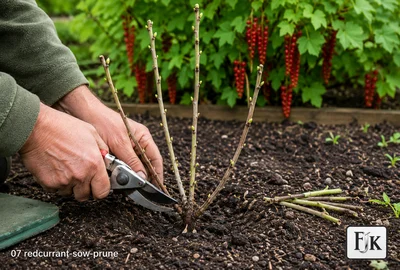
Prune in winter: shorten main branches by a third, cut all sideshoots to one or two buds — this builds fruiting spurs
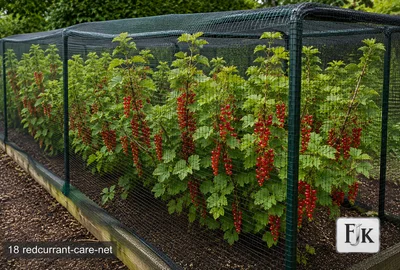
Net against birds before fruits colour — redcurrants are extremely attractive to blackbirds and starlings
Red and white currants fruit on old wood and short spurs — unlike blackcurrants, do not cut out old stems
🌱 SowPlant bare-root Nov–Mar
🌾 HarvestJul–Aug
☀ PositionFull sun or partial shade
📐 Spacing1.5m (bush) · 45cm (cordon)
DifficultyEasy
⚡ Quick facts
Sow
Plant bare-root Nov–Mar
Plant
Nov–Mar (bare-root) · Mar–Apr (container)
Harvest
Jul–Aug
Position
Full sun or partial shade — tolerates north-facing wall
Spacing
1.5m (bush) · 45cm (single cordon)
Height
1.0–1.5m (bush) · 1.8m (cordon)
Hardiness
Fully hardy — flowers are frost-sensitive in severe late frosts
Lifespan
20–25 years
Difficulty
Easy
01 About
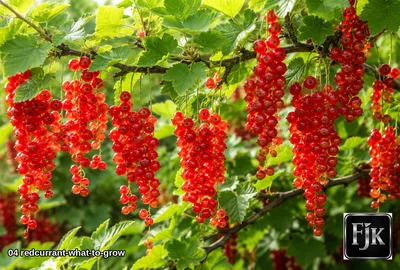
Among the most beautiful fruits in the kitchen garden — long translucent strigs of jewel-like red or pale ivory berries in July. Unlike blackcurrants, red and white currants fruit on old wood and respond beautifully to formal training as cordons, fans, or standards. They tolerate shade better than almost any other fruiting plant and a north-facing wall that would defeat most crops suits them perfectly.
02 Varieties
The number of varieties shown for each crop is based on UK consumption data (2025/26) — the more popular the crop, the more variety choices we include.
Red Currants — Early
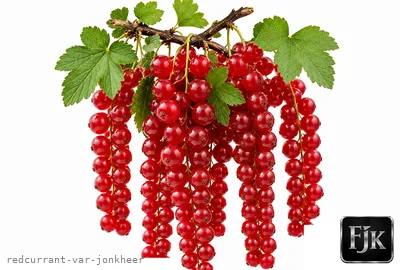
Jonkheer van Tets
Red · Early
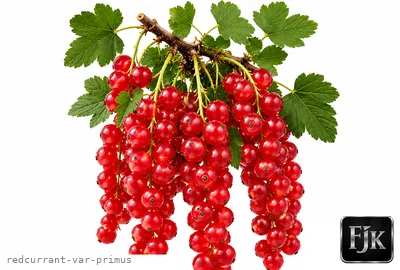
The earliest and most vigorous redcurrant variety. Very heavy crops of large, deep red berries on long strigs in early July. Upright habit. One of the most reliable and widely planted redcurrant varieties in the UK. AGM.
Harvest
Jul
Flavour
Sharp, classic redcurrant
Fruit size
Large
Yield
Very high
Disease resistance
Good
🏅 AGM
✓ Self-fertile
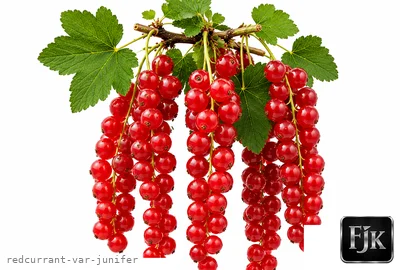
Junifer
Red · Very early
One of the earliest redcurrants — berries colour in late June in the south, extending the harvesting season. Compact bush. Good crops of bright red berries. Useful for growers wanting to start the redcurrant season as early as possible.
Harvest
Jun–Jul
Flavour
Sharp, bright
Fruit size
Medium-large
Yield
High
Disease resistance
Good
✓ Self-fertile
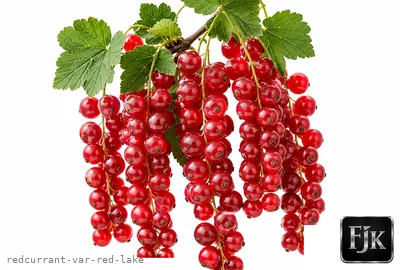
Red Lake
Red · Mid-season
A reliable mid-season variety with large berries and consistently good yields. Upright growth habit. The long-established standard variety for many UK gardeners. Good all-round performance.
Harvest
Jul
Flavour
Sharp, classic
Fruit size
Large
Yield
High
Disease resistance
Moderate
🏅 AGM
✓ Self-fertile
Red Currants — Late & Heavy Crop
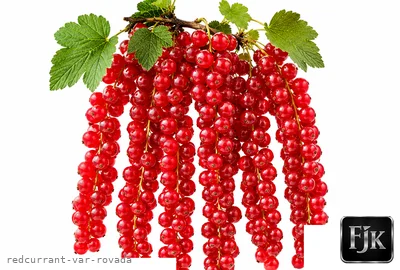
Rovada
Red · Late
The outstanding late-season redcurrant — extraordinarily heavy crops of very large berries on the longest strigs of any variety. AGM winner and widely considered the best redcurrant currently available. Extends the season into August. Vigorous, upright growth.
Harvest
Jul–Aug
Flavour
Sharp-sweet, excellent
Fruit size
Very large
Yield
Exceptional
Disease resistance
Very good
🏅 AGM
✓ Self-fertile
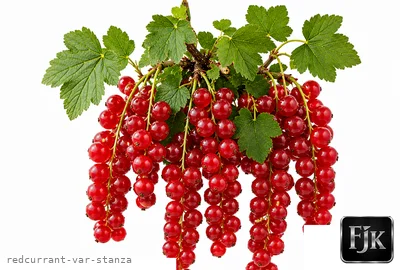
Stanza
Red · Mid-late
A mid to late season variety with good-sized berries that are slightly sweeter than most redcurrants. AGM. Compact, manageable bush suitable for smaller gardens. Good consistent yields without the exceptional vigour of Rovada.
Harvest
Jul–Aug
Flavour
Rich, sweet for a redcurrant
Fruit size
Large
Yield
High
Disease resistance
Good
🏅 AGM
✓ Self-fertile
🪴 Container
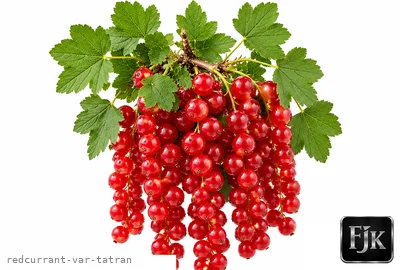
Tatran
Red · Mid-season
A productive mid-season variety with upright growth and good yields of large berries. Czech-bred. Solid performer across UK conditions. Less well known than the Ben and Rovada types but highly valued by growers who have trialled it.
Harvest
Jul
Flavour
Classic, sharp
Fruit size
Large
Yield
High
Disease resistance
Good
✓ Self-fertile
White Currants
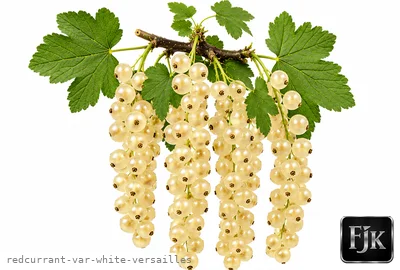
White Versailles
White · Early
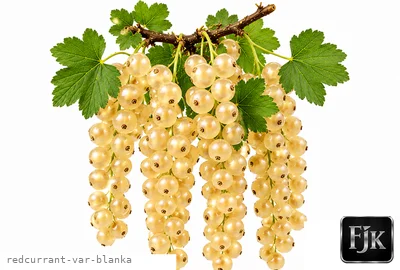
The classic whitecurrant — large, pale cream-ivory berries with a milder, sweeter flavour than red varieties. Much more pleasant for eating raw. An old variety that remains one of the best for flavour quality. Same management as redcurrants. Beautiful on the bush.
Harvest
Jul
Flavour
Mild, sweet, honeyed
Fruit size
Large
Yield
High
Disease resistance
Good
✓ Self-fertile
🪴 Container
Blanka
White · Mid-season
Outstanding yields of large, pale berries — among the most prolific whitecurrants available. AGM. Good disease resistance. Similar in character to White Versailles but with heavier cropping. One of the best choices for a whitecurrant where productivity is the priority.
Harvest
Jul–Aug
Flavour
Sweet, mild, light
Fruit size
Large
Yield
Very high
Disease resistance
Very good
🏅 AGM
✓ Self-fertile
🪴 Container
Primus
White · Early
An early-ripening whitecurrant with very sweet, delicate berries — the sweetest of the commonly available varieties. Excellent for eating fresh. Compact, well-behaved bush. A good choice for those who want a whitecurrant primarily for dessert rather than preserving.
Harvest
Jun–Jul
Flavour
Very sweet, delicate
Fruit size
Medium-large
Yield
High
Disease resistance
Good
✓ Self-fertile
🪴 Container
03 Where to Source
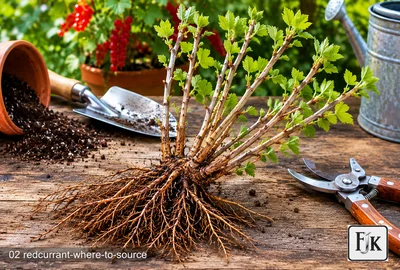
Redcurrants and whitecurrants are almost always sold as bare-root bushes or cordons through autumn and winter. Specialist fruit nurseries offer by far the widest choice of varieties, including trained cordons and standards not usually found at general garden centres.
🌳 Specialist Fruit Nurseries
Look for named, certified virus-free stock rather than unnamed seedlings — named varieties are true to type and free of the viruses that gradually reduce yield in older, unverified plants.
Timing tip: Order seeds in January and February. Popular varieties sell out quickly. Garden centres and markets are a reliable backup from April onwards.
04 Planting Options
🌿 As a Bush
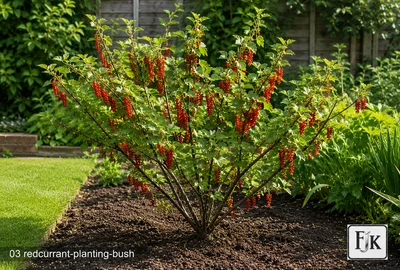
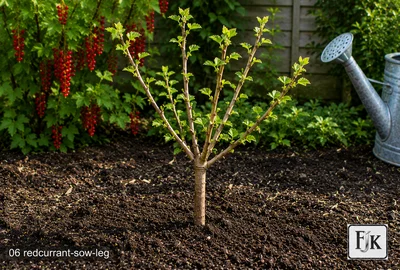
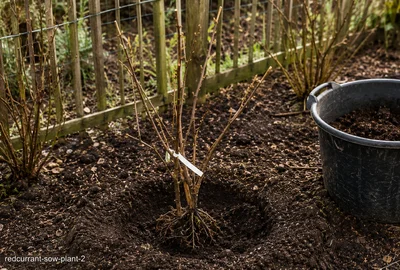
Like gooseberries, red and white currants are grown on a short clear leg of 10-15cm, with all buds below that point removed to keep the fruiting wood up off the ground. Plant at the same depth as the nursery mark — not deeper, unlike blackcurrants — and firm in well. After planting, shorten each main branch by half to an outward-facing bud to establish the open, airy framework that currants need for good fruit quality. Mulch generously and get bird netting in place from the moment berries begin to colour; blackbirds and pigeons will strip a currant bush just as readily as a gooseberry.
Establish on a short leg
Like gooseberries, red and white currants are grown on a short clear leg of 10–15cm. Remove all buds and sideshoots from the lower stem at planting. This lifts the fruiting branches off the ground, improves airflow, and makes cultivation and picking easier.
Plant at nursery depth
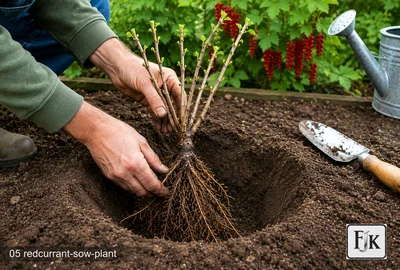
Unlike blackcurrants, do not plant deeper than the nursery soil mark. Plant at the same depth, firm well, and water in thoroughly. Space bushes 1.5m apart in all directions.
Formative pruning
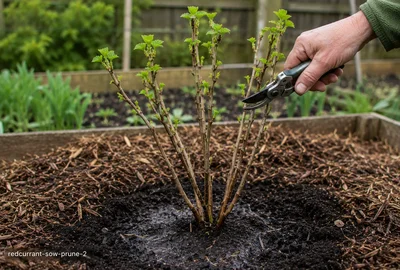
After planting, shorten each main branch by half to an outward-facing bud. This establishes the open goblet framework. Unlike blackcurrants, no hard renovation prune is needed at planting — the existing framework is retained and built upon.
Mulch and net early
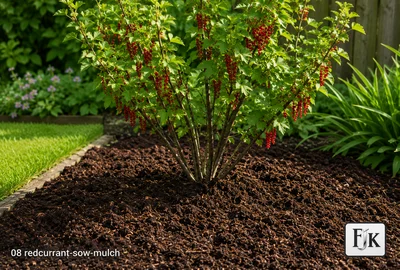
Apply a generous mulch and install bird netting from the moment berries begin to colour — birds, particularly blackbirds and starlings, are extremely fast to strip a redcurrant. The translucent red berries are irresistible.
🌿 As a Cordon (Recommended)
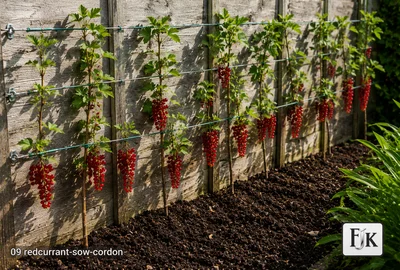
Training red and white currants as single vertical cordons against a wall, fence, or free-standing wire system is the most space-efficient way to grow several varieties in a modest garden. Plant at 45cm intervals against horizontal wires at 30cm, 60cm and 90cm, tying the single main stem in as it grows. As with gooseberry cordons, summer pruning is the key technique: shorten all sideshoots to 5 leaves in June-July, then reduce those same shoots further to 1-2 buds in winter. This builds short, productive fruiting spurs directly along the main stem rather than a spreading bush.
The cordon is the ideal form
Redcurrants and white currants trained as single vertical cordons against a wall, fence, or free-standing wire system are perhaps the most space-efficient fruiting plants in the garden. Each cordon occupies just 45cm of wall space and produces a generous crop of easily accessible, easily netted fruit.
Plant and tie to wire or cane
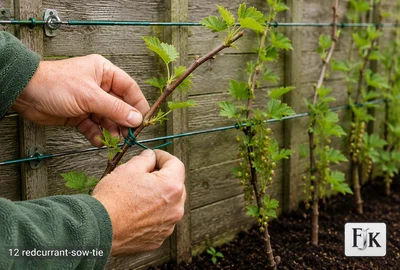
Plant at 45cm intervals against horizontal wires at 30cm, 60cm, and 90cm. Tie the single main stem to a vertical cane attached to the wires. As the stem extends, continue tying in at each stage of growth.
Summer pruning is key
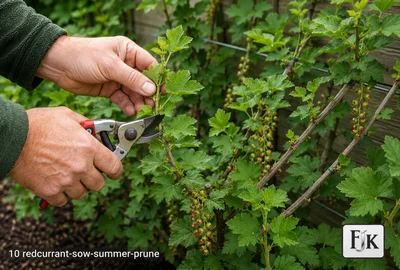
In June–July, shorten all sideshoots to 5 leaves. This is the most important management step for cordons — it restricts excessive growth and channels energy into building productive fruiting spurs.
Winter pruning
In winter, cut the summer-pruned sideshoots back to 1–2 buds. These short spurs develop into productive fruiting clusters over successive years. Extend the leader by a third of its annual growth each year until the cordon reaches the desired height.
05 Companion Planting
✅ Grow nearby
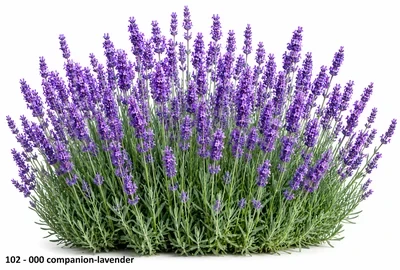
💜 Lavender
Attracts pollinators and adds a decorative, low-maintenance border nearby.
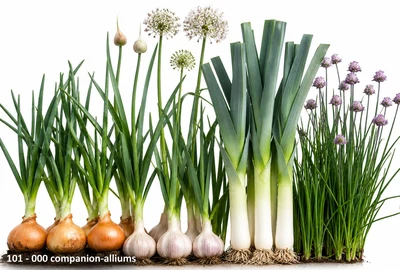
🧄 Alliums
Onion-family plants grown nearby are thought to help deter pests with their strong scent.
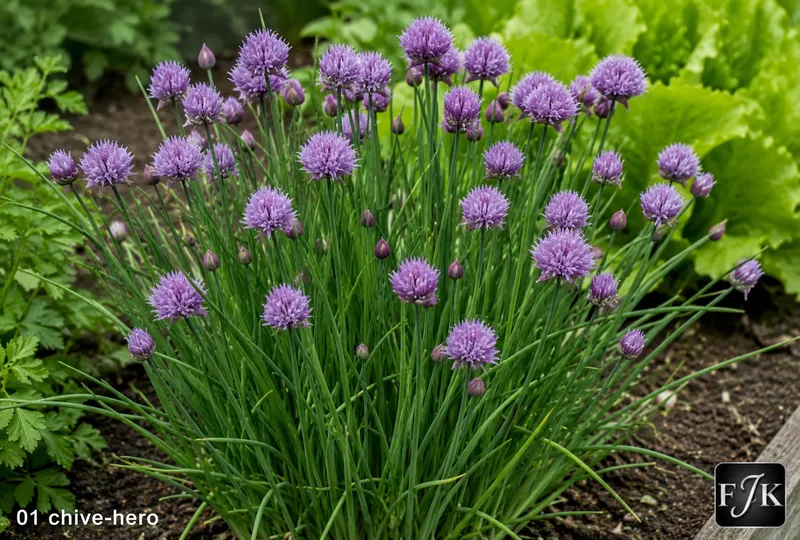
Attracts pollinators, but plant at a distance or in a sunken container as it spreads aggressively.
06 Sowing — How To
Plant Nov–Mar while dormant
Bare-root plants must go in while dormant. November and February are ideal — the soil is moist, the plants are resting, and establishment is reliable.
Establish leg and prune
Remove buds from the lower 15cm to create the leg. Shorten all remaining branches by half to outward-facing buds. Mulch and water in.
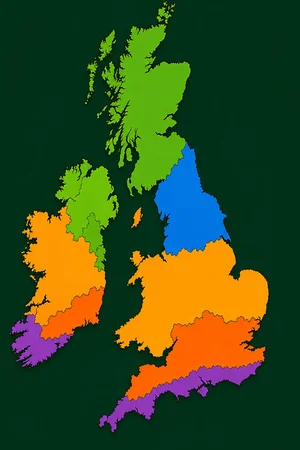
Regional sowing timing
Region
Sow / plant
Harvest
Notes
Scotland & Far North
Nov–Mar
Jul–Aug
Northern England
Nov–Mar
Jul–Aug
Midlands & Wales
Nov–Mar
Jul–Aug
Ireland & Isle of Man
Nov–Mar
Jul–Aug
South & SE England
Nov–Mar
Jul–Aug
South Coast & SW
Nov–Mar
Jul–Aug
07 Using a Propagator
Red and white currants propagate from hardwood cuttings in exactly the same way as gooseberries — with the crucial difference that buds must be removed from the lower portion to form a leg rather than a basal stool.
Heated propagator
Not Required — No propagator needed. Hardwood cuttings root reliably in open ground through winter.
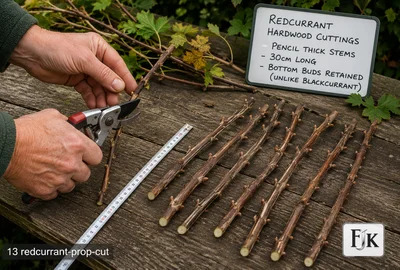
Take cuttings Oct–Nov
Cut 25–30cm of pencil-thick current-season wood. Remove all buds except the top 4–5 — these will form the canopy while the cleared section becomes the leg.
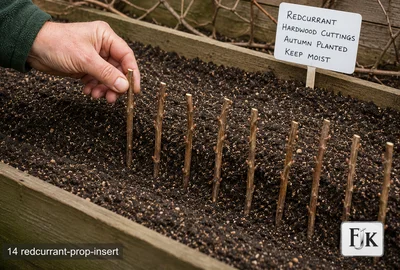
Insert in open ground
Push cuttings vertically into a prepared trench with only the top buds above ground. Firm well. Mark with a cane — they are easy to disturb accidentally in a busy garden.
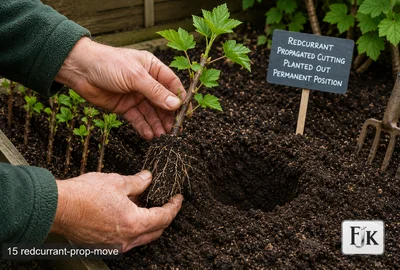
Move to final position
After a full season, rooted cuttings can be moved to permanent positions in autumn. Handle roots carefully — do not allow them to dry out during transplanting.
08 Soil Requirements
pH
6.0–7.0
Best
Loam, Sandy loam
Tolerates
Clay loam
Avoid
Waterlogged, Very acid
💡 Well-drained, fertile soil. Tolerates partial shade better than most soft fruit.
09 Ongoing Care
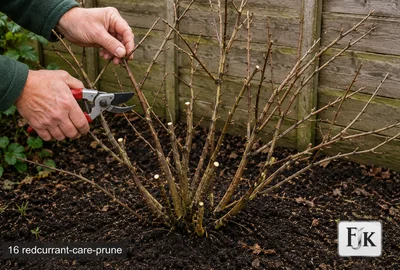
✂️ Spur Pruning
Red and white currants are pruned to build and maintain a system of productive spurs on a permanent framework — entirely different from blackcurrant management. In summer (June–July), shorten all sideshoots to 5 leaves. In winter, cut these same sideshoots back to 1–2 buds. Over successive years, these short spurs develop into fat, productive clusters that produce the characteristic long strigs of berries. Also in winter, shorten the main framework branches by a third. The goal is a balanced, open bush or cordon with a clear spur system — not a dense, leafy shrub.
🌱 Feeding
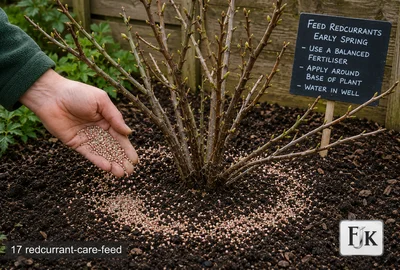
Apply a balanced general fertiliser in early March. Potassium is particularly important for redcurrants and whitecurrants — sulphate of potash applied in February promotes good fruiting. Follow with a mulch of compost around the base. Do not apply high-nitrogen feeds in summer as this stimulates excessive leafy growth at the expense of the fruiting spurs that produce the crop.
🐦 Bird Protection
Birds, especially blackbirds and starlings, strip redcurrants with extraordinary speed the moment berries colour. A single blackbird can empty a bush in a morning. Net from the moment colour develops — do not delay. The cordon form is particularly easy to protect with a simple tunnel of netting over a wire frame. Cordons can also be grown in a permanent fruit cage, making protection completely reliable. Without netting, expect to lose most or all of the crop.
🍓 Harvesting
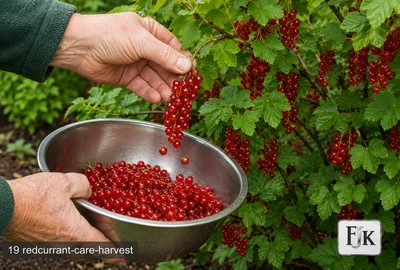
Harvest whole strigs (the complete cluster on its stem) rather than individual berries — this is faster and avoids damaging the fruiting spurs for next year. Pull the entire strig away from the spur cluster cleanly. In the kitchen, strip berries from strigs by drawing them through the prongs of a fork. Redcurrants are ready when fully coloured and the berries feel slightly firm but not hard. White currants are ready when translucent and cream-coloured. Harvest over 2–3 weeks as berries ripen progressively.
10 Watch Out For
Warning
Birds are the primary threat — net without fail as soon as berries begin to colour. Aphids, particularly the redcurrant blister aphid, cause red blisters and leaf puckering — treat with soap spray in spring. Gooseberry sawfly attacks redcurrants as well as gooseberries — inspect the centre of the bush weekly from April. Coral spot fungus causes orange-pink pustules on dead wood — remove and burn affected stems promptly, as it spreads to living wood.
🐛 Insects & pests
🐜 Aphids (Blackfly & Greenfly) — Curled, distorted, or stunted growing tips — aphids inject saliva that causes leaf curl to protect them
🟤 Scale Insect — Small brown or grey bumps on stems, branches, and the underside of leaves — the scale covers themselves
🪲 Vine Weevil — Irregular, rounded notches cut from leaf margins — the work of adult beetles feeding at night
🍄 Diseases to watch
🩶 Botrytis (Grey Mould) — Botrytis cinerea (grey mould) is the most ubiquitous fungal pathogen in temperate gardens — present in virtually every garden soil and on plant debris. It becomes a disease only when conditions favour it: cool, humid, poorly ventilated environments with damaged or senescent plant tissue. In a greenhouse in autumn it can destroy an entire tomato or grape crop.
⬜ Powdery Mildew — Powdery mildew is caused by a range of related fungi, each specific to its host plant — courgette mildew cannot infect peas, and vice versa. The characteristic white powdery coating on leaf surfaces appears in warm, dry conditions (unlike downy mildew which prefers cool and wet). Rarely kills plants but severely reduces yield and plant vigour.
Full identification and treatment advice is in the Pests and Diseases sections.
11 Storage & Preserving
🔴 Fresh
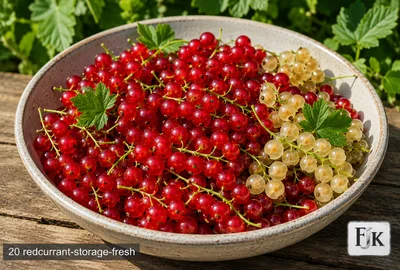
Redcurrants and whitecurrants keep for up to a week refrigerated in their strigs — do not strip from strigs until ready to use. They are rarely eaten raw in quantity due to their acidity but are outstanding mixed with sweeter fruits, used as a garnish, or served with cream and sugar. Whitecurrants have a milder, sweeter flavour and are more pleasant for raw eating.
🫙 Jelly & Preserves
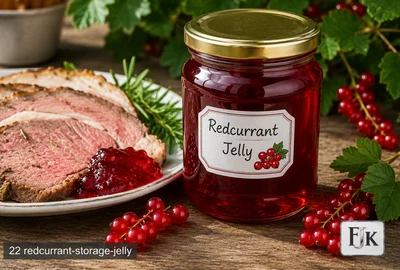
Redcurrant jelly is one of the great British preserves — clear, brilliant red, and the perfect accompaniment to lamb, venison, and cold meats. Redcurrant sauce — jelly thinned with port — is a classic alongside game and roasts. Follow a tested recipe.
❄️ Frozen
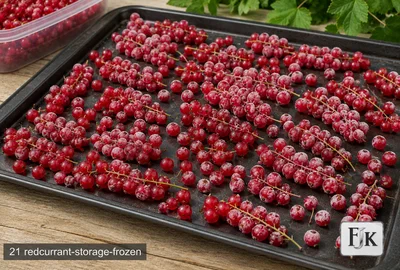
Redcurrants and whitecurrants freeze very well. Strip from strigs, wash, dry, and open freeze on a tray before bagging. Use within 12 months. Frozen redcurrants make excellent jelly through winter. They can also be frozen in strigs and stripped when partially thawed for easy processing.
12 Expert Tips
💡 The cordon against a north wall
A north-facing wall or fence that defeats tomatoes, cucumbers, and even apples is ideal for red and whitecurrant cordons. They tolerate shade better than virtually any other fruiting plant and remain highly productive in these difficult positions. Grow them where nothing else will fruit — they will reward you generously.
💡 Grow red and white together
Plant one whitecurrant alongside your redcurrants. White Versailles or Blanka produce milder, sweeter berries with the same management requirements. The contrast in colour at harvest is striking, and the flavour difference makes them useful for different purposes — whites for eating fresh, reds for jelly.
💡 Standards as ornamental features
Red and whitecurrants trained as standards — a single clear stem topped with a rounded head, like a miniature ornamental tree — are productive, unusual, and genuinely decorative. They take 3–4 years to develop but can be grown in large containers, used as focal points, or underplanted with herbs and low-growing companions.