⚡ Quick facts
- Difficulty
- Moderate
- Crop type
- Hardy Biennial grown as Annual
- Position
- Full Sun
- Soil
- Well-drained, fertile, not recently manured
- Container friendly
- Not ideal — needs depth for taproot development
- Greenhouse recommended
- Not needed for growing; useful for forcing Witloof in winter
- Outdoor suitable
- Yes — all UK regions; radicchio and sugarloaf types are very hardy
- Frost hardy
- Yes — radicchio and sugarloaf hardy to -10°C; Witloof roots lifted before hard frost
01 About
Chicory is the most versatile and underused salad crop in the British kitchen garden. When the summer salad bed is long past its best, chicory takes over — delivering crisp, bitter leaves through autumn, forced pale chicons through the darkest winter months, and ornamental radicchio heads in vivid crimson that double as garden features. Three completely distinct types exist: Witloof chicory, forced in the dark to produce the pale chicons of restaurant menus; radicchio, with its tight, jewel-red heads; and green sugarloaf types, forming upright pale-hearted cones. All are sown the same way and grown without fuss — chicory is far easier than its gourmet reputation suggests, and no other crop delivers as much from the autumn and winter garden.
02 What to Grow

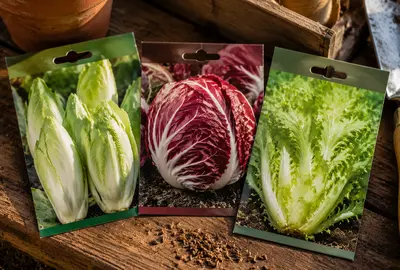
Chicory divides into three distinct horticultural groups, each producing a completely different end product. Witloof or forcing chicory is sown in summer, allowed to develop a fleshy taproot through the growing season, then lifted in November and forced in darkness at 10–18°C. The result — in three to four weeks — is the pale, tightly packed, slightly bitter chicon of Belgian cuisine, entirely different from anything that can be bought cheaply. Radicchio is the red chicory of Italian cooking: tight, round or elongated heads in deep burgundy-red with brilliant white veining, which colour up dramatically as autumn temperatures drop. The flavour is bitter and complex, outstanding raw in salads, braised in olive oil, or grilled on a griddle. Sugarloaf chicory forms tall, upright cones of tightly packed pale green leaves with a creamy-yellow heart — the mildest of the three types, with less bitterness than radicchio and a crisp, lettuce-like texture. All three are sown the same way and give the same season of autumn and winter harvest; the choice between them is simply a matter of what you want on the plate.
03 Varieties
The number of varieties shown for each crop is based on UK consumption data (2025/26) — the more popular the crop, the more variety choices we include.
⬜ Witloof / Forcing Chicory
The classic forcing chicory, grown for its fleshy taproot which is lifted in November and forced in darkness to produce pale, tightly packed chicons. The chicon is entirely different from the garden plant — blanched, crisp, mildly bitter, and completely unlike any shop-bought salad ingredient. Modern F1 varieties produce larger, more uniform chicons than heritage open-pollinated types.

Witloof
Witloof · Heritage
The original Witloof (White Leaf) forcing chicory from Belgium, introduced in the 19th century and still one of the most widely grown forcing types. Produces tightly packed, bullet-shaped pale yellow-white chicons 10–15cm long when correctly forced in darkness. The root is robust and reliable. Witloof is the benchmark against which all modern F1 forcing varieties are measured — slower to produce than modern types but dependable, widely available, and excellent in flavour.
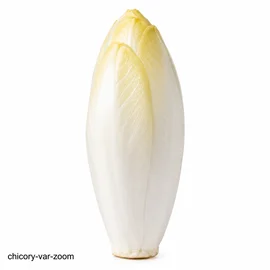
Zoom F1
Witloof · F1 Hybrid
A modern F1 forcing variety producing large, very firm, tightly wrapped chicons with minimal greening even in imperfect forcing conditions. Zoom F1 is notably tolerant of slight light exposure compared to heritage varieties, making it more forgiving for home gardeners without perfect darkness during forcing. The chicons are somewhat larger than standard Witloof and have a clean, mildly bitter flavour. Recommended for first-time Witloof growers.
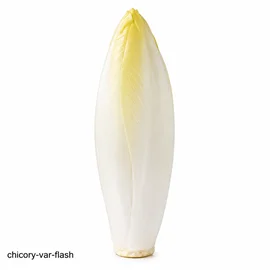
Flash F1
Witloof · F1 Hybrid
A very fast-forcing modern F1 Witloof variety, producing chicons in as little as 2–3 weeks under good conditions compared to 3–4 weeks for standard varieties. Compact, very uniform pale chicons with excellent tight wrapping and minimal leaf separation at the tip. Flash F1 is ideal where forcing space is limited and a quick turnover is needed between batches of roots. The flavour is excellent — slightly less bitter than heritage Witloof, with a clean, crisp texture.
🔴 Radicchio
The red chicory of Italian cooking — tight, jewel-red heads with brilliant white veining that develop their colour as temperatures drop in autumn. Radicchio is among the most ornamental vegetables in the British garden and one of the most versatile in the kitchen. Raw in salads, grilled, braised, or stirred into risotto, its complex bitter flavour elevates every dish it touches.
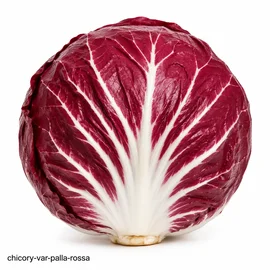
Palla Rossa
Radicchio · Round Head
The definitive round-headed radicchio — compact, tight-headed, with deep burgundy-red outer leaves and brilliant white veining that intensifies dramatically after the first autumn frosts. Palla Rossa (Red Ball) is the most widely grown radicchio in UK gardens and the benchmark of the type. The heads are firm, dense, and about the size of a tennis ball when mature. The flavour is robustly bitter raw and becomes mellow and slightly sweet when grilled or braised. Outstanding ornamental value in the autumn kitchen garden.
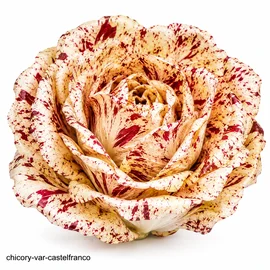
Castelfranco
Radicchio · Loose Head
The most beautiful of all chicory varieties — a loosely cupped head of pale cream leaves generously splashed and spotted with vivid red and pink. Named after the town of Castelfranco Veneto in northern Italy, where it has been grown for centuries. Castelfranco is considerably milder and less bitter than round radicchio types, making it one of the most accessible chicory varieties for those new to bitter salad leaves. Outstanding raw in salads. The open head is less hardy than closed-head types and benefits from a cloche in hard winters.

Treviso
Radicchio · Long Head
An elongated, upright radicchio with deep red leaves and prominent white midribs forming a tight, torpedo-shaped head quite distinct from the round Palla Rossa. Named after Treviso in the Veneto, where it is the most prized local vegetable. The flavour is slightly less bitter than round radicchio and the texture crisper, making Treviso outstanding for grilling — the elongated halves sit beautifully on a griddle and caramelise evenly. More frost-hardy than Castelfranco. Colours up deepest red of all radicchio types in cold weather.
🟢 Sugarloaf / Green Chicory
The mildest chicory type — tall, upright heads of tightly packed pale green leaves with a creamy-yellow blanched heart. Sweeter and less bitter than radicchio, sugarloaf types are the most accessible chicory for those unused to strong bitter flavours. Very hardy and long-standing in the garden, they provide welcome crisp salad material through autumn and early winter.

Pain de Sucre
Sugarloaf · Classic
Pain de Sucre (Sugarloaf) is the definitive sugarloaf chicory — a tall, upright cone of tightly packed pale green outer leaves enclosing a brilliantly white to pale yellow inner heart. The name refers to the old-fashioned conical sugar loaf shape of the head, which can reach 40–50cm tall in good growing conditions. The inner leaves are the most prized part — blanched by the outer leaves, they are crisp, mildly bitter, and sweet. One of the hardiest salad crops available, standing through heavy frosts without protection in most UK winters.
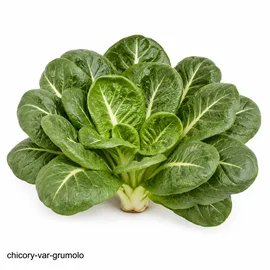
Grumolo Verde
Sugarloaf · Winter Rosette
Grumolo Verde is the most winter-hardy chicory available — a compact, low rosette of small, rounded, slightly crinkled dark green leaves that flatly refuses to be killed by even the hardest British winter. Unlike most chicory, Grumolo Verde produces its best growth in late winter and early spring, when it re-grows vigorously after winter dormancy to provide fresh salad leaves from February onwards. The flavour is mild and pleasantly bitter. A superb gap-filler in the winter and early spring salad bed when almost nothing else is available.

Catalogna
Sugarloaf · Leaf Chicory
Catalogna is the most vigorous and productive chicory variety — a tall, upright plant with long, deeply notched, dandelion-like leaves on prominent white midribs, reaching 40–60cm. It is grown as a cut-and-come-again crop, harvested repeatedly throughout the growing season. The flavour is assertively bitter — somewhere between wild chicory and radicchio — and is most commonly used cooked in Italian cuisine: briefly boiled then sautéed in olive oil and garlic. Catalogna is one of the most productive salad crops per square metre available to UK gardeners.
04 Where to Source
Chicory seed is available from most specialist vegetable seed companies, though general garden centres typically stock only one or two varieties. For the full range — Witloof forcing types, Italian radicchio varieties including Castelfranco and Treviso, and sugarloaf — specialist online seed companies offer the widest choice. Named Witloof varieties such as Zoom F1 and Flash F1 are worth seeking out over generic forcing chicory as they produce larger, more uniform chicons. Radicchio seed is worth ordering from Italian seed companies for the widest variety selection. Chicory is not commonly available as plug plants — almost all sowings are from seed.
05 Planting Options
🌿 Open Ground
The standard and only reliable method for chicory. Sow direct into well-prepared, well-drained soil from May to July. Chicory develops a deep taproot that does not transplant well — direct sowing is strongly preferred. Avoid recently manured ground, which produces excessive foliage at the expense of roots and hearts. The bed that grew an early brassica or pea crop earlier in the season is ideal. Thin progressively to 25–30cm final spacing.
Suitable varieties: All types. Direct sowing essential — chicory does not transplant well.
06 Companion Planting
✅ Grow nearby

Chicory taproots break up compacted subsoil, improving structure and drainage for nearby carrots. The two crops grow well side by side without competing significantly.

Good salad bed companions with similar growing requirements. The slight bitterness of chicory deters some slugs from the surrounding area, offering mild protection to nearby lettuce.
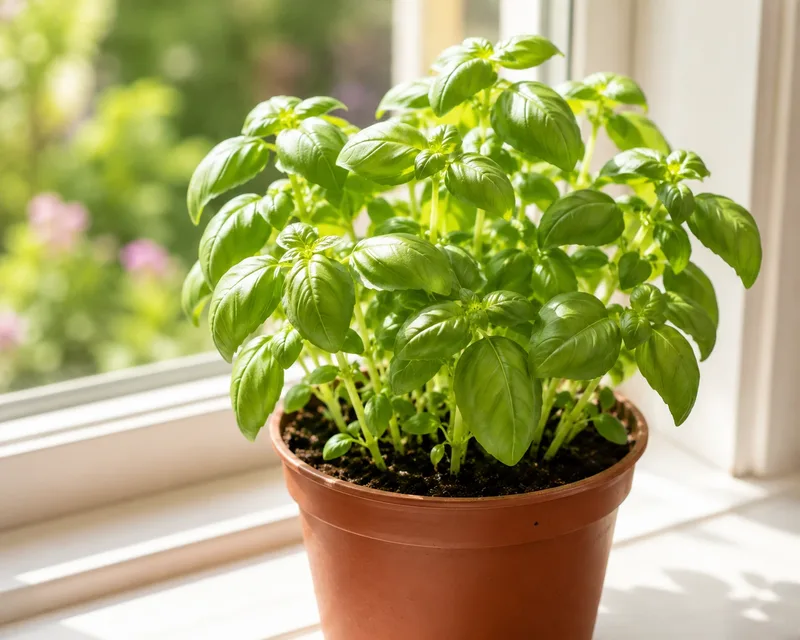
Aromatic herbs grown nearby reduce pest pressure on chicory through the summer. Particularly useful herbs include thyme, sage, and marjoram, whose scent confuses and deters flying pests.
❌ Keep apart
- 🌿 Fennel — Florence fennel releases allelopathic compounds from its roots that inhibit chicory germination and early growth. Keep well separated in the bed.
- 🫘 Runner Beans — The large, vigorous root system of runner beans competes aggressively with chicory for moisture and nutrients. Avoid planting adjacent to climbing bean supports.
07 Sowing — How To
Prepare the seedbed
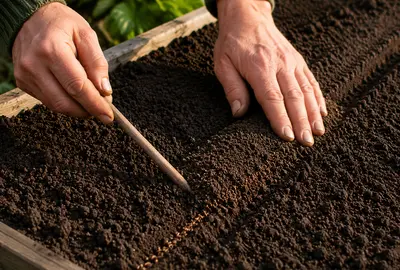
Rake the soil to a fine, firm tilth. Chicory does not need rich soil — a bed that has not had fresh manure added is ideal. Remove all weeds, as chicory seedlings are slow to establish and easily overwhelmed in the first weeks. A well-drained, open soil with some prior crop residue is perfect.
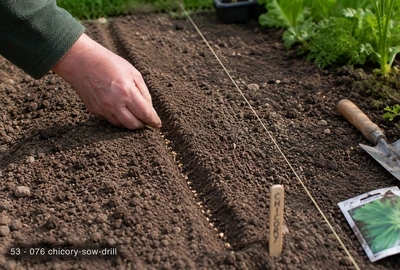
Draw shallow drills
Using a cane or the corner of a hoe, draw shallow drills 1cm deep and 30cm apart. Water the drill before sowing if the soil is dry — chicory germinates best in moist conditions and the small seeds can dry out before germinating in warm summer soils. A gentle watering along the drill is sufficient.
Sow thinly
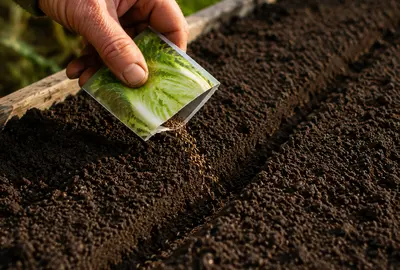
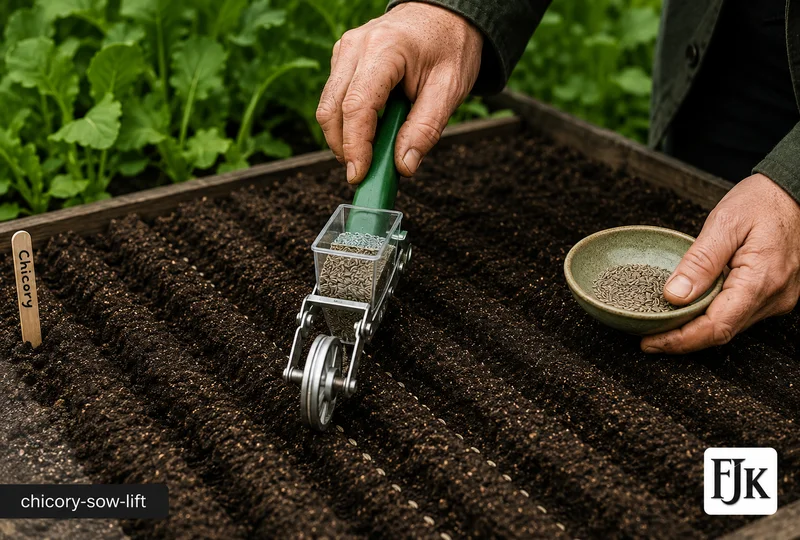
Tip a small quantity of seed into the palm of your hand and sow thinly along the drill at roughly 1cm intervals. Chicory seed is small and light — sow in calm conditions and do not rush. Thin sowing saves considerable work at the thinning stage and avoids wasting seed. Aim for one seed per centimetre of drill.
Cover and firm
Draw fine soil back over the drill with the back of a rake. The covering need only be 1cm deep. Firm gently and water the whole bed with a fine rose if conditions are dry. Germination takes 7–14 days in warm summer conditions. Keep the seedbed moist until seedlings emerge — the main failure point is allowing the thin soil covering to dry out.
Thin the seedlings
When seedlings reach 5–8cm tall, thin to one plant every 10cm initially. A second thinning to the final 25–30cm spacing follows 2–3 weeks later as the stronger plants establish. Remove the weakest plants cleanly at soil level — do not pull, as this disturbs the roots of neighbouring plants. The thinnings are edible as salad greens.
Grow through summer
Chicory plants look unpromising through July and August — they may bolt to flower and the foliage appears coarse and uninviting. This is normal. The basal rosette that forms as temperatures drop from September onwards is the edible part. Leave plants undisturbed and weed around them. Do not panic at summer bolting — the edible heart develops later regardless.
Force Witloof (November)
For Witloof chicons: lift the roots carefully in November before hard frost. Trim the leaves to 2–3cm above the crown and the roots to approximately 20cm. Pack roots upright and closely together in a large pot or box of barely moist compost. Cover with a second pot or black plastic to exclude all light — any light turns the chicons bitter and green. Keep at 10–18°C. Chicons emerge in 3–4 weeks.
Harvest
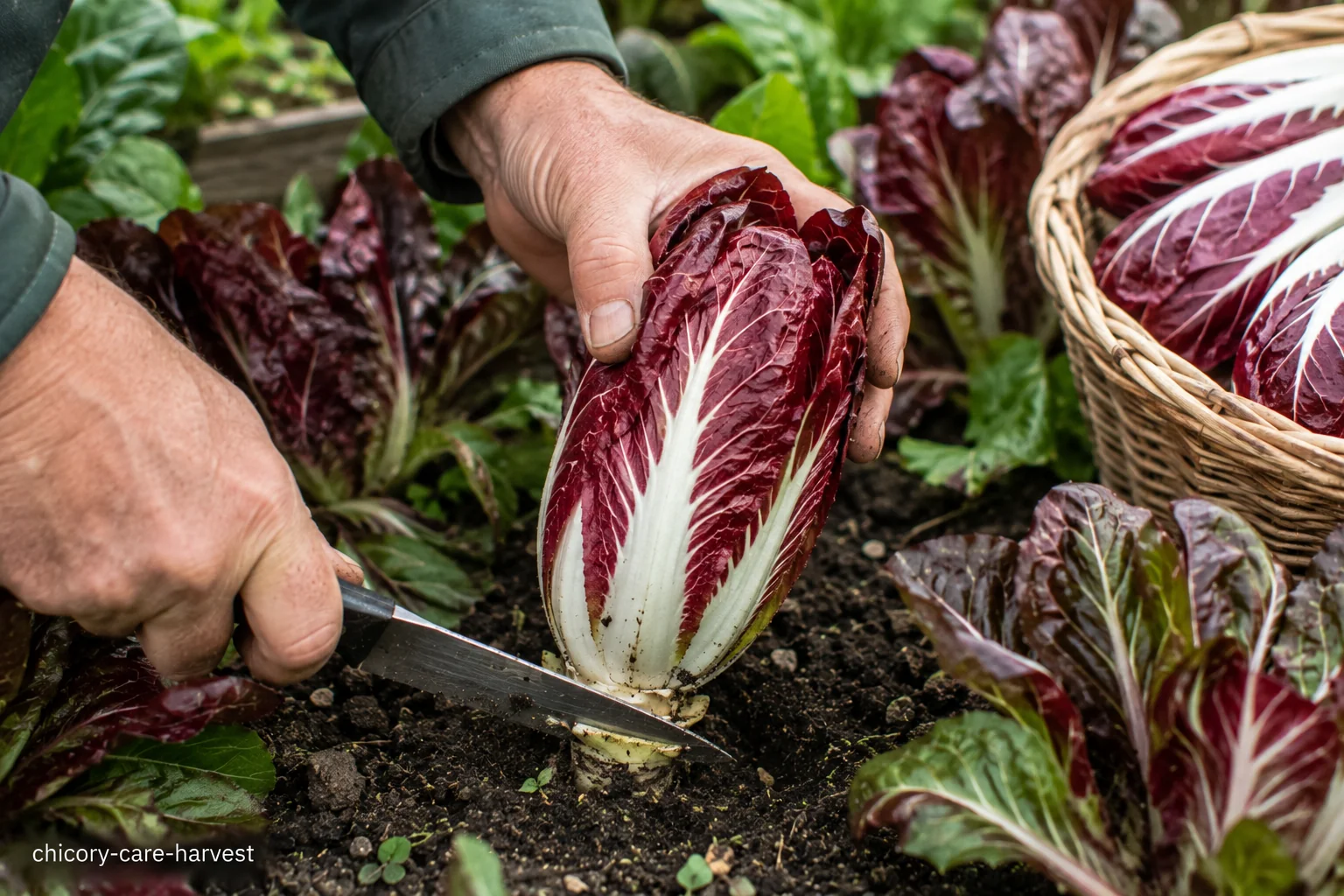
Radicchio and sugarloaf: cut heads at soil level when firm and tight, from October onwards. Some plants will produce a second crop of smaller leaves from the stump. Witloof chicons: cut when 10–15cm tall at the base of the chicon. The root will produce a second, smaller chicon before exhausting itself. Harvest all chicons before they turn green or open.
Regional sowing timing| Region | Sow / plant | Harvest | Notes |
|---|
| Scotland & Far North | May–Jul | Sep–Feb | May–Jul direct · Plant: N/A · Harvest: Sep–Feb |
|---|
| Northern England | May–Jul | Sep–Feb | May–Jul direct · Plant: N/A · Harvest: Sep–Feb |
|---|
| Midlands & Wales | May–Jul | Sep–Mar | May–Jul direct · Plant: N/A · Harvest: Sep–Mar |
|---|
| Ireland & Isle of Man | May–Jul | Sep–Mar | May–Jul direct · Plant: N/A · Harvest: Sep–Mar |
|---|
| South & SE England | May–Jul | Sep–Mar | May–Jul direct · Plant: N/A · Harvest: Sep–Mar |
|---|
| South Coast & SW | May–Jul | Sep–Mar | May–Jul direct · Plant: N/A · Harvest: Sep–Mar |
|---|
08 Using a Propagator
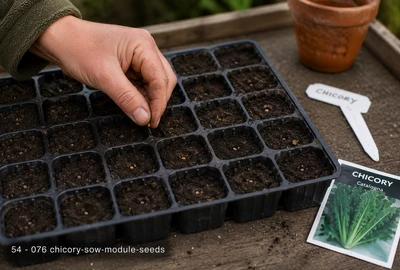
Chicory does not benefit from propagator use and should never be started indoors. It is direct-sown outdoors from May onwards when soil temperatures are naturally warm enough for reliable germination. Starting chicory indoors causes root disturbance at transplanting, which significantly reduces heart formation — chicory's deep taproot must develop undisturbed in the ground from the start.
Heated propagator
A heated propagator is not appropriate for chicory. Chicory must be direct-sown outdoors — starting seeds indoors in any propagator, heated or unheated, leads to transplant shock that prevents proper taproot and heart development. If you are looking to extend the season, a cloche or fleece over the outdoor seedbed in May achieves better results than any indoor propagation method.
No propagator needed
Sow chicory direct outdoors only. Draw drills 1cm deep in warm soil from late May and sow thinly. No indoor heat or propagator gives better results than a well-prepared outdoor seedbed in June.
Sow from late May
Wait until late May or June before sowing. Earlier sowings in cold or cool soil tend to bolt without forming usable heads or roots. June sowings in most UK regions give the most reliable results — the plants have enough growing season without the bolt risk of early sowing.
Keep seedbed moist
After sowing, keep the seedbed consistently moist until seedlings emerge — typically 7–14 days. Chicory seeds are small and the thin soil covering dries out quickly in summer heat. A light daily watering with a fine rose is sufficient.
Thin to final spacing
Thin seedlings progressively — first to 10cm, then to the final 25–30cm spacing. Crowded plants form small, poor-quality heads and underdeveloped roots. Adequate spacing is particularly important for Witloof types, where taproot size directly determines chicon quality.
Leave undisturbed through summer
Allow plants to develop through summer without disturbance. Plants may bolt and look tatty in midsummer — this is normal. The harvestable heart or root develops from September onwards as temperatures cool.
09 Soil Requirements
- pH
- 5.5–7.0
- Best
- Loam, Sandy loam
- Tolerates
- Clay loam, Sandy
- Avoid
- Waterlogged, Compacted
💡 Tolerates poor soils well. Deep, free-draining soil helps witloof root development.
10 Ongoing Care
🛡️ Pest Protection
Slugs are the main threat to chicory, and they target seedlings and young plants in spring and early summer with particular enthusiasm. A fine insect mesh laid directly over the bed on hoops keeps slugs off entirely while still letting light and rain through, and offers the added benefit of excluding flea beetle in the seedling's first vulnerable weeks. Keep the mesh in place until plants reach about 15cm and have several true leaves — after this stage chicory is largely trouble-free and the mesh can come off.
🏺 Forcing Witloof
Forcing Witloof chicory is one of the most satisfying winter tasks in the kitchen garden. Lift the roots carefully in November before the first hard frost, using a fork to avoid breaking the long taproots. Trim the foliage to 2–3cm above the crown and cut the root to approximately 20cm length. Pack roots upright and closely together in a large pot, box, or bucket filled with barely moist compost or sand — the roots should be touching. Cover completely with a second upturned pot or black polythene to exclude all light. Keep in a frost-free space at 10–18°C — a garage, shed, or under the greenhouse bench is ideal. In three to four weeks, pale yellow-white chicons will emerge, 10–15cm tall and tightly folded. Cut at the base when fully formed. The roots will produce a second smaller chicon; after this, discard the roots.
💧 Watering
Chicory is drought-tolerant once established but needs consistent moisture in its first six weeks. Water the seedbed regularly until plants reach 10–15cm tall. After this, chicory manages well on natural rainfall in most UK summers — over-watering of established plants encourages excessive leaf growth at the expense of heart formation. Radicchio and sugarloaf heads should be kept slightly on the dry side from September onwards, as excess moisture in autumn encourages soft outer leaves that do not close tightly into a firm heart. Witloof roots being grown on for forcing need adequate summer moisture to develop a plump, well-sized taproot.
🌾 Harvesting
Harvest radicchio heads when the outer leaves have closed firmly around a tight, dense centre — typically from October onwards. Cut at soil level with a sharp knife; the stump often produces a second crop of smaller, loose leaves. Sugarloaf is harvested the same way — when the cone is firm and the inner leaves pale yellow. Both types improve in flavour after light frost and can be left in the ground well into winter in mild areas. Forced Witloof chicons should be cut when 10–15cm tall. Harvest before any greening occurs at the tip — once chicons turn green they become unacceptably bitter. Use chicons within 3–4 days of cutting, stored wrapped in the refrigerator away from light.
11 Watch Out For
WarningSlugs are the main threat to seedlings and young plants in spring and early summer — protect with nematodes or copper barriers until plants reach 15cm. Once established, chicory is remarkably trouble-free. Downy mildew can affect radicchio in wet autumns — remove affected outer leaves and improve airflow. Forced Witloof chicons turn green and bitter immediately if exposed to any light during the forcing period — ensure complete darkness. Aphids occasionally colonise the leaf undersides in summer; a sharp jet of water dislodges them without the need for spraying.
🐛 Insects & pests
- 🐌 Slugs & Snails — Silver slime trails on leaves, soil, and pots — often the first sign before damage is found
- 🐜 Aphids (Blackfly & Greenfly) — Curled, distorted, or stunted growing tips — aphids inject saliva that causes leaf curl to protect them
🍄 Diseases to watch
- 🩶 Botrytis (Grey Mould) — Botrytis cinerea (grey mould) is the most ubiquitous fungal pathogen in temperate gardens — present in virtually every garden soil and on plant debris. It becomes a disease only when conditions favour it: cool, humid, poorly ventilated environments with damaged or senescent plant tissue. In a greenhouse in autumn it can destroy an entire tomato or grape crop.
Full identification and treatment advice is in the Pests and Diseases sections.
12 Storage & Preserving
🧊 Refrigerator Storage
Witloof chicons must be stored away from light — wrap in a damp cloth or paper and place in the refrigerator salad drawer, covered. Exposure to light within hours of cutting causes rapid greening and bitterness. Stored correctly in the dark, chicons keep for 3–5 days. Radicchio heads store well in the refrigerator for up to a week — place in a sealed bag in the salad drawer. Sugarloaf heads can be kept for 5–7 days wrapped loosely. All chicory types deteriorate quickly at room temperature — refrigerate promptly after harvest or purchase.
🥗 Using Fresh
All chicory types are at their finest eaten fresh. Radicchio is outstanding thinly sliced raw in salads — the bitterness is balanced by sweet dressings, orange segments, walnuts, and aged cheese. Witloof chicons are classic served raw as crudités with anchovy or blue cheese dips, or finely sliced in salads with apple and walnut. Sugarloaf is the mildest and most versatile raw type — use the inner pale leaves as you would Little Gem lettuce. The bitterness of all chicory types softens noticeably if the heads are left whole in cold water for 30 minutes before use.
🍳 Cooking
Radicchio transforms when cooked — the bitterness mellows dramatically and a sweet, slightly caramelised flavour emerges. Halved heads grilled on a ridged griddle pan cut-side down until charred and softened are one of the great Italian preparations. Radicchio also braises beautifully in olive oil with garlic and a splash of balsamic, or can be added to risotto for depth of flavour. Witloof chicons are classic braised in butter and wrapped in ham under a béchamel sauce — the Belgian dish chicons au gratin. Cooking any chicory type reduces its volume considerably — allow one head per person as a side dish.
13 Expert Tips
💡 For the best Witloof chicons, sow
For the best Witloof chicons, sow in June rather than May. A June sowing gives roots that are exactly the right size for forcing in November — neither too thin (early May) nor too thick and multi-crowned (very late July). The taproot should be roughly 3–4cm in diameter at lifting time; thinner roots produce small, disappointing chicons.
💡 Radicchio colours up dramatically with cold
Radicchio colours up dramatically with cold — plants that look entirely green through summer will turn vivid crimson-red after the first autumn frosts. Do not harvest radicchio until after at least one or two cold nights below 5°C. The colour change is not cosmetic; the cold also concentrates sugars in the leaves and mellows the bitterness, improving the flavour significantly.
💡 Witloof roots can be stored in
Witloof roots can be stored in the refrigerator in a plastic bag for up to six weeks before forcing, allowing you to stagger the harvest of chicons across the winter rather than forcing all roots at once. Lift all roots in November, trim and bag them, then bring out a batch every two to three weeks for forcing. This gives a continuous supply of fresh chicons from November through to February.
14 Common Mistakes
⚠ Sowing
- Sowing too early — sowings before May in most regions produce plants that bolt without forming usable hearts; wait until late May or June for best results
- Starting indoors in modules — transplanting disturbs the taproot and causes bolting or failure to heart up; chicory must be direct sown
⚠ Ongoing Care
- Panic-harvesting in summer when plants look tatty — the summer growth phase is normal; the edible heart develops only in autumn as temperatures cool
- Adding too much nitrogen — rich soil or fresh manure produces enormous leafy plants that never form tight heads or useful roots for forcing
⚠ Harvest & Forcing
- Allowing light to reach Witloof chicons during forcing — even small amounts of light turn chicons green and unpleasantly bitter; check the cover is completely lightproof
- Lifting Witloof roots too early — roots need the full growing season to fatten; lift only from November, after foliage has died back naturally