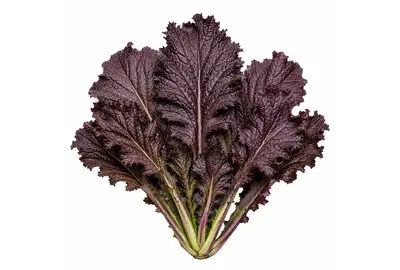
Red Giant
Large, deep red-purple crinkled leaves. Striking in the garden and on the plate. Moderately pungent. Good cut-and-come-again productivity.
Brassica juncea
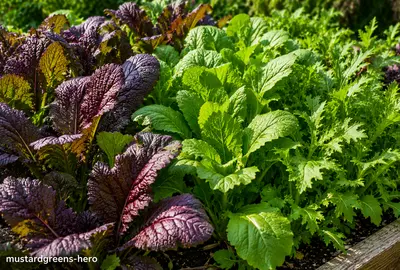
Mustard greens are among the fastest and most rewarding brassica leaves you can grow — and one of the most underused in British kitchen gardens. Fiery, pungent, and complex in flavour, they are indispensable in Asian cooking: stir-fried, pickled, braised, or eaten raw in small quantities in mixed salads. They grow rapidly from seed, tolerate moderate frost, and produce generous harvests from spring through to late autumn with just two sowings a year.
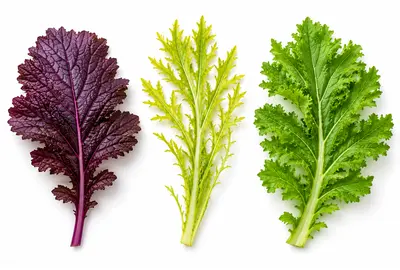
Mustard greens divide into three broad groups: purple/red types with dramatic colour and strong pungency; green cut-and-come-again types with milder flavour ideal for salad mixes; and frilly/decorative types that combine ornamental value with good eating quality. Choose bolt-resistant varieties for spring sowings and cold-hardy types for the August–September sowing. Leaf size at harvest — baby, semi-mature, or full — dramatically affects flavour intensity.
The number of varieties shown for each crop is based on UK consumption data (2025/26) — the more popular the crop, the more variety choices we include.
Bold colour, strong pungency. Excellent for cooking, pickling, and visual impact in salad mixes.
Large, deep red-purple crinkled leaves. Striking in the garden and on the plate. Moderately pungent. Good cut-and-come-again productivity.
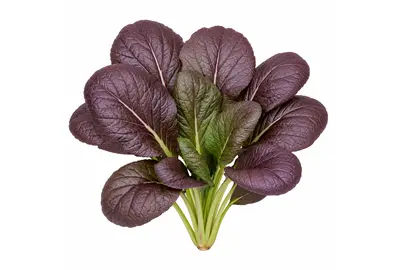
Rounded, purple-tinged leaves with a smooth texture. Bold pungent flavour. Excellent for cooking, pickling, and Korean-style preparations.
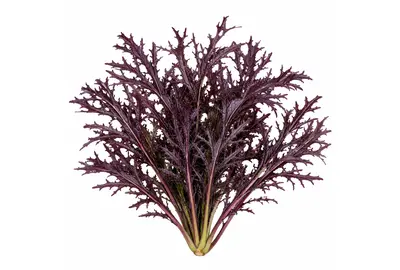
Finely cut, deep red-purple leaves. Very decorative. Medium heat. Excellent in mixed salad bags and as a garnish.
Milder flavour, faster growing, ideal for salad use and cut-and-come-again harvesting.
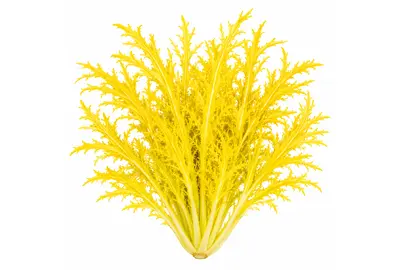
Finely cut, golden-yellow leaves. Milder than most and slightly sweet. Outstanding in oriental salad mixes. Bolt-resistant.
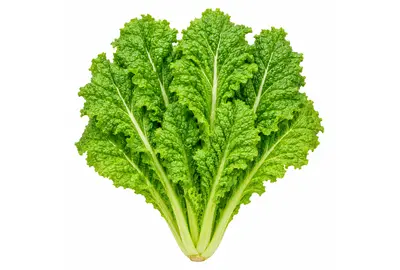
Exceptionally cold-hardy. Serrated, bright green leaves. Mild-medium heat. The best choice for the August–September sowing and overwintering.
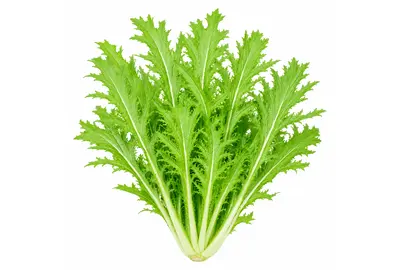
Vigorous, crinkled mid-green leaves with high yields. Popular for stir-fry and braising. Good summer variety with some bolt resistance.
Ornamental as well as edible. Excellent for containers, decorative beds, and mixed salad mixes.
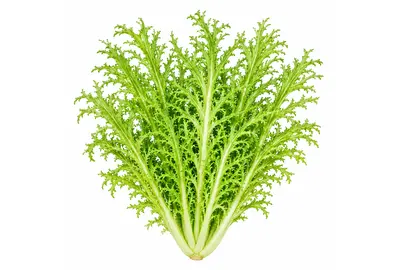
Deeply frilled, lacy leaves. Very ornamental in the garden. Medium heat. Popular in continental mixed salad seed collections.
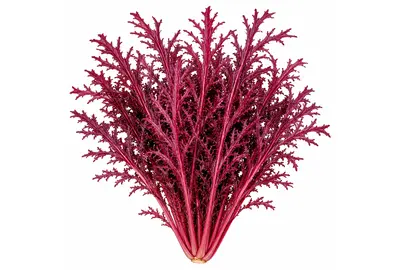
Deeply cut, red-purple frilly leaves. Beautiful and peppery. Excellent mixed with green leaves for visual contrast in salad bags.
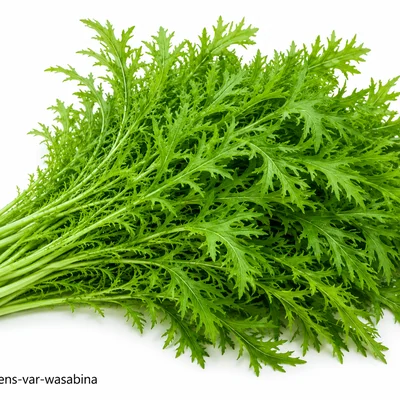
Finely cut, mid-green leaves with a distinctive wasabi-like heat. Unique flavour profile. Popular with chefs and for gourmet salad mixes.
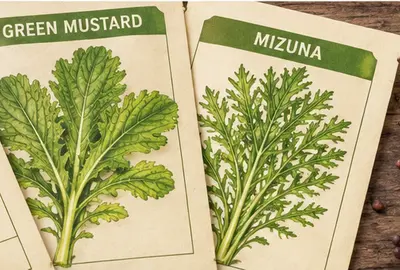
Mustard greens seed is widely available from online seed companies specialising in oriental vegetables. Named varieties like 'Red Giant', 'Green in Snow', and 'Golden Streaks' are readily found. Oriental salad seed mixes often include mustard greens as a component. Seed is inexpensive and packets contain generous quantities.
Widely available from online seed retailers specialising in oriental vegetables
Often include mustard greens as a component — good for sampling multiple types
Several specialist retailers online for authentic variety selection
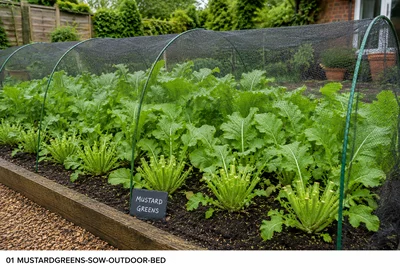
Main production method. Direct sown in prepared beds under insect mesh. Most productive and simplest approach.
Outdoor Bed — regional timing: Sow direct March–May and August–September
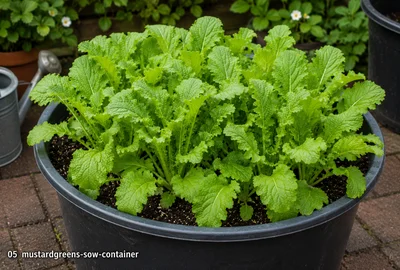
Excellent in large containers and raised beds. Good drainage, easier to net against pests, and convenient for kitchen use.
Containers & Raised Beds — regional timing: Sow March–May and August–September; pot on as needed
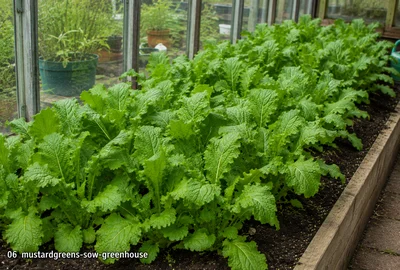
Extends the season significantly at both ends. Particularly valuable for winter production of the hardiest varieties.
Greenhouse / Polytunnel — regional timing: Autumn sowing September–October for winter harvest; February–March for earliest spring crop
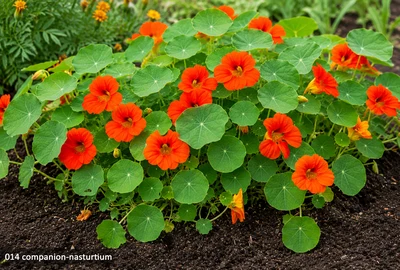
Trap crop — aphids are drawn to nasturtiums instead of mustard greens. Plant at the bed perimeter.
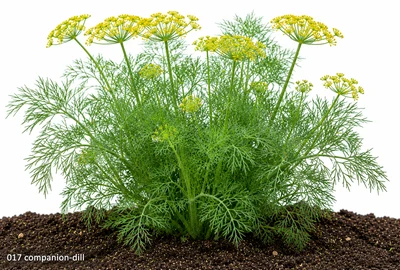
Attracts beneficial insects including hoverflies and parasitic wasps that predate cabbage white caterpillars.
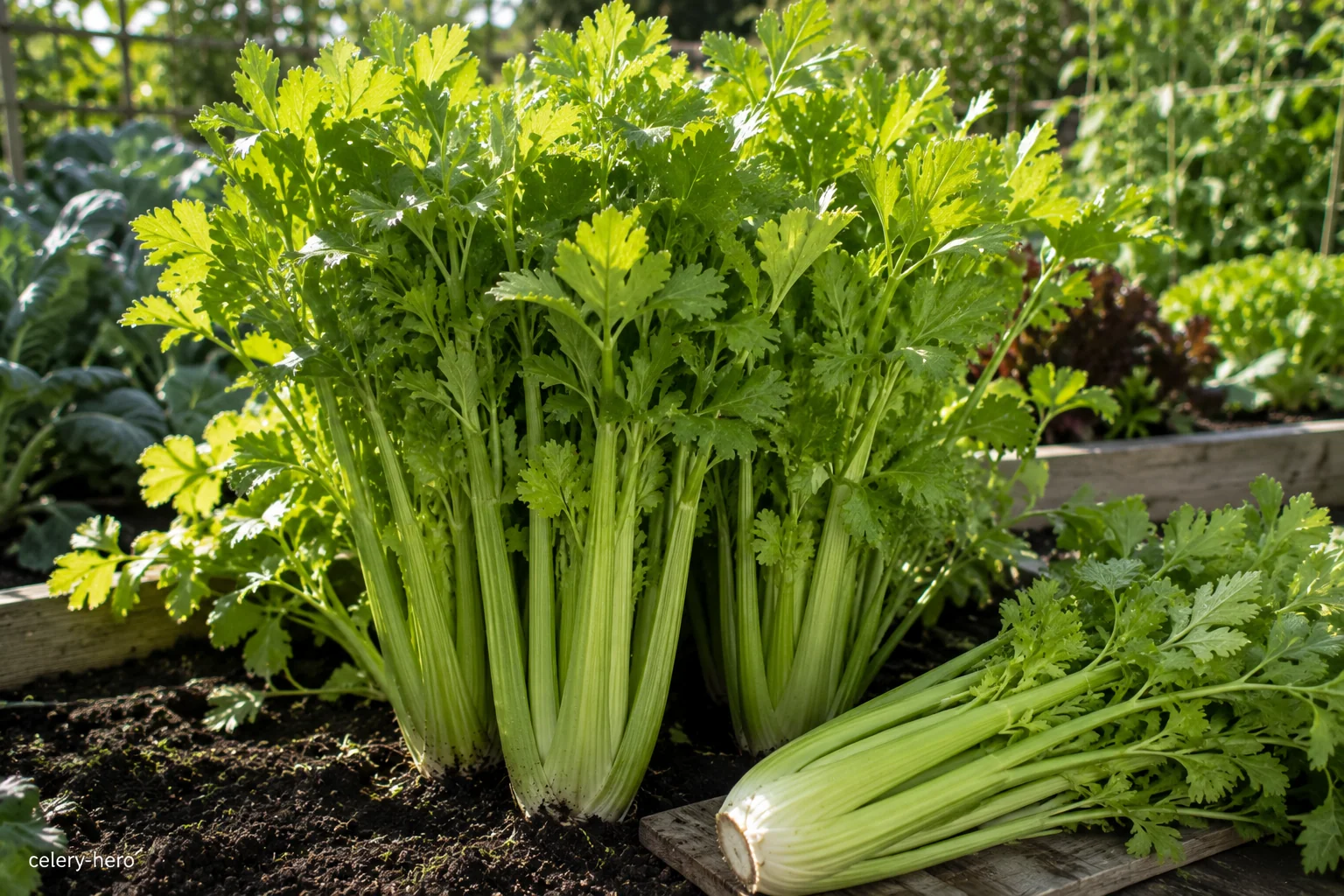
Strong celery scent deters cabbage white butterfly. Good intercropping companion between mustard rows.
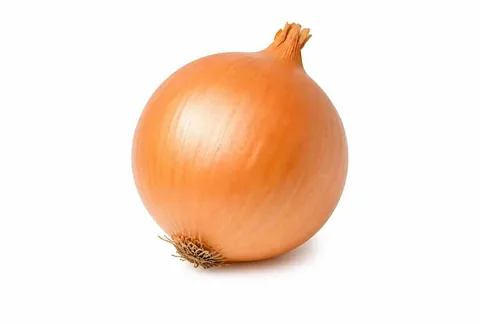
Strong allium scent confuses and deters brassica pests including cabbage white and root fly.
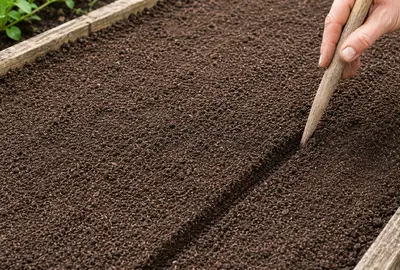
Rake to a fine tilth. Incorporate a balanced general fertiliser if the soil is poor. Mustard greens are not demanding but a fertile soil produces larger, more flavourful leaves.
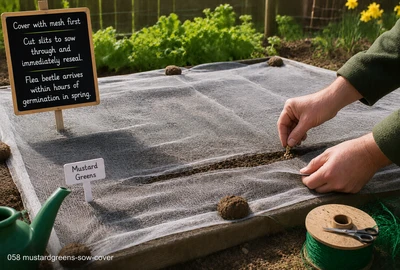
Lay insect-proof mesh or fine net over the bed before sowing, securing edges firmly. Cut slits to sow through and immediately reseal. Flea beetle arrives within hours of germination in spring.
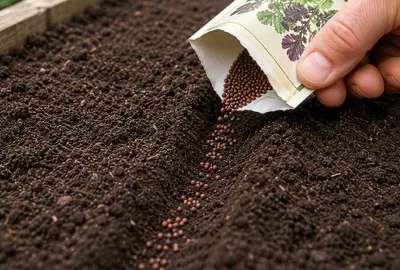
Draw a shallow drill 1cm deep. Sow seeds thinly 2–3cm apart. Do not sow densely — the temptation is always to oversow brassica seeds. Cover and firm gently.
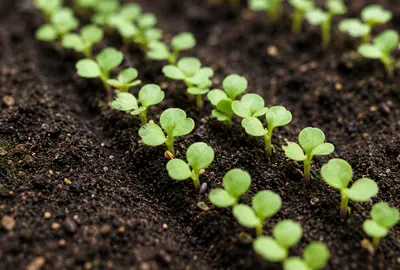
Germination is rapid at 10–20°C — you’ll see seedlings within a week. Keep the bed moist during germination. Do not remove the mesh.
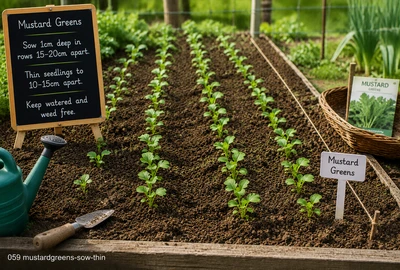
For cut-and-come-again baby leaves: thin to 10cm. For full-sized plants for cooking: thin to 25–30cm. Use thinnings as microgreens.
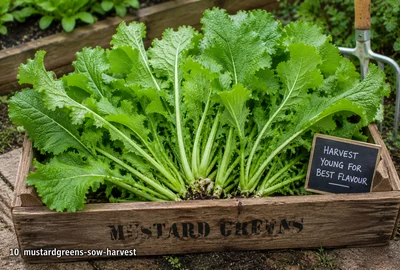
Baby leaves are ready in 3–4 weeks. Full leaves at 5–7 weeks. For cut-and-come-again: cut to 5cm above the ground; for full leaves: harvest outer leaves working inward.
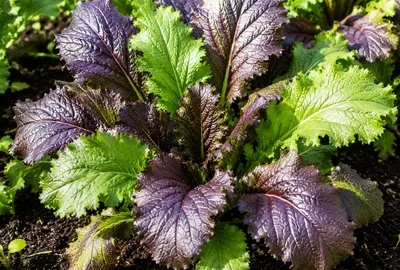
Full-sized plants develop substantial crowns. In cool conditions they can produce for 2–3 months before bolting. Monitor for signs of flowering and harvest frequency increases as days lengthen.
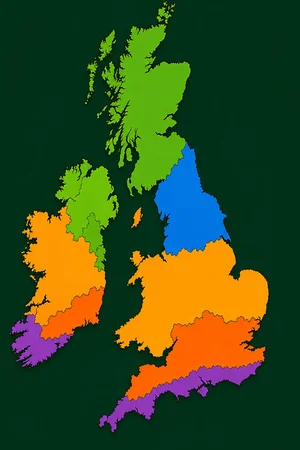
| Region | Sow / plant | Harvest | Notes |
|---|---|---|---|
| Scotland & Far North | Apr–May | May–Aug | Sow under cover March; direct April–May. Short spring window before summer heat triggers bolting. Harvest June–August. · Apr–May |
| Northern England | Mar–May | Apr–Aug | Sow under cover February–March; direct March–May. Harvest May–August. Bolt pressure increases from June. · Mar–May |
| Midlands & Wales | Mar–May | Apr–Aug | Sow direct from March. Reliable spring harvest April–July. Bolt risk increases in July — summer gap before August sowing. · Mar–May |
| Ireland & Isle of Man | Mar–May | Apr–Aug | Sow March–May direct. Good spring performance. August sowing especially productive in mild Irish climate. · Mar–May |
| South & SE England | Mar–May | Mar–Aug | Earliest sowing February under cover; March direct. Bolt risk from June. Summer gap. Autumn sowing August–September. · Mar–May |
| South Coast & SW | Feb–May | Mar–Aug | February under cover for very early crop. Spring harvest March–June. Autumn sowing very productive in mild autumn conditions. · Mar–May |
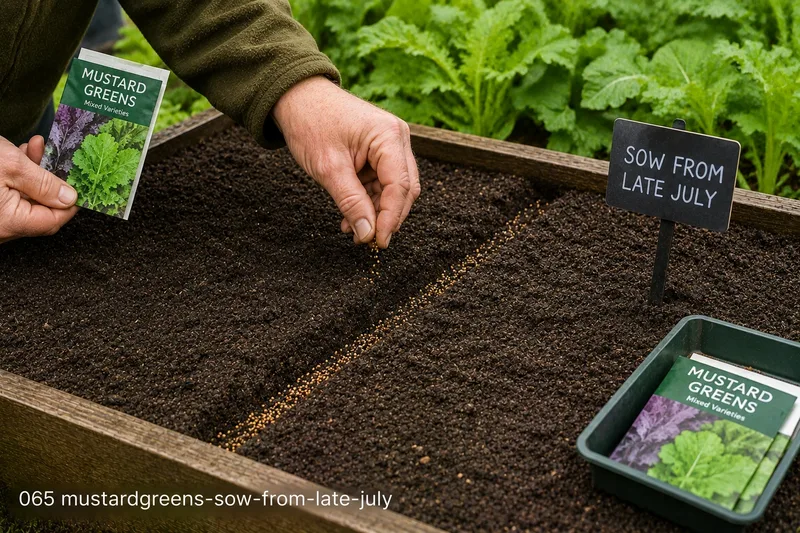
The August sowing is often more productive than the spring sowing. Shorter days reduce bolt pressure and cooler temperatures improve flavour. Sow from late July in the north; August–September further south.
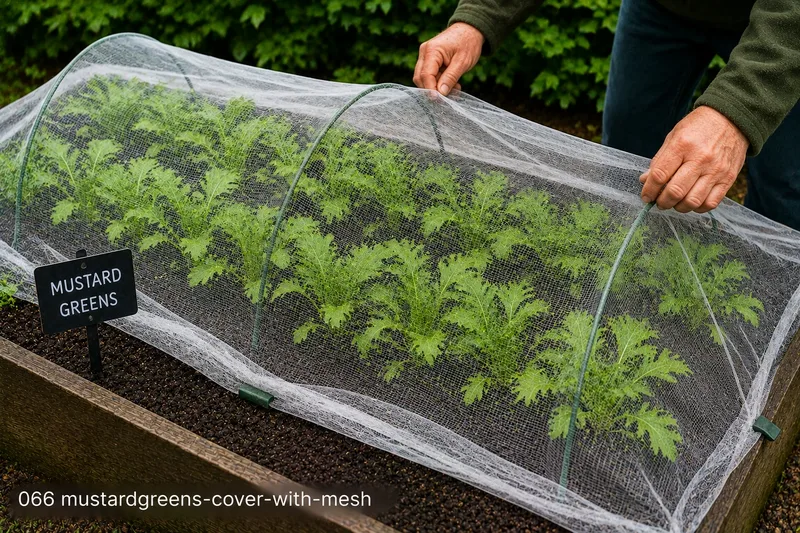
Late summer still brings cabbage white butterfly. Apply insect mesh immediately. Also protects against early flea beetle activity which continues into September.
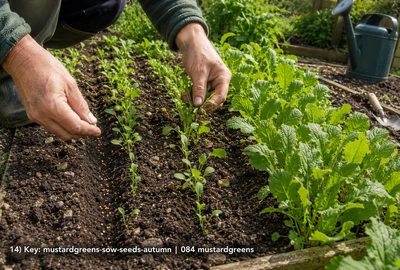
Sow 1cm deep, thin to 10–30cm depending on use. The autumn sowing can be grown slightly more densely as bolt pressure is lower.
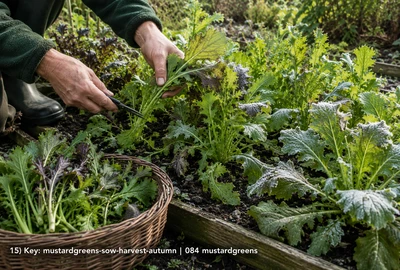
First cut-and-come-again harvest from September. Full leaves from October. Plants withstand moderate frost and continue producing until hard frosts (−5°C).
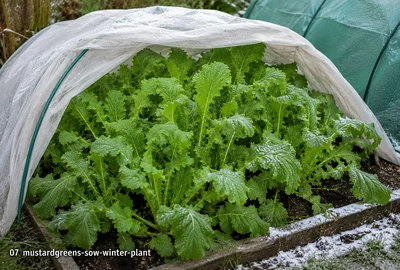
Cover with fleece or a polytunnel in October–November to extend harvest into December. "Green in Snow" will survive under fleece through most UK winters and produce fresh leaves in mild spells.
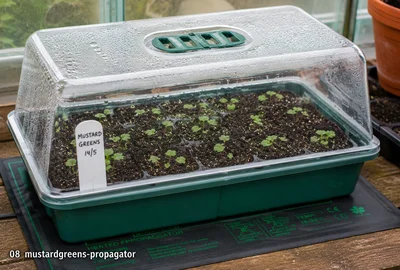
Early spring sowings (February–March) benefit from propagator warmth. A heated propagator at 15–18°C produces seedlings in 4–5 days. Remove as soon as seedlings emerge and move immediately to bright light — mustard greens etiolate quickly in warm low-light conditions.
An unheated propagator offers limited benefit for mustard greens — they germinate readily at 10°C+ without heat. From March onwards, sow directly into modules on a bright windowsill or outdoors under fleece. Harden off thoroughly before planting out.
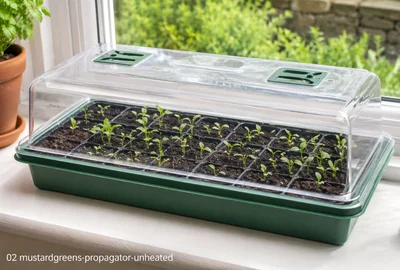
Standard unheated propagator — A lidded seed tray traps warmth and humidity around germinating seeds without electricity. Performance depends entirely on room temperature — best placed on a warm windowsill and used from March onwards. Replace the lid promptly after watering. Remove it completely the moment seedlings emerge to prevent damping off.
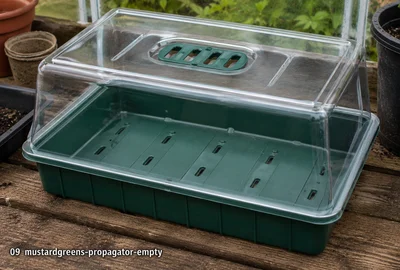

Flea beetle is the single biggest pest of mustard greens and all brassica-family crops. Tiny black beetles create characteristic small round holes in leaves, can devastate seedlings within 48 hours of germination, and are worst in warm, dry conditions. The only reliable control is fine insect-proof mesh (not netting — the holes must be small enough to exclude beetles) applied before sowing and kept in place through the entire spring period. Biological controls, companion planting, and yellow sticky traps are all secondary measures. Get the mesh on before the seeds go in.
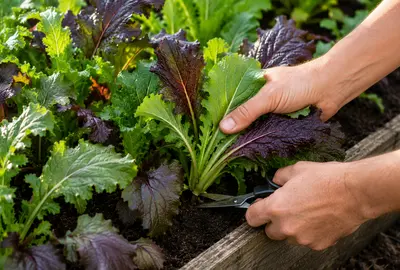
Mustard greens bolt (run to seed) readily when days are long and temperatures are high — primarily June and July. Once bolting begins, leaf production slows dramatically and flavour becomes aggressively bitter. Delay bolting with three strategies: choose bolt-resistant varieties for spring sowings; harvest frequently — cutting the plant regularly slows the bolting trigger; keep plants well-watered since drought stress accelerates bolting. When plants do bolt, remove them promptly. The August sowing almost never bolts and consistently outperforms spring sowings for total yield.
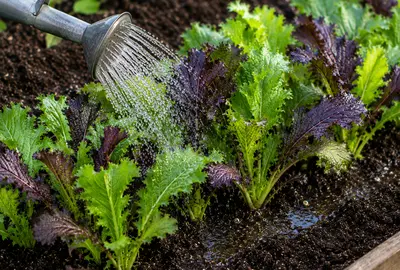
Mustard greens are not heavy feeders but they do need consistent moisture for the largest, most flavourful leaves. Drought stress causes leaves to become small, tough, and excessively bitter. Water regularly in dry spells — once or twice a week deeply is better than daily light watering. If leaves are pale yellow-green rather than deep green, apply a balanced liquid feed or a top-dressing of blood, fish and bone. The autumn sowing generally requires less feeding as soils are still warm and nutrient-rich after the growing season.
Mustard greens are a brassica (Brassica juncea) and must be rotated on a 4-year cycle to prevent clubroot buildup in the soil. Clubroot is a devastating soil-borne disease with no cure — affected soil cannot grow brassicas for years. Always cover with fine insect-proof mesh against flea beetle. Do not eat large quantities of raw mature mustard greens in one sitting — they contain glucosinolates which in very large quantities can interfere with thyroid function (cooking deactivates these).
Full identification and treatment advice is in the Pests and Diseases sections.
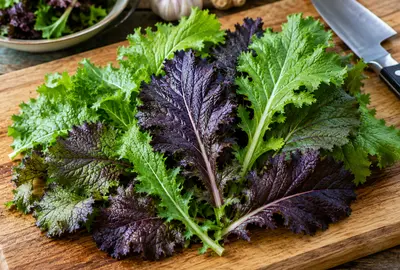
Freshly harvested mustard greens keep well in the refrigerator for 3–5 days. Store unwashed in a loose bag or wrapped in a slightly damp paper towel in the crisper drawer. Wash immediately before use. Young baby leaves are more delicate and last 2–3 days; full mature leaves last up to 5 days. Mustard greens wilt faster than lettuce but significantly slower than watercress. The flavour actually mellows slightly after a day or two in the fridge, which can be an advantage for raw eating.

Large, mature mustard green leaves are best cooked rather than eaten raw — the heat mellows the fierce pungency to a complex, slightly bitter flavour. Stir-fry with garlic, ginger, and a splash of soy sauce for 2–3 minutes for the classic Chinese preparation (chao jie lan). Also excellent braised in stock, added to soups and ramen, or wilted into curries. Cooked mustard greens can be frozen for up to 2 months — blanch for 1 minute, cool, squeeze out moisture, and freeze in portions.
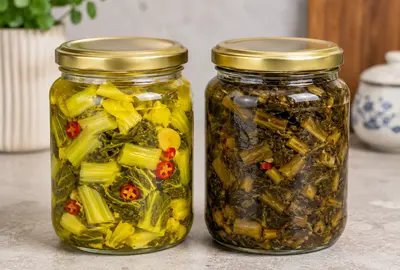
Pickled mustard greens, quick-pickled or fermented, are used across East and Southeast Asian cuisines and are one of the most useful ways to deal with a large mustard greens harvest. Follow a tested recipe.
Many growers focus on the spring sowing and find results disappointing — bolt pressure, flea beetle, and summer heat all work against mustard greens in April–June. The late July to August sowing is almost always more productive: shorter days eliminate bolt pressure, cooler temperatures improve flavour dramatically, flea beetle pressure drops, and plants grow through to November. If you only do one sowing, make it August.
Mustard greens have three distinct harvest stages with very different flavour profiles. Baby leaves (5–10cm): mild, peppery, excellent raw in salads — best harvested 3–4 weeks after sowing. Semi-mature leaves (15–20cm): medium-hot, good for wilting, stir-frying, or eating raw in small quantities. Full mature leaves (30cm+): very pungent, best for cooking, braising, pickling. The same variety tastes completely different at different sizes. Match the harvest stage to the intended use.
Rather than growing individual plants to full size, sow mustard greens densely (seeds 2–3cm apart) and harvest the entire bed at 8–10cm height with scissors — essentially like growing as a microgreen but at a larger scale. The bed regrows 2–3 times. This approach gives you far more harvestable leaf from a given area, reduces the impact of flea beetle (the harvest cycle is shorter), and avoids the bolting problem entirely. Particularly effective for the spring sowing.